
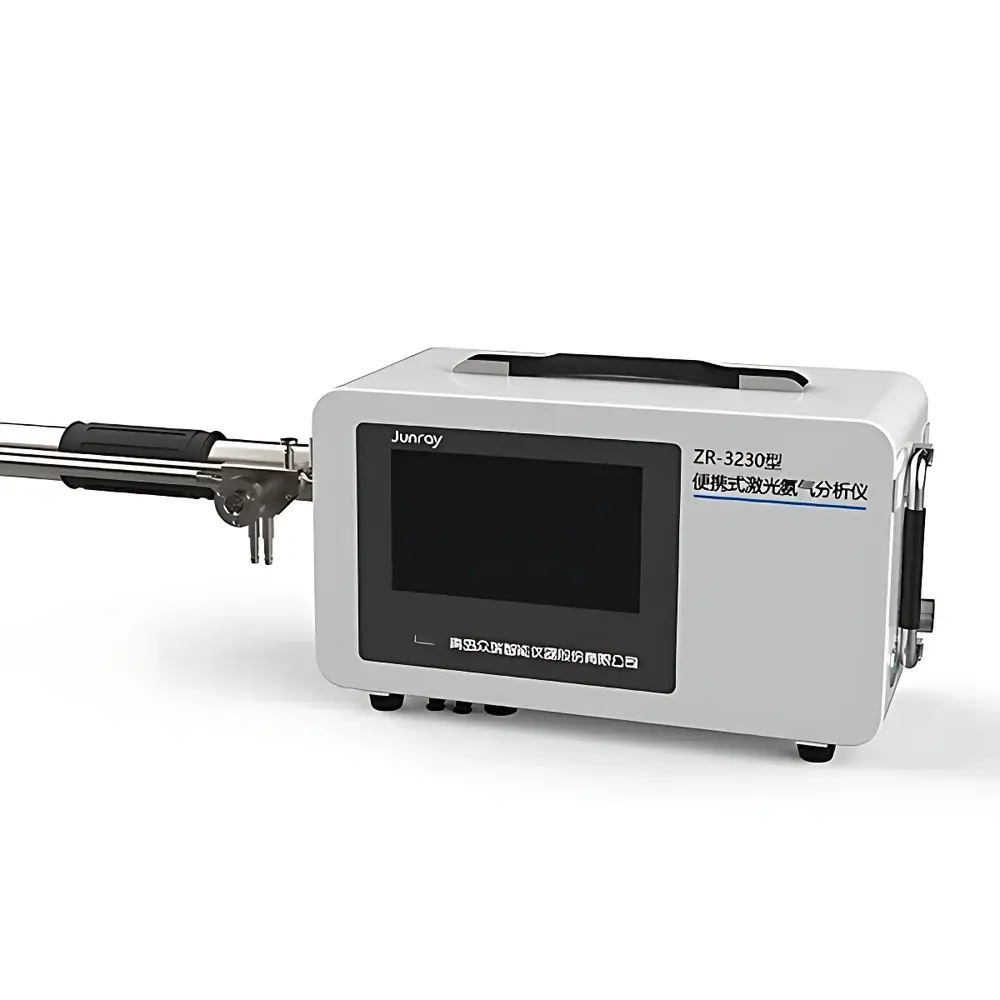
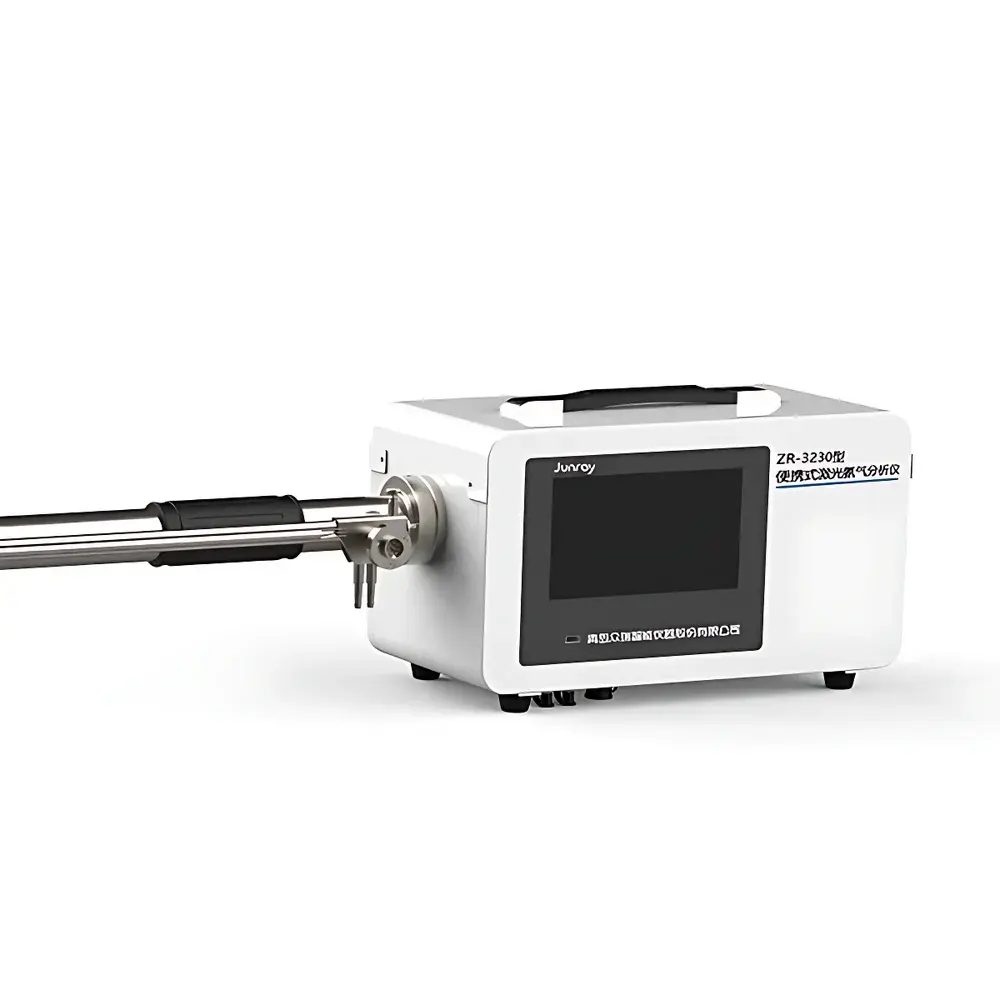
Junray ZR-3230 Portable Ammonia Analyzer with TDLAS Technology
| Brand | Junray |
|---|---|
| Model | ZR-3230 (TDLAS) |
| Type | Portable |
| Origin | Shandong, China |
| Manufacturer | Junray Instruments Co., Ltd. |
| Compliance | GB/T 16157–1996, JJG 1105–2015, T/SSESB 10–2024, JJG 518–2023, JJG 968–2002 |
| Measurement Principle | Tunable Diode Laser Absorption Spectroscopy (TDLAS) |
| Sampling Method | Heated Hot-Wet Extraction (up to 180 °C) |
| Gas Interference Rejection | Single-line absorption at NH₃-specific near-infrared wavelength (~1512 nm) |
| Output Interfaces | Wi-Fi + Bluetooth v5.0 |
| Display | 7-inch capacitive color touchscreen (1024 × 600) |
| Data Handling | Onboard storage (≥32 GB), real-time dry/wet basis conversion, auto-purge on power-off |
| Probe Design | Removable S-type Pitot tube (JJG 518–2023 compliant) |
| Integrated Parameters | NH₃, O₂, flue gas temperature, velocity, static/dynamic pressure, moisture content |
Overview
The Junray ZR-3230 Portable Ammonia Analyzer is an engineered solution for regulatory-grade measurement of ammonia (NH₃) in hot, humid, and particulate-laden exhaust streams from stationary emission sources. It employs Tunable Diode Laser Absorption Spectroscopy (TDLAS), a physics-based optical technique that quantifies NH₃ concentration by measuring attenuation of a narrow-linewidth laser beam tuned precisely to a rovibrational absorption line near 1512 nm. Unlike broad-band NDIR or electrochemical sensors, TDLAS offers inherent selectivity—eliminating cross-sensitivity to H₂O, CO₂, NOₓ, SO₂, and hydrocarbons—while maintaining high signal-to-noise ratio under field conditions. The analyzer implements heated hot-wet sampling: the entire sample path—including probe, heated line, and optical cell—is maintained at ≥180 °C to prevent NH₃ adsorption on surfaces and condensation-induced loss. This architecture ensures trace-level accuracy (detection limit <0.5 ppm) and long-term stability without catalytic scrubbers or chemical conditioning.
Key Features
- Integrated hot-wet sampling system with full-path heating (180 °C) and TDLAS optical cavity—designed to meet T/SSESB 10–2024 requirements for portable NH₃ measurement in flue gas.
- Single-gas optical detection: laser wavelength locked to isolated NH₃ absorption line; no spectral overlap with common interferents ensures compliance with JJG 1105–2015 verification protocols.
- Onboard multi-parameter acquisition: simultaneous measurement of NH₃, O₂ (zirconia sensor), flue gas temperature (K-type thermocouple), velocity (S-type Pitot tube per JJG 518–2023), static/dynamic pressure, and real-time moisture content.
- Dual-mode operation: automatic timed sampling (configurable interval and cycle count) for audit-ready comparison against CEMS; manual mode for spot checks and troubleshooting.
- Embedded data management: 32 GB internal flash memory, timestamped CSV export, dry/wet basis concentration conversion using measured humidity—aligned with GB/T 16157–1996 reporting conventions.
- Robust human-machine interface: 7-inch industrial-grade capacitive touchscreen with intuitive icon-driven navigation, real-time status dashboard, and multilingual firmware support (English/Chinese).
- Intelligent maintenance architecture: automatic line purge upon shutdown, RFID-enabled instrument lifecycle tracking via Junray AssetLink™ platform, and modular probe design enabling field replacement of Pitot tube without calibration loss.
Sample Compatibility & Compliance
The ZR-3230 is validated for use across heterogeneous emission matrices encountered in thermal power plants, iron & steel mills, cement kilns, municipal waste incinerators, chemical synthesis units, fertilizer production facilities, and biomass combustion systems. Its heated sampling train tolerates dust loading up to 10 g/m³ and dew points up to 120 °C without filter clogging or optical window fouling. All measurement algorithms and uncertainty budgets adhere to ISO/IEC 17025–2017 principles for testing laboratories. The device satisfies metrological traceability requirements under JJG 968–2002 (flue gas analyzers) and JJG 1105–2015 (NH₃ detectors), with factory calibration verified against NIST-traceable NH₃ permeation tubes. Optional GLP-compliant audit trail logging (user actions, calibration events, fault logs) supports regulatory submissions under China’s MEP Order No. 39 and EU IED Annex IV monitoring obligations.
Software & Data Management
Junray’s proprietary AnalyzePro™ firmware provides embedded control logic, real-time spectral fitting (least-squares deconvolution of Beer–Lambert absorbance), and automated baseline correction. Data output conforms to EPA Method 320 and ISO 14956–2002 formatting standards. Wireless connectivity enables secure remote configuration via Android/iOS mobile app (Bluetooth 5.0) or enterprise network integration (Wi-Fi 802.11n). Exported datasets include raw spectra, fitted absorbance, environmental compensation factors, and uncertainty estimates per GUM (JCGM 100:2008). For laboratory QA/QC workflows, the unit supports direct pairing with Junray’s TraceCal™ desktop software for calibration curve generation, drift correction, and report generation compliant with CNAS-CL01:2018 documentation requirements.
Applications
The ZR-3230 serves as a reference-grade verification tool for continuous emission monitoring systems (CEMS) in compliance with China’s “Technical Specifications for Continuous Monitoring of Flue Gas Emissions” (HJ 75–2017). It is routinely deployed for stack testing during environmental impact assessments (EIAs), permit renewal audits, fugitive emission surveys in urea granulation zones, DeNOₓ catalyst efficiency evaluation in SCR systems, and process optimization in caprolactam and adipic acid manufacturing. Field engineers use its portability and rapid response (<15 s T₉₀) for leak detection in NH₃ storage and transfer infrastructure, while research institutions apply it in atmospheric chemistry studies involving agricultural NH₃ volatilization and urban airshed modeling. Its dual-basis concentration output supports both mass emission rate calculations (kg/h) and volumetric concentration reporting (ppmvd) required by national and provincial environmental authorities.
FAQ
What regulatory standards does the ZR-3230 comply with for field deployment?
It meets GB/T 16157–1996, JJG 1105–2015, T/SSESB 10–2024, and JJG 968–2002—covering sampling methodology, instrument verification, and performance criteria for portable NH₃ analyzers in fixed source monitoring.
How does the heated hot-wet design improve measurement accuracy compared to dilution or cold-dry methods?
By maintaining the entire sample path above the dew point and NH₃ adsorption threshold, it prevents analyte loss on tubing walls and eliminates errors from condensate-phase partitioning—critical for achieving sub-ppm precision in high-moisture flue gases.
Can the ZR-3230 be used for ambient air monitoring?
No—it is optimized for hot, humid, high-particulate exhaust streams (100–300 °C, >5% H₂O); ambient applications require lower-range, diffusion-based sensors with different optical path design.
Is the Pitot tube calibration traceable to national standards?
Yes—the removable S-type Pitot tube is supplied with individual calibration certificate traceable to China National Institute of Metrology (CNIM) and complies with JJG 518–2023 dimensional and dynamic pressure accuracy requirements.
Does the device support 21 CFR Part 11-compliant electronic records?
While not FDA-certified, its optional audit trail module logs all user interactions, calibration events, and measurement metadata with tamper-evident timestamps—enabling internal validation for GLP/GMP-aligned quality systems.







