
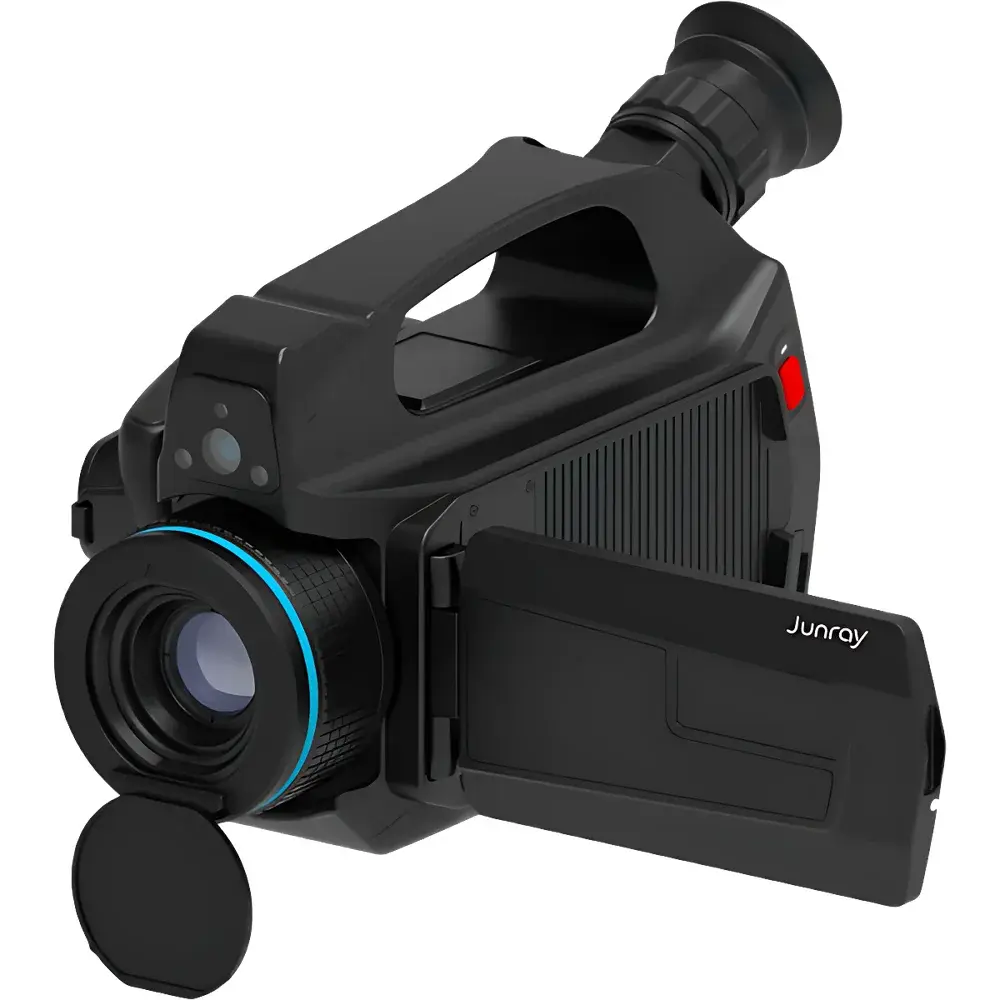


Junray ZR-3140 Portable Optical Gas Imaging (OGI) Camera for VOC Leak Detection
| Brand | Junray |
|---|---|
| Origin | Shandong, China |
| Manufacturer Type | OEM/ODM Manufacturer |
| Country of Origin | China |
| Model | ZR-3140 |
| Pricing | Available Upon Request |
Overview
The Junray ZR-3140 is a portable optical gas imaging (OGI) camera engineered for real-time, non-contact detection of volatile organic compound (VOC) emissions—including hydrocarbons such as methane, propane, butane, benzene, toluene, and other C1–C6 aliphatic and aromatic species. It operates on the principle of infrared absorption spectroscopy in the mid-wave infrared (MWIR) spectral band (typically 3.2–3.4 µm), where many VOCs exhibit strong, characteristic absorption features. Unlike cooled quantum well infrared photodetector (QWIP) or mercury cadmium telluride (MCT) systems, the ZR-3140 utilizes an uncooled microbolometer focal plane array optimized with a narrowband spectral filter to enhance contrast between background thermal radiation and gas plume absorption. This enables visualization of gaseous leaks as dynamic “smoke-like” silhouettes against ambient thermal scenes—even at sub-ppm·m column densities—without requiring tracer gases, pressurization, or physical sampling. Designed for field deployment in hazardous and hard-to-access locations, it supports rapid walkdown surveys, regulatory compliance monitoring, and LDAR (Leak Detection and Repair) program execution across upstream, midstream, and downstream oil & gas infrastructure.
Key Features
- Optimized MWIR spectral response (3.2–3.4 µm) targeting fundamental C–H stretch absorption bands of common VOCs
- Uncooled microbolometer detector (640 × 480 resolution) with real-time video output and adjustable gain/contrast
- Integrated visible-light camera for simultaneous dual-spectrum imaging and precise leak localization
- Portable ergonomic design with integrated battery (≥3.5 h continuous operation), IP54-rated enclosure, and ruggedized housing
- Onboard GPS geotagging and timestamping compliant with EPA OOOOa and EU IED reporting requirements
- Real-time leak quantification estimation (qualitative to semi-quantitative mode) via plume size, drift velocity, and background ΔT modeling
- Support for post-processing analysis using proprietary software with frame-by-frame annotation, report generation, and CSV export
Sample Compatibility & Compliance
The ZR-3140 is validated for detection of saturated and unsaturated aliphatic hydrocarbons (e.g., CH₄, C₂H₆, C₃H₈), chlorinated solvents (e.g., CH₂Cl₂, CHCl₃), oxygenates (e.g., ethanol, acetone), and aromatic compounds (e.g., benzene, xylene). It meets functional performance criteria aligned with ASTM D7986–21 (Standard Practice for Optical Gas Imaging of Volatile Organic Compounds) and supports implementation of China’s national emission standards: GB 20950–2020 (Emission Standards for Atmospheric Pollutants from Oil Storage Depots), GB 20951–2020 (Emission Standards for Atmospheric Pollutants from Oil Transportation), GB 20952–2020 (Emission Standards for Atmospheric Pollutants from Gas Stations), and technical guidance documents HJ 733–2014 and HJ 1230–2021. While not certified to ATEX or IECEx for Zone 1 use, it is rated for safe operation in Class I, Division 2 environments when used per manufacturer instructions.
Software & Data Management
The ZR-3140 interfaces with Junray’s OGI Analysis Suite v2.1—a Windows-based desktop application supporting raw thermal video import (.seq/.avi), multi-frame plume tracking, annotated image export (PNG/JPEG), and automated PDF report generation including site ID, inspection date, GPS coordinates, operator ID, and observed leak location. All metadata—including camera settings, environmental conditions (ambient T, RH, wind speed input), and annotation timestamps—are embedded in EXIF-compatible headers. Audit trails comply with GLP-aligned data integrity principles; software logs user login sessions, file modifications, and export actions. Raw data files are stored in vendor-neutral formats to ensure long-term archival compatibility and third-party interoperability.
Applications
- Routine LDAR inspections across flanges, valves, pumps, compressors, pressure relief devices, and open-ended lines
- Pre-commissioning and turnaround leak screening in refineries, petrochemical plants, and LNG terminals
- Environmental compliance verification for VOC emissions reporting under local ecological bureaus and MEE mandates
- Emergency response assessment during pipeline ruptures, tank overfills, or storage facility incidents
- Training and demonstration of invisible gas dispersion behavior for HSE personnel and regulatory auditors
- Baseline surveys and fugitive emission inventory development per ISO 50001 and GHG Protocol Scope 1 guidance
FAQ
Does the ZR-3140 require calibration gas or daily zeroing?
No—optical gas imaging relies on differential absorption contrast rather than quantitative concentration calibration. However, annual factory recalibration of spectral filter alignment and detector response uniformity is recommended.
Can it detect methane specifically, or only generic hydrocarbons?
It visualizes methane effectively due to its strong 3.3 µm C–H absorption, but cannot spectrally distinguish methane from other C–H-rich VOCs without additional spectral filtering or orthogonal confirmation (e.g., PID or FTIR).
Is the device suitable for indoor use in confined spaces?
Yes—its passive, non-intrusive detection method eliminates ignition risk. However, adequate thermal contrast (>2°C) between plume and background is required; HVAC-induced air currents may affect plume visibility.
What training is required to operate the ZR-3140 in compliance with Chinese LDAR regulations?
Operators must complete Junray-certified OGI fundamentals training (8 hours) covering instrument physics, regulatory context (HJ 1230–2021), inspection protocols, documentation standards, and false-positive mitigation—aligned with MEE-recommended competency frameworks.



