
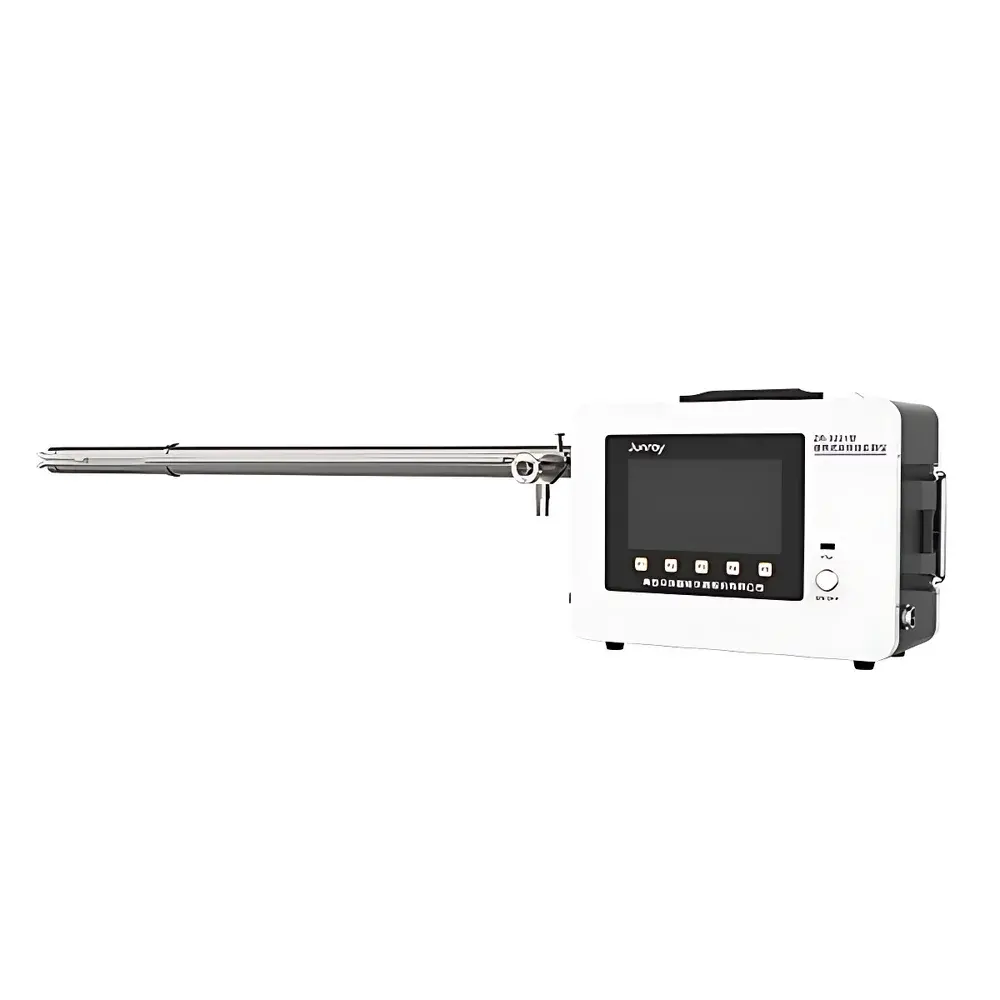
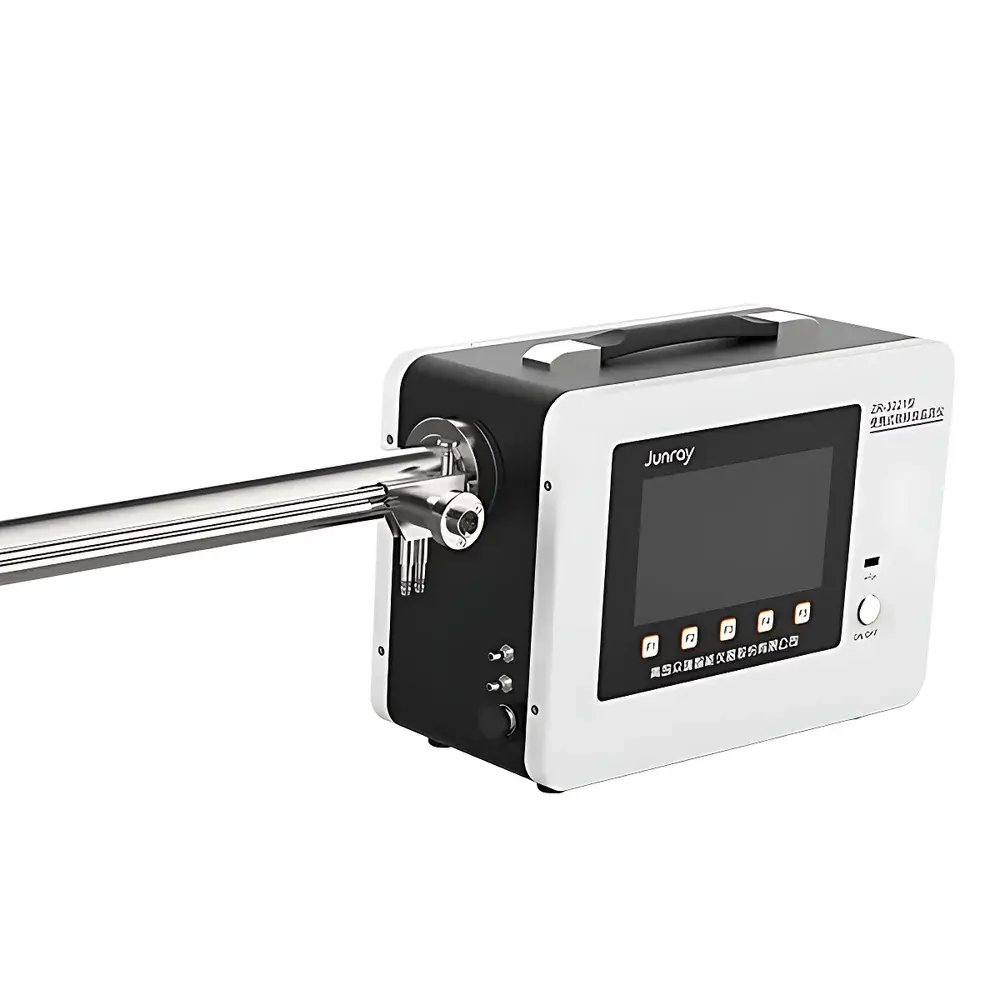
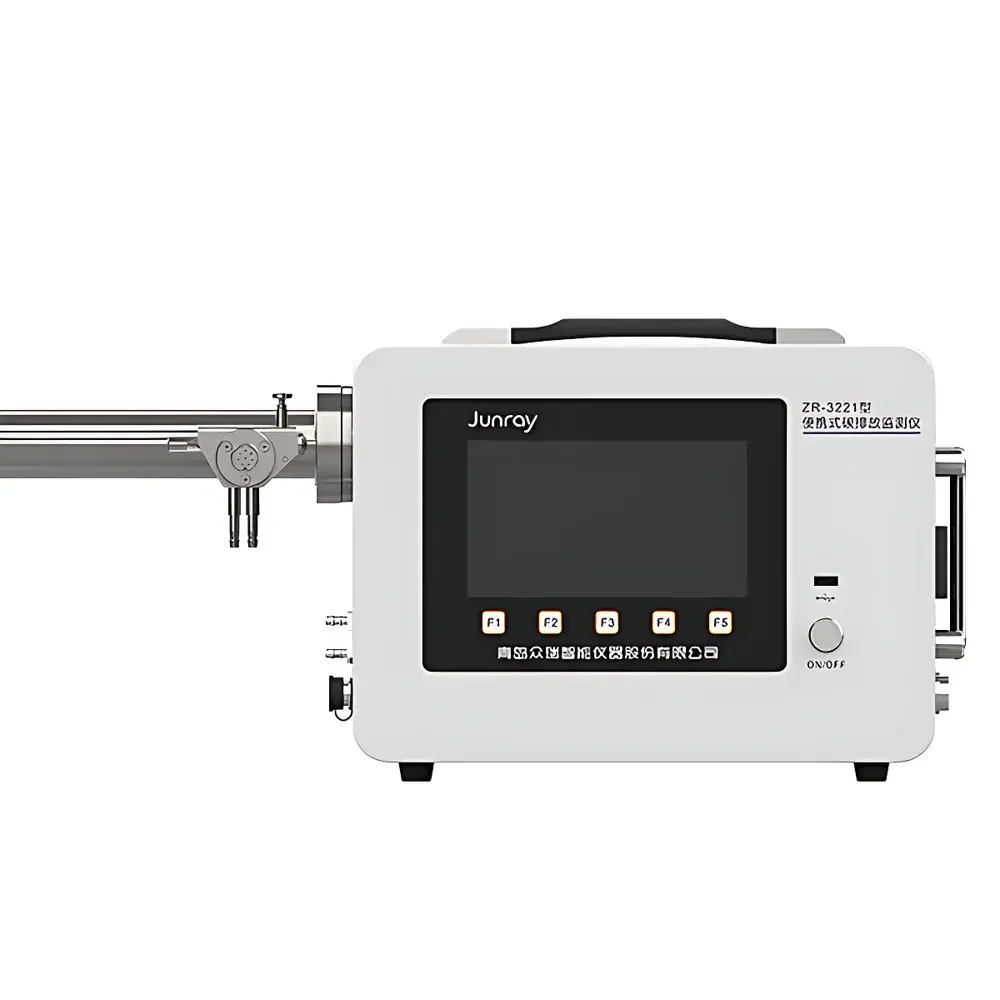
Junray ZR-3221 Portable Carbon Emission Monitor with NDIR Multi-Gas Detection
| Brand | Junray |
|---|---|
| Model | ZR-3221 |
| Origin | Shandong, China |
| Manufacturer Type | Direct Manufacturer |
| Technology Principle | Non-Dispersive Infrared (NDIR) Absorption |
| Measured Gases & Ranges | CO, CO₂, CH₄, N₂O, O₂ |
| Resolution | 0.01 |
| Calibration Modes | Ambient Air Mode & Zero Gas Mode |
| Compliance Standards | HJ 870–2017, HJ/T 44–1999, HJ/T 397–2007, JJG 635–2011, JJG 968–2002, JJG 693–2011 |
| Connectivity | Integrated Bluetooth & Wi-Fi |
| Operating Modes | Manual & Programmable Automatic (configurable measurement duration & cycle count) |
| Additional Parameters | Flue Gas Temperature, Stack Velocity, Oxygen Content, Moisture Content, Real-Time CO₂-eq Emission Calculation (with built-in GWP factors) |
Overview
The Junray ZR-3221 Portable Carbon Emission Monitor is an integrated field-deployable instrument engineered for regulatory-grade quantification of key anthropogenic greenhouse gases (GHGs) in flue gas streams from stationary combustion sources. It operates on the physical principle of non-dispersive infrared (NDIR) absorption spectroscopy—where target gases (CO₂, CO, CH₄, and N₂O) exhibit characteristic vibrational absorption bands in the mid-infrared region (typically 2–14 µm). Each gas is measured via dedicated optical channels equipped with narrowband interference filters and thermopile detectors, ensuring spectral selectivity and minimizing cross-sensitivity. O₂ is simultaneously determined using a galvanic electrochemical sensor, while auxiliary parameters—including flue gas temperature, stack velocity (via modular Pitot tube), and moisture content—are acquired to support stoichiometric and dilution-corrected emission calculations. The device implements real-time conversion of mass concentrations into CO₂-equivalent emissions using IPCC-referenced Global Warming Potential (GWP) coefficients (AR5 values), aligned with reporting requirements under China’s national carbon monitoring framework and international GHG inventory protocols.
Key Features
- Multi-gas NDIR detection core calibrated per HJ 870–2017 (CO₂), HJ/T 44–1999 (CO), and supporting metrological standards (JJG 635–2011, JJG 968–2002)
- Modular, detachable Pitot tube assembly enabling flexible deployment across ducts of varying diameter and flow profile
- Dual operational modes: manual point sampling and programmable automatic mode with user-defined measurement interval and repetition count—facilitating method-compliant comparison against CEMS
- Integrated environmental parameter acquisition: O₂ (electrochemical), flue gas temperature (K-type thermocouple), velocity (differential pressure), and moisture content (capacitive sensor)
- Onboard emission calculation engine compliant with GB/T 32150–2015 and technical guidance from MEP’s Carbon Monitoring Assessment Pilot Program (2021)
- Embedded wireless connectivity: Bluetooth 5.0 for remote control via handheld operator interface and Wi-Fi for secure data upload to centralized platforms
- Calibration flexibility: supports both ambient air zeroing and certified zero gas calibration, traceable to national primary standards
Sample Compatibility & Compliance
The ZR-3221 is validated for use with hot, humid, and particulate-laden flue gases typical of coal-fired boilers, cement kilns, waste incinerators, and industrial furnaces. Its heated sampling probe (up to 180 °C) and condensate trap prevent water condensation and acid dew point corrosion. All gas measurement modules meet the accuracy and repeatability criteria defined in HJ/T 397–2007 for field-based emission testing. The instrument conforms to GLP-aligned data integrity practices: all calibrations, measurements, and configuration changes are time-stamped and logged with operator ID. Audit trails comply with principles referenced in ISO/IEC 17025:2017 Clause 7.7 (result reporting) and support verification during provincial ecological environment bureau inspections or third-party verification audits under China’s National Carbon Market (NCM) framework.
Software & Data Management
Data acquisition and visualization are managed through a dual-interface architecture: a 7-inch capacitive touchscreen on the main unit and a companion Android/iOS hand-held controller. Raw sensor outputs, calculated emissions (kg/h CO₂-eq), and metadata (location GPS, operator ID, sampling duration) are stored locally in encrypted SQLite databases with SHA-256 hashing. Export options include CSV, PDF reports (with embedded digital signature), and direct transmission via TLS 1.2–secured MQTT or HTTP POST to cloud-based environmental information systems (EIS). Firmware supports over-the-air (OTA) updates and includes configurable alarm thresholds for exceedance events (e.g., CO > 100 ppm), triggering visual alerts and auto-log archiving. All software modules adhere to functional safety principles outlined in IEC 62443-3-3 for industrial control systems.
Applications
- Regulatory compliance monitoring at fixed sources under China’s Environmental Protection Tax Law and Carbon Emission Trading Scheme
- Source-specific GHG inventories for enterprises participating in the National Carbon Market (NCM) Phase II verification cycles
- Method validation and performance auditing of continuous emission monitoring systems (CEMS)
- Field studies supporting regional carbon flux modeling and urban atmospheric GHG budgeting
- Technical support for environmental impact assessments (EIAs) and clean production audits per GB/T 24001–2016
- Training and capacity building in provincial environmental monitoring centers and vocational colleges
FAQ
Does the ZR-3221 support traceability to national metrological standards?
Yes. All NDIR modules are factory-calibrated against certified reference gases traceable to NIM (National Institute of Metrology, China), with calibration certificates issued per JJF 1001–2011.
Can the instrument measure SF₆ or fluorinated gases (HFCs/PFCs)?
No. The optical design targets only CO₂, CO, CH₄, N₂O, and O₂. SF₆ and fluorocarbons require tunable diode laser (TDLAS) or FTIR detection and fall outside this model’s scope.
Is the moisture sensor suitable for saturated flue gas conditions?
Yes—the capacitive humidity sensor operates up to 100% RH and includes active temperature compensation to maintain ±2% RH accuracy across 0–180 °C flue gas temperatures.
How is data integrity ensured during field operation?
All measurement records include cryptographic hash signatures, immutable timestamps, and operator authentication; logs cannot be edited or deleted without audit trail generation.
What maintenance intervals are recommended for field deployment?
Filter replacement every 50 hours of cumulative sampling; full system verification (span/zero check) every 72 operational hours or prior to each new site survey.
Related Products







