
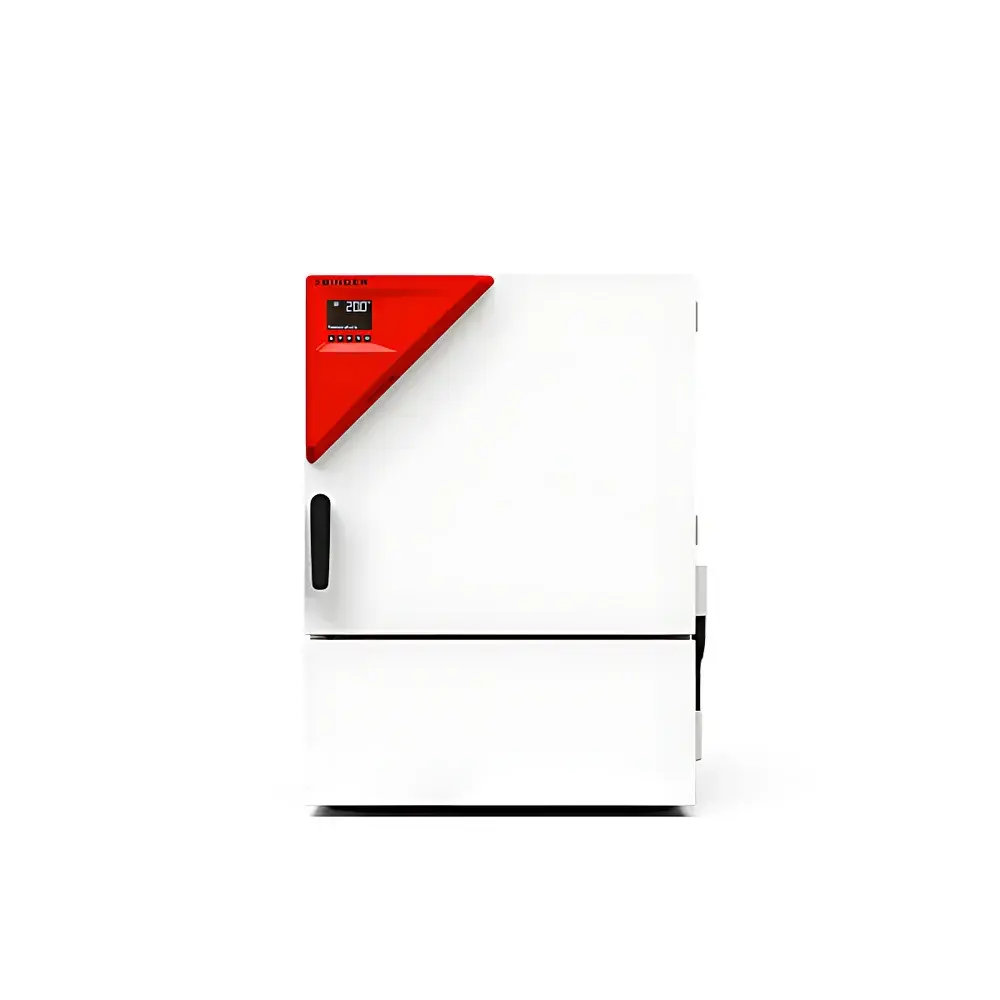
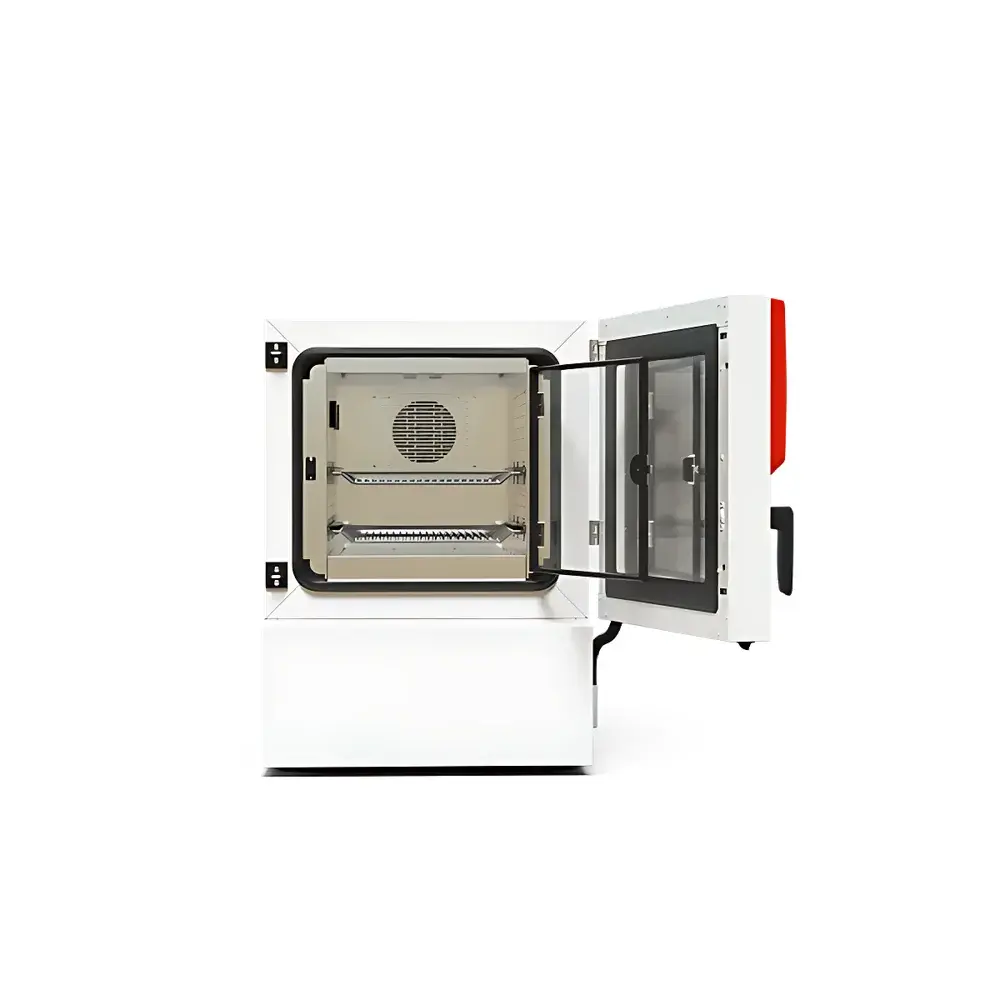
BINDER KB 65 Low Temperature Incubator
| Brand | BINDER |
|---|---|
| Origin | Germany |
| Manufacturer Type | Direct Manufacturer |
| Origin Category | Imported |
| Model | KB 65 |
| Cooling Method | Peltier Thermoelectric Cooling |
| Heating Method | Water-Jacketed Heating |
| Temperature Range | 0 to 70 °C |
| Temperature Fluctuation | ±0.2 °C at 37 °C |
| Temperature Uniformity | ±0.2 °C at 37 °C |
| Chamber Capacity | 63 L |
| External Dimensions | 650 mm × 710 mm × 905 mm |
Overview
The BINDER KB 65 Low Temperature Incubator is an engineered solution for precise, stable, and energy-efficient microbial cultivation under controlled thermal conditions. Designed specifically for life science laboratories requiring reliable sub-ambient to moderate-temperature incubation (0–70 °C), the KB 65 integrates thermoelectric (Peltier) cooling with water-jacketed heating to deliver exceptional thermal stability without reliance on volatile refrigerants or mechanical compressors. This hybrid thermal management architecture ensures continuous, quiet, and vibration-free operation—critical for sensitive cell cultures, psychrophilic microorganisms, and temperature-dependent enzymatic assays. Unlike conventional forced-air incubators, the KB 65 employs passive convection within a stainless-steel chamber, minimizing airflow-induced desiccation and thermal gradients. Its design conforms to ISO 13485 manufacturing standards and supports GLP-compliant workflows through traceable temperature logging and configurable alarm thresholds.
Key Features
- Thermoelectric (Peltier) cooling system: Enables precise sub-ambient operation down to 0 °C without refrigerant gases, reducing environmental impact and maintenance requirements.
- Water-jacketed heating: Provides uniform, slow-response thermal control ideal for long-term incubation and avoids overshoot during setpoint transitions.
- Stainless-steel inner chamber (AISI 304): Corrosion-resistant, non-porous, and autoclavable-compatible surface—ensuring bioburden control and compliance with USP and EU GMP Annex 1 hygiene expectations.
- Integrated dry-heat decontamination cycle: Programmable up to 180 °C for in-chamber sterilization of surfaces and accessories, eliminating need for external autoclaving of internal components.
- Energy-optimized architecture: Achieves up to 40% lower power consumption versus prior-generation models—validated per IEC 62304 and aligned with ISO 50001 energy management principles.
- Dual-setpoint programming: Supports independent scheduling of primary incubation and secondary decontamination phases, enabling unattended weekend or overnight operation with automatic transition logic.
Sample Compatibility & Compliance
The KB 65 accommodates standard microbiological and cell culture formats—including Petri dishes, multi-well plates, flasks, and roller bottles—within its 63 L chamber. Its uniform temperature distribution (±0.2 °C at 37 °C) meets ASTM E145-22 Class II performance criteria for laboratory ovens and incubators. The unit is CE-marked and complies with IEC 61010-1 (safety) and IEC 61326-1 (EMC). Optional validation packages support IQ/OQ documentation per FDA 21 CFR Part 11 requirements, including electronic audit trails, user access controls, and calibrated NIST-traceable temperature sensors.
Software & Data Management
Equipped with BINDER’s intuitive touch-enabled controller (KB Series firmware v4.2+), the KB 65 provides real-time monitoring of chamber temperature, system status, and event logs. Data export via USB port supports CSV-formatted time-series records for integration into LIMS or ELN platforms. Optional Ethernet connectivity enables remote supervision via BINDER’s CDS (Control and Data System) software, which supports automated report generation, alarm escalation (email/SNMP), and 21 CFR Part 11-compliant electronic signatures when paired with validated user authentication modules.
Applications
- Cultivation of cold-adapted bacteria, yeasts, and fungi (e.g., Pseudomonas fluorescens, Yarrowia lipolytica) requiring stable 4–15 °C incubation.
- Storage and recovery of cryopreserved cell lines pre-thawing at controlled ramp rates.
- Enzyme kinetics studies where thermal hysteresis must be minimized across repeated heating/cooling cycles.
- Pharmaceutical stability testing per ICH Q1A(R3) guidelines under intermediate storage conditions (e.g., 30 °C/65% RH simulated via dry-heat conditioning).
- Quality control of diagnostic reagents requiring extended low-temperature incubation without condensation risk.
FAQ
Does the KB 65 require external water supply for the water jacket?
No—the water jacket is sealed and pre-filled at the factory; no user refilling or maintenance is required during normal operation.
Can the dry-heat decontamination cycle be validated for sterility assurance?
Yes—BINDER provides optional IQ/OQ protocols and thermocouple mapping services compliant with ISO 14644-3 and EU GMP Annex 1 Annex 15 requirements.
Is the Peltier cooling system suitable for continuous operation at 0 °C?
Yes—the system is rated for indefinite operation between 0 °C and 70 °C; ambient room temperature must remain ≤25 °C for optimal cooling efficiency.
How is temperature uniformity verified across the chamber volume?
BINDER performs 9-point sensor mapping per DIN EN 255-2 during final quality inspection; calibration certificates are included with each unit.
Can multiple KB 65 units be networked for centralized monitoring?
Yes—via optional CDS Server software, up to 32 units can be managed from a single interface with synchronized alarm handling and consolidated data archiving.



