
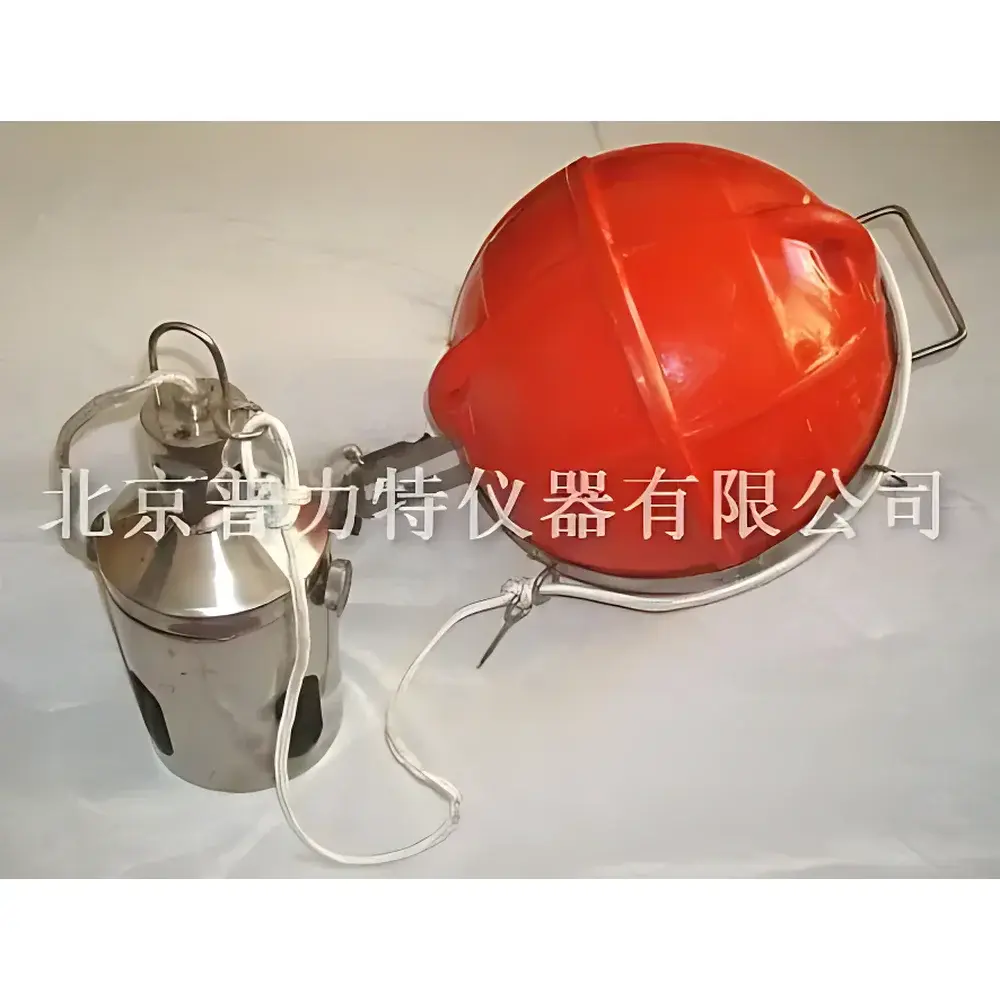
QCC9 Surface Oil Analysis Water Sampler
| Origin | Beijing, China |
|---|---|
| Manufacturer Type | Distributor |
| Origin Category | Domestic |
| Model | QCC9 |
| Price Range | USD 0.15–750 (based on exchange rate) |
| Instrument Type | Manual Water Sampler |
| Sampling Method | Quantitative Sampling |
| Form Factor | Portable Water Sampler |
| Single Sample Volume | 1000 mL |
| Sampling Volume Accuracy | ±1% |
| Sampling Duration | ≤60 s per sample |
| Sampling Interval | Continuous (manual operation) |
| Operational Depth | 0.5–1.0 m below surface |
| Bottle Material | Borosilicate Glass |
| Protective Housing | Stainless Steel (304) |
| Operating Temperature Range | −2 °C to +40 °C |
| Standard Accessories | 1 buoyant float, 3 glass sampling bottles, 1 stainless steel protective cage |
Overview
The QCC9 Surface Oil Analysis Water Sampler is a purpose-engineered manual portable device designed for the quantitative collection of surface water samples specifically intended for petroleum hydrocarbon (e.g., total petroleum hydrocarbons, TPH; polycyclic aromatic hydrocarbons, PAHs) and general physicochemical water quality analysis. It operates on the principle of gravity-driven, depth-controlled immersion sampling: the unit is lowered vertically into the water column with its integrated buoyant float maintaining stable orientation at the air–water interface, while the stainless-steel protective cage ensures structural integrity and prevents bottle damage during deployment and retrieval. Its fixed operational depth range of 0.5–1.0 m enables consistent sampling from the photic zone and oil film–enriched surface layer—critical for detecting floating hydrocarbon sheens, weathered crude residues, and dissolved hydrophobic contaminants. Developed in alignment with national marine environmental monitoring protocols in China, the QCC9 conforms to the technical specifications mandated by the National Marine Environmental Monitoring Center (NMEMC) for baseline surveys and routine surveillance programs.
Key Features
- Quantitative single-stroke sampling: delivers precisely 1000 mL per actuation with ≤1% volumetric deviation, verified per ISO 5667-10:2017 (Water quality — Sampling — Part 10: Guidance on sampling of water and wastewater).
- Borosilicate glass sampling bottles: chemically inert, low extractables, and compatible with EPA Method 1664A (n-hexane extractable material), ASTM D3921 (Standard Practice for Sampling Petroleum Hydrocarbons in Water), and ISO 9377-2 (Water quality — Determination of hydrocarbons — Part 2: Gas chromatographic method).
- Stainless steel (AISI 304) protective housing: corrosion-resistant, impact-durable, and compliant with marine exposure requirements per ASTM A240/A240M.
- Integrated buoyant float system: ensures vertical alignment and consistent submersion depth without requiring active depth control or electronic feedback.
- Manual, cable-deployed operation: eliminates power dependency, enabling use in remote coastal zones, inland lakes, and riverine environments where portability and field robustness are essential.
- Temperature-resilient design: functional across −2 °C to +40 °C, supporting year-round deployment in temperate and subtropical aquatic ecosystems.
Sample Compatibility & Compliance
The QCC9 is validated for collecting representative surface water matrices—including seawater, brackish estuarine water, freshwater lakes, and slow-moving rivers—for subsequent laboratory quantification of oil and grease (O&G), total hydrocarbons, and standard parameters such as COD, BOD, nutrients, and metals. Its glass-bottle configuration meets USP , ISO 3585, and GB/T 2828.1 sampling container requirements for trace organic analysis. As designated equipment in China’s National Marine Pollution Monitoring Network and the Second National Marine Pollution Baseline Survey, it satisfies GLP-aligned documentation standards for chain-of-custody traceability. While not an automated system, its manual protocol supports audit-ready recordkeeping under ISO/IEC 17025:2017 and China’s HJ 493-2009 (Environmental Monitoring — Technical Guidelines for Water Sampling).
Software & Data Management
The QCC9 is a hardware-only sampling tool with no embedded electronics, firmware, or onboard data logging capability. Sample metadata—including date, time, GPS coordinates (recorded externally), depth, temperature, and operator ID—are documented manually or via compatible field data capture applications (e.g., ESRI Field Maps, Fulcrum, or custom LIMS-integrated mobile forms). All accessories include serialized identification tags to support sample tracking in accordance with 21 CFR Part 11-compliant workflows when integrated into regulated analytical laboratories. Calibration verification records (e.g., volume accuracy checks using certified volumetric flasks) are maintained offline per ISO/IEC 17025 clause 7.7.
Applications
- Marine oil spill response: rapid acquisition of surface-integrated samples for forensic hydrocarbon fingerprinting and dispersion modeling inputs.
- National and provincial marine environmental monitoring programs requiring standardized surface-layer sampling per NMEMC Technical Specification No. HY/T 077-2005.
- Baseline ecological risk assessment of ports, offshore platforms, and industrial discharge zones.
- Research on air–water exchange dynamics of volatile organic compounds (VOCs) and semi-volatile organic compounds (SVOCs).
- Validation of in-situ sensor readings (e.g., fluorometers, UV-Vis spectrophotometers) through concurrent grab sampling.
- Training and capacity building in environmental field methodology for regulatory agencies and academic institutions.
FAQ
Is the QCC9 suitable for subsurface or discrete-depth sampling?
No. The QCC9 is engineered exclusively for surface-layer sampling at 0.5–1.0 m depth. It does not support Niskin-style triggering or multi-depth profiling.
Can the glass bottles be replaced with HDPE or PTFE alternatives?
Glass is specified for hydrocarbon analysis to prevent sorption losses and plasticizer leaching. Substitution with polymer containers is not recommended for TPH or PAH assays per EPA 1664A and ISO 9377-2.
Does the stainless steel housing require periodic passivation or maintenance?
Yes. In saline environments, rinsing with deionized water after each use and visual inspection for pitting or crevice corrosion are advised per ASTM G46 guidelines.
How is sampling depth verified during field use?
Depth is controlled mechanically via calibrated rope markings and float positioning. No pressure transducers or depth sensors are included; verification relies on pre-deployment calibration and operator training.
Is the QCC9 compliant with international marine monitoring standards such as OSPAR or HELCOM?
While not formally certified under OSPAR Assessment Guidelines or HELCOM COMBINE, its performance characteristics align with the physical sampling principles outlined in those frameworks for surface oil screening—particularly when used within nationally harmonized QA/QC protocols.







