
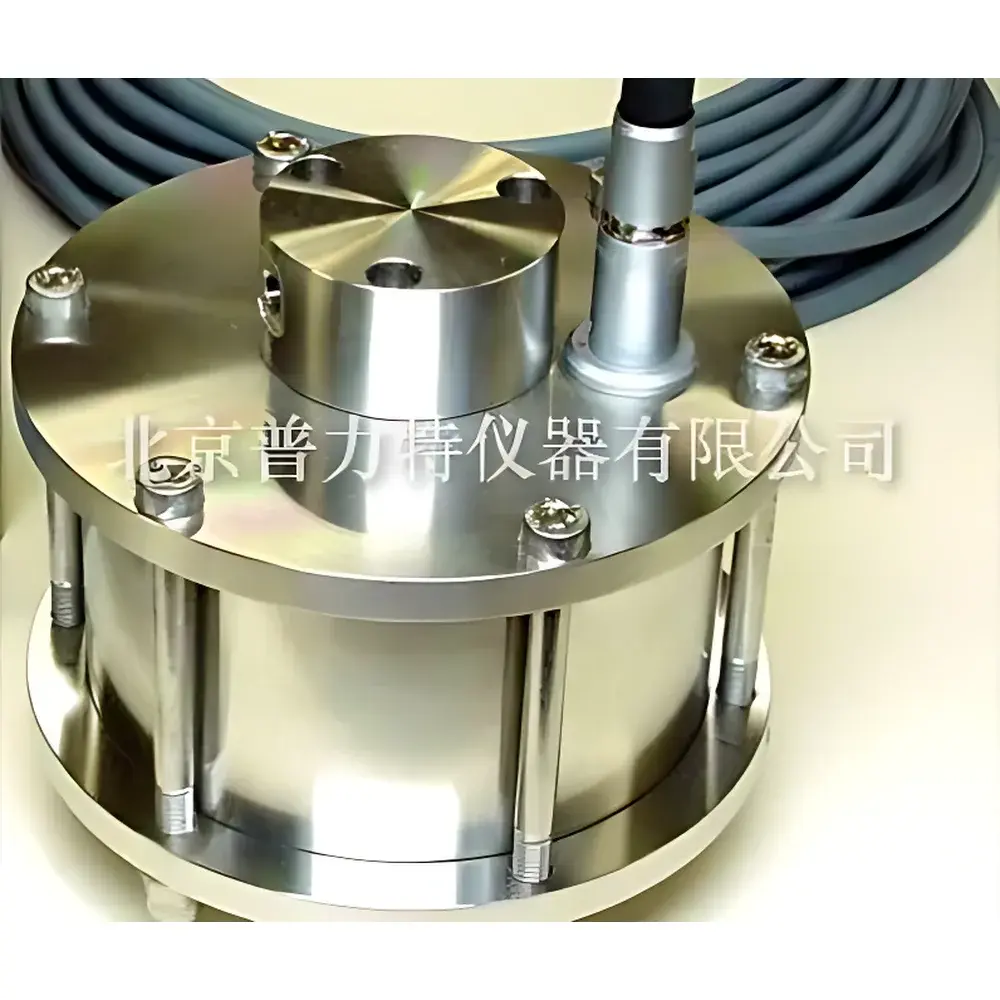


FL30 Tracer Fluorometer
| Origin | Switzerland |
|---|---|
| Manufacturer Type | Authorized Distributor |
| Origin Category | Imported Instrument |
| Model | FL30 |
| Instrument Type | Portable/Handheld Water Quality Analyzer |
| Measurable Parameters | Fluorescent Tracers (e.g., Sodium Fluorescein), Turbidity, Temperature |
| Optional Modules | Conductivity, Pressure |
| Operating Depth | 0–20 m |
| Excitation-Detection Channels | 4 independent optical channels |
| Light Sources | 4 LED-based sources covering UV–visible spectrum |
| Detection Limit | 2 × 10⁻¹¹ g/mL (Sodium Fluorescein), 2 × 10⁻¹⁰ g/mL (Other Tracers) |
| Turbidity Range | 0.2–1000 NTU |
| Temperature Accuracy | ±0.01 °C |
| Data Logging Capacity | Up to 240,000 records (4 parameters × 60,000 entries) on removable 2 GB SD card |
| Sampling Interval | Configurable from 2 s to 20 min (9 preset options) |
| Power Supply | 6–12 V DC (lead-acid battery, 12–24 Ah total capacity) |
| Standby Current Draw | 1.5 mA |
| A/D Resolution | 24-bit |
| Cable Length | ≥15 m (weight: 1 kg per 10 m) |
| Sensor Housing | Stainless steel, Ø160 mm × H170 mm, 7.3 kg |
| Data Logger | Waterproof IP68-rated unit, 7.9 kg (including two 6 V / 12 Ah batteries) |
| Communication Interface | RS232 or USB |
Overview
The FL30 Tracer Fluorometer is a field-deployable, multi-parameter optical sensor engineered for quantitative hydrological tracer studies in surface water systems. It operates on the principle of excitation-emission spectrofluorometry, utilizing four discrete, narrow-band LED light sources and matched photodetector channels to simultaneously quantify fluorescent tracers—primarily sodium fluorescein—alongside turbidity and temperature. Its design conforms to established methodologies for dye tracing outlined in ASTM D3690 and ISO 7888, supporting regulatory-compliant mass-balance calculations, flow velocity estimation, and residence time distribution analysis in rivers, streams, reservoirs, and wastewater outfalls. The instrument’s submersible architecture enables continuous in-situ monitoring at depths up to 20 meters, eliminating sample transport artifacts and preserving temporal resolution critical for transient hydrodynamic events.
Key Features
- Quad-channel optical architecture: Four independent excitation-detection pairs enable concurrent measurement of turbidity and three distinct fluorescent tracers—facilitating multi-dye experiments and cross-interference correction.
- High-sensitivity fluorimetry: Detection limit of 2 × 10⁻¹¹ g/mL for sodium fluorescein meets EPA Method 418.1 sensitivity requirements for environmental tracer quantification.
- Integrated thermal compensation: Built-in 0.01 °C-accurate platinum resistance thermometer (Pt1000) corrects fluorescence signal drift across diurnal and seasonal temperature gradients.
- Robust mechanical design: 316 stainless steel housing rated IP68; pressure-tested to 20 bar; corrosion-resistant for long-term deployment in freshwater, brackish, and estuarine environments.
- Modular expandability: Optional conductivity and pressure modules integrate via standardized I²C bus, enabling salinity-corrected tracer dilution modeling and depth-referenced profiling.
- Low-power embedded logging: 24-bit analog-to-digital conversion with 1.5 mA standby draw supports unattended operation for up to 3 months on dual 12 Ah batteries.
Sample Compatibility & Compliance
The FL30 is validated for use with common hydrological tracers including sodium fluorescein, rhodamine WT, and uranine, with spectral response optimized for their characteristic excitation/emission maxima (e.g., 490/515 nm for fluorescein). It complies with ISO 7888:2012 for turbidity measurement and supports GLP-aligned data integrity through time-stamped, non-volatile storage. All firmware and calibration routines are traceable to NIST-certified reference standards. The system satisfies key requirements for environmental monitoring under EU Water Framework Directive (WFD) Annex V and USGS National Field Manual Chapter A6 protocols.
Software & Data Management
Data acquisition and configuration are managed via the proprietary TracerLog Pro software suite, compatible with Windows 10/11. The software supports real-time telemetry over RS232 or USB, batch calibration curve generation using certified standard solutions, and automated QA/QC flagging based on signal-to-noise ratio thresholds. Export formats include CSV, Excel (.xlsx), and NetCDF for integration into GIS platforms (e.g., QGIS, ArcGIS) and hydrodynamic modeling tools (e.g., MIKE SHE, HEC-RAS). Audit trails—including user login, parameter changes, and calibration history—are retained in accordance with FDA 21 CFR Part 11 requirements when configured with digital signature and electronic record settings.
Applications
- Quantitative dye tracing for hydraulic residence time and dispersion coefficient estimation in rivers and lakes
- Wastewater effluent plume tracking and mixing zone delineation
- Groundwater–surface water interaction studies (GW-SW exchange flux quantification)
- Validation of computational fluid dynamics (CFD) and solute transport models
- Emergency response monitoring during accidental chemical releases or illicit discharges
- Long-term trend analysis of tracer decay kinetics under varying UV exposure and microbial activity conditions
FAQ
What calibration standards are required for routine operation?
Sodium fluorescein stock solutions (1–100 µg/L) traceable to NIST SRM 1932, plus formazin or AMCO-AE standards for turbidity verification.
Can the FL30 operate autonomously without external power?
Yes—the integrated data logger draws power from onboard lead-acid batteries, supporting continuous operation for up to 90 days depending on sampling interval and ambient temperature.
Is the instrument suitable for saline or high-turbidity waters?
It is rated for salinities up to 35 ppt and turbidities up to 1000 NTU; however, field validation against site-specific matrix effects (e.g., humic interference, suspended solids scattering) is recommended prior to regulatory reporting.
How is sensor fouling mitigated during extended deployments?
The optical windows feature hydrophobic anti-fouling coating; optional wiper module (FL30-WP) is available for automated cleaning at user-defined intervals.
Does the system support remote telemetry via cellular or LoRaWAN?
Not natively—but the RS232 output can interface with third-party telemetry gateways compliant with Modbus RTU or ASCII serial protocols.







