
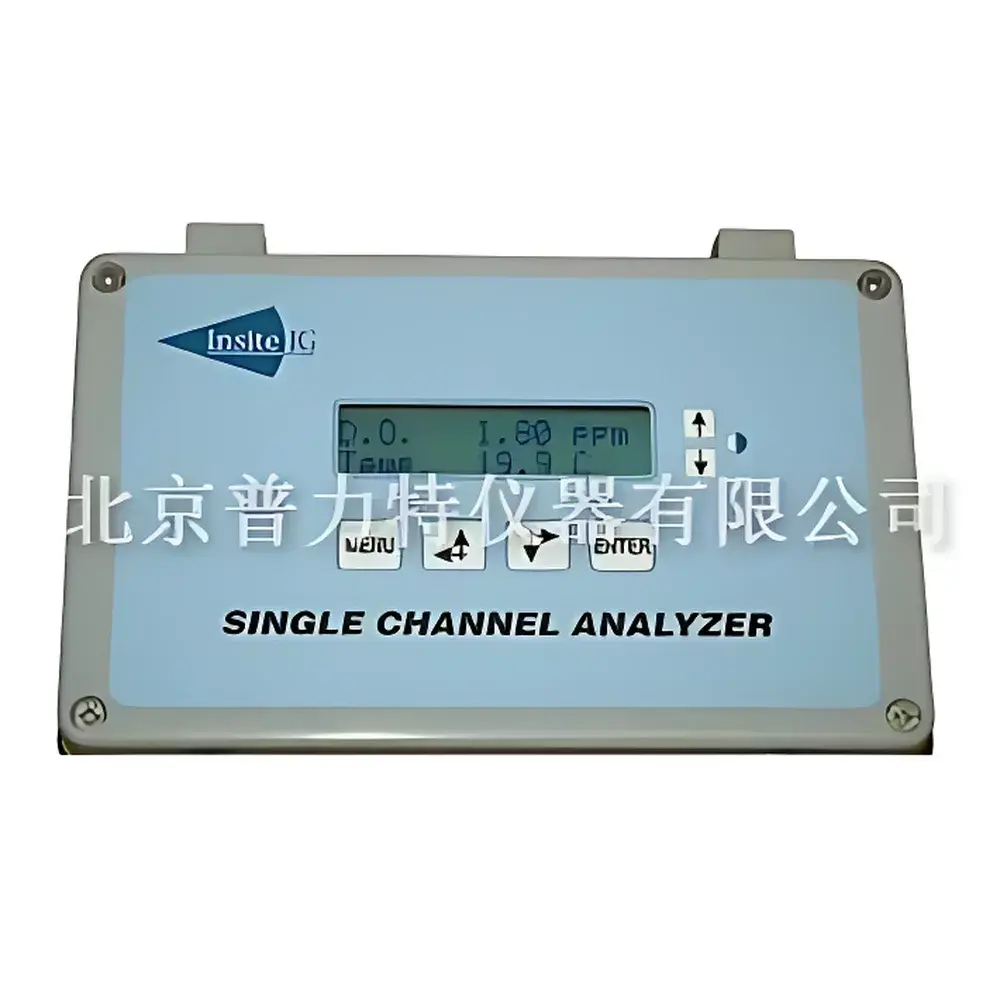
SCA Single-Channel Online Water Quality Monitor (DO/SS/pH/ORP)
| Origin | USA |
|---|---|
| Manufacturer Type | Authorized Distributor |
| Origin Category | Imported |
| Model | SCA |
| Instrument Type | Online |
| Price Range | USD 2,800 – 7,000 (FOB) |
| Compliance | NEMA 4X Enclosure |
| Operating Temp | −20 °C to +70 °C |
| Humidity | 0–100% RH (non-condensing) |
| Max Pressure Rating | 100 psi |
| Sensor Cable Standard Length | 10 m (up to 610 m optional) |
| Display | UV-resistant LCD with adjustable contrast and backlight |
| Data Backup | Yes |
| Communication | RS-485 Modbus RTU |
| Analog Outputs | Two isolated 4–20 mA outputs |
| Relay Outputs | Two 10 A setpoint relays, one alarm relay, one self-cleaning relay |
Overview
The SCA Single-Channel Online Water Quality Monitor is an industrial-grade, multi-parameter analyzer engineered for continuous, real-time monitoring of critical water quality parameters in municipal wastewater treatment plants, industrial effluent streams, aquaculture systems, and process water loops. Designed and manufactured in the United States, the SCA integrates four core measurement modalities—dissolved oxygen (DO), suspended solids (SS), pH, and oxidation-reduction potential (ORP)—within a single compact NEMA 4X-rated enclosure. Its architecture follows a modular sensor interface principle: the analyzer automatically detects and configures connected smart sensors without manual parameter entry, enabling rapid deployment and minimizing commissioning time. The system operates on proven physical measurement principles: DO is quantified via fluorescence quenching (eliminating membrane replacement and electrolyte refills); SS is measured using near-infrared (NIR) optical transmission to mitigate chromatic interference from colored organics or tannins; pH and ORP employ flat-surface glass electrodes with dual-reference junctions and integrated temperature compensation—ensuring stable electrochemical performance across variable flow and fouling conditions.
Key Features
- Auto-sensing intelligent interface: Recognizes and initializes DO, SS, pH, and ORP sensors upon connection—no manual calibration ID entry required.
- Fluorescence-based DO sensor: Solid-state optical design with no membranes, gels, or fill solutions; drift <1% per year; zero-oxygen and air-saturated calibrations supported.
- NIR SS sensor: Dual-wavelength near-infrared detection minimizes error from pigment interference (e.g., humic substances, algae pigments) and provides linear response across 0–30,000 mg/L range.
- Dual-junction flat-glass pH/ORP electrodes: Integrated Pt1000 temperature sensor and low-noise前置 amplifier reduce signal degradation over long cable runs (up to 610 m).
- Robust analog & digital I/O: Two isolated 4–20 mA outputs (user-assignable per parameter), two 10 A SPDT setpoint relays, one dedicated alarm relay, and one self-cleaning control relay for automated sensor maintenance cycles.
- Industrial communications: RS-485 Modbus RTU protocol compliant with SCADA integration standards; supports polling intervals down to 1 second.
- Environmental resilience: NEMA 4X polycarbonate/epoxy composite housing; IP66-rated; operational at −20 °C to +70 °C ambient; 100 psi pressure rating suitable for pressurized pipe or submersible mounting.
Sample Compatibility & Compliance
The SCA is validated for use in raw influent, activated sludge, secondary clarifier effluent, tertiary filtration streams, and recirculated aquaculture water. It meets material compatibility requirements for ASTM D1129 (water terminology), ISO 5814 (electrochemical DO measurement), and EPA Method 160.1 (pH and ORP in wastewater). While not certified under FDA 21 CFR Part 11, its data logging and relay event timestamping support GLP/GMP-aligned recordkeeping when deployed with external audit-trail-capable SCADA systems. Sensor materials—including PVC, borosilicate glass, epoxy resin, and polyurethane encapsulation—are compliant with NSF/ANSI Standard 61 for drinking water system components (where applicable to sensor wetted parts).
Software & Data Management
The SCA operates autonomously without embedded software or firmware updates—configuration is performed via front-panel keypad navigation or Modbus register writes. All calibration history, sensor diagnostics (e.g., electrode impedance, fluorescence decay time, NIR LED intensity), and relay activation logs are stored in non-volatile memory with battery-backed retention. Data export is achieved through Modbus polling by supervisory systems; no proprietary software or cloud dependency is required. For facilities requiring regulatory traceability, the unit supports configurable event-triggered data snapshots (e.g., on relay state change or calibration initiation), enabling correlation with process events in third-party historian platforms such as Ignition, Siemens Desigo, or Honeywell Experion.
Applications
- Municipal wastewater: Aeration basin DO control, final effluent SS compliance monitoring, and denitrification ORP profiling.
- Food & beverage processing: CIP rinse water pH/ORP verification, cooling tower biocide dosing feedback, and post-filtration turbidity surrogate (SS) trending.
- Power plant condensate polishing: Low-level pH and ORP monitoring for corrosion control in high-purity water circuits.
- Aquaculture and hydroponics: Real-time DO and pH stabilization in recirculating aquaculture systems (RAS) and nutrient film technique (NFT) channels.
- Industrial pretreatment: Monitoring of pH neutralization tanks, chemical coagulation basins (via SS), and chlorine residual surrogates (via ORP).
FAQ
Can the SCA monitor all four parameters simultaneously?
Yes—the analyzer continuously acquires and processes DO, SS, pH, and ORP data in parallel using time-sliced sensor excitation and synchronized signal conditioning.
Is sensor calibration traceable to NIST standards?
DO and pH sensors support calibration using NIST-traceable standards (e.g., WTW-certified zero-O₂ solution, pH 4.01/7.00/10.01 buffers); ORP verification uses Zobell’s or quinhydrone solutions per ASTM D1293.
What maintenance is required for the NIR SS sensor in high-fouling environments?
The integrated self-cleaning relay output can trigger pneumatic wipers, ultrasonic transducers, or intermittent air-pulse cleaning systems—configured via user-defined timer or threshold-based activation.
Does the SCA support HART communication?
No—it uses RS-485 Modbus RTU exclusively; HART is not implemented due to architectural focus on deterministic industrial networking and reduced electromagnetic interference in electrically noisy plants.
How is temperature compensation handled across parameters?
Each sensor contains its own Pt1000 RTD; compensation algorithms are embedded in sensor firmware and applied prior to analog output generation—no host-system correction is needed.
Related Products







