
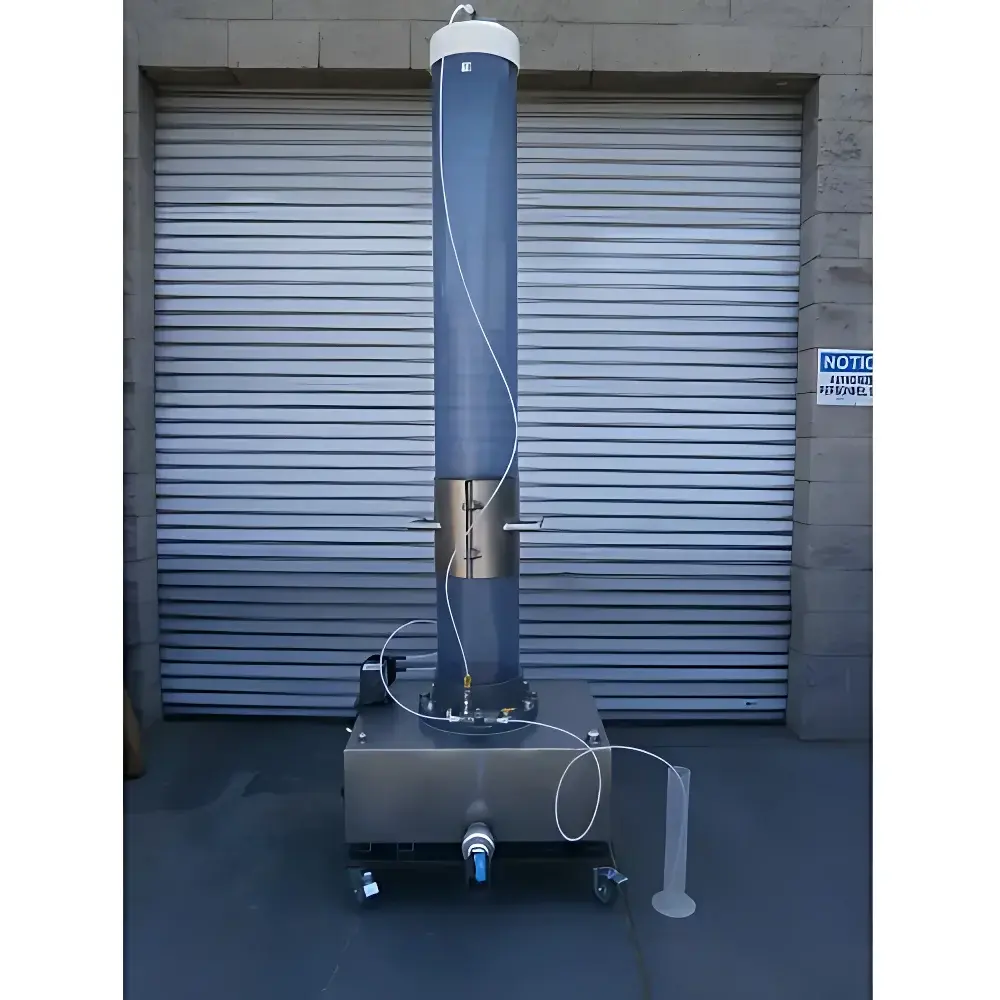
Sepor 050T-100/205 Laboratory Leach Column System
| Origin | USA |
|---|---|
| Manufacturer Type | Authorized Distributor |
| Origin Category | Imported |
| Model | 050T-100/205 |
| Pricing | Available Upon Request |
Overview
The Sepor 050T-100/205 Laboratory Leach Column System is a rigorously engineered bench-scale apparatus designed to replicate heap leaching kinetics under controlled laboratory conditions. Based on the principle of percolation leaching—where lixiviant solution flows vertically through a packed bed of crushed ore—the system enables quantitative assessment of metal dissolution rates, recovery efficiency, and reagent consumption over time. It operates on well-established hydrometallurgical mass-transfer fundamentals, incorporating Darcy’s law for saturated flow and first-order kinetic modeling for solid–liquid reaction interfaces. The dual-column configuration (6-inch and 10-inch diameters) allows systematic scale-up studies from fine-grained feed (<0.5 in) to coarser material (<2.0 in), supporting ASTM E1754-22 (Standard Guide for Heap Leach Testing) and aligned with ISO 11273:2020 (Soil quality — Determination of leaching behavior). Constructed primarily from chemically resistant PVC and 304 stainless steel, the system maintains structural integrity during prolonged exposure to acidic (H₂SO₄, HCl), alkaline (NaOH, CaO slurry), or cyanidation (NaCN) leachants.
Key Features
- Dual-column platform: 6″ × 72″ (ID × height) and 10″ × 79″ configurations, each rated for maximum particle size limits per ASTM guidance to minimize wall-channeling effects
- Integrated stainless steel solution reservoir with calibrated sampling port, isolation valves, and adjustable-speed peristaltic pump for precise flow control (range: 40–110 mL/min)
- PVC-wetted components throughout—including tubing, fittings, column shell, and drainage assembly—to ensure compatibility with aggressive lixiviants
- Stainless steel support plate fitted with 10-mesh perforated screen to retain fines while permitting uniform effluent collection and preventing pump clogging
- Ergonomic stainless steel lifting handles integrated into column flanges for safe handling and column unloading after test completion
- Modular design enabling rapid setup, cleaning, and reconfiguration between sequential leach trials
Sample Compatibility & Compliance
The system accommodates crushed ore samples sized according to defined upper limits (≤0.5 in for 6″ column; ≤2.0 in for 10″ column), requiring prior sieve analysis (per ASTM D6913/D6913M) to document particle size distribution. Feed material must be dried and weighed accurately prior to column packing to establish mass balance baselines. All wetted surfaces comply with FDA CFR Title 21 Part 177.1630 (PVC for food-contact applications) and meet general corrosion resistance benchmarks outlined in NACE MR0175/ISO 15156 for sour service environments. While not intrinsically certified for hazardous location use, the system supports operation within fume hoods compliant with ANSI/AIHA Z9.5–2022 laboratory ventilation standards.
Software & Data Management
This is a manually operated, analog-integrated system with no embedded firmware or proprietary software. Data acquisition relies on external instrumentation: digital thermometers (±0.1°C), pH/conductivity meters (traceable to NIST standards), gravimetric balances (Class I, readability ≤0.01 g), and ICP-OES or AAS analyzers for elemental quantification. Users are expected to maintain electronic lab notebooks (ELN) conforming to ALCOA+ principles (Attributable, Legible, Contemporaneous, Original, Accurate, Complete, Consistent, Enduring, Available) and implement audit trails per 21 CFR Part 11 if used in GLP/GMP-regulated workflows. Sample collection intervals, flow rate logs, temperature records, and solution density measurements are documented in standardized templates compatible with LIMS integration.
Applications
- Kinetic profiling of copper, gold, uranium, nickel, and cobalt ores under sulfuric acid, ammonium sulfate, thiosulfate, or cyanide leaching regimes
- Optimization of lixiviant concentration, pH buffering (e.g., lime addition), redox potential (Eh), and residence time
- Assessment of passivation layer formation, gangue dissolution interference, and reagent consumption efficiency
- Benchmarking against pilot-scale heap leach data for metallurgical accounting and process simulation (e.g., PHREEQC, HYDROGEOCHEM input calibration)
- Environmental leach testing per TCLP (EPA Method 1311) or SPLP (EPA Method 1312) when adapted with appropriate eluent protocols
FAQ
What particle size distribution is required before loading the column?
Crushed ore must be dry-sieved using ASTM E11-compliant test sieves; the top size must not exceed 0.5 in (6″ column) or 2.0 in (10″ column), and full PSD data must be recorded for mass-balance reconciliation.
Can the system handle oxidizing leachants such as ferric sulfate or hydrogen peroxide?
Yes—provided concentrations remain within PVC chemical resistance limits (consult Cole-Parmer Chemical Compatibility Database); elevated Eh conditions require periodic inspection of pump tubing integrity.
Is temperature control integrated into the system?
No—external heating/cooling jackets or environmental chambers are required for isothermal testing; users must log ambient and effluent temperatures at defined intervals.
How is solution flow rate calibrated and verified?
Using volumetric collection over timed intervals (minimum 5-minute duration) into a tared container on a calibrated balance; flow stability must be confirmed prior to sample withdrawal.
Does the system include analytical methods for metal quantification?
No—the column system delivers representative leachate samples only; elemental analysis requires off-line ICP-MS, ICP-OES, or AAS instrumentation operated per ISO/IEC 17025 requirements.





