
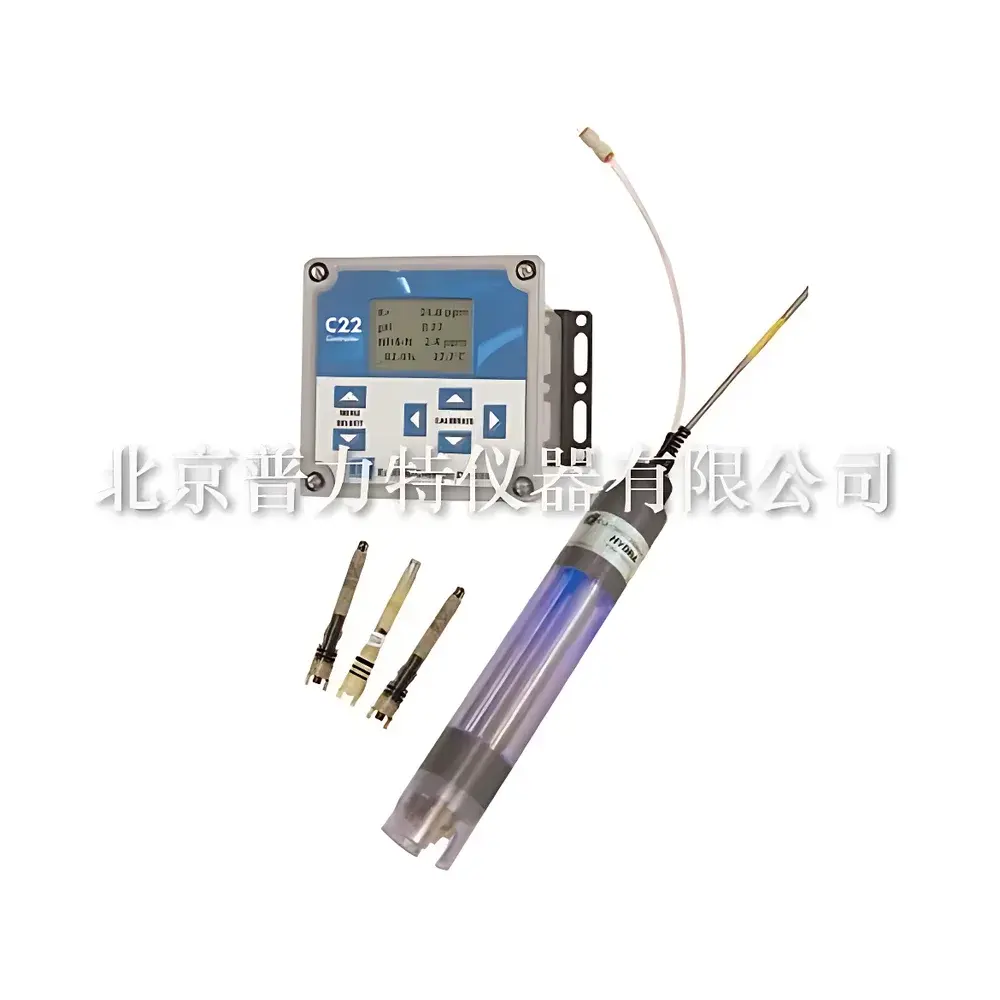
HYDRA Online Ammonia Nitrogen (NH₄⁺-N) Analyzer
| Origin | USA |
|---|---|
| Manufacturer Type | Authorized Distributor |
| Origin Category | Imported |
| Model | HYDRA |
| Price Range | USD 7,000–14,000 |
| Instrument Type | Online |
| Measurement Principle | Ion-Selective Electrode (ISE) Method |
| Measurement Range | 0.1–14,000 ppm NH₄⁺-N |
| Accuracy | ±3% of reading |
| Detection Limit | 0.1 ppm NH₄⁺-N |
| Measurement Cycle Time | 60 seconds |
| Batch Capacity | Single-stream continuous monitoring |
Overview
The HYDRA Online Ammonia Nitrogen (NH₄⁺-N) Analyzer is a robust, field-deployable electrochemical instrument engineered for continuous, real-time quantification of ammonium nitrogen in natural and industrial water matrices—including surface water (lakes, rivers), groundwater, wastewater effluent, and influent streams. It operates on the ion-selective electrode (ISE) principle, utilizing a proprietary three-electrode configuration to deliver chemically specific, interference-compensated measurements of NH₄⁺-N concentration. Unlike optical or colorimetric methods, the ISE approach provides direct potentiometric response to ammonium ions (NH₄⁺), eliminating reagent consumption, optical path fouling, and spectral interferences common in spectrophotometric systems. The analyzer accounts for thermodynamic equilibria between NH₄⁺ and unprotonated NH₃ by integrating simultaneous pH, potassium (K⁺), and temperature measurements—enabling accurate conversion from measured NH₄⁺ activity to total NH₄⁺-N mass concentration across variable water chemistry conditions.
Key Features
- Triple-sensor ISE architecture: NH₄⁺-selective electrode (primary sensor), K⁺-selective electrode (interference correction), and combination pH electrode (equilibrium modeling)
- Integrated temperature sensor with automatic thermal compensation for all electrode signals
- Onboard jet-type mechanical cleaner with user-configurable activation frequency (cycle interval and duration)
- Internal signal conditioning circuitry enabling stable analog transmission over distances up to 200 meters
- IP68-rated sensor housing constructed from chemically resistant materials: PVC body, PES/PVDF membranes, PTFE seals, fluorocarbon elastomer gaskets, and 316 stainless steel wetted parts
- Modular electrode protection cap—tool-free removal for routine maintenance, calibration, or replacement
- NEMA 4X-rated C22 data logger with backlit 4-line LCD display (6.35 cm × 4.45 cm), dual 4–20 mA outputs (800 Ω max load @ 24 VDC), and two SPDT alarm relays (230 VAC/5 A or 30 VDC/5 A)
Sample Compatibility & Compliance
The HYDRA system is validated for use in aqueous environments with flow velocities between 0.1 and 3.0 m/s and operational temperatures from 0 °C to 50 °C. Its electrode configuration is optimized for waters exhibiting pH 4–10 and K⁺ concentrations up to 1000 ppm—conditions commonly encountered in municipal wastewater, agricultural runoff, and aquaculture discharge. While not certified to a single harmonized standard, the measurement methodology aligns with principles outlined in ASTM D1426 (Standard Test Methods for Nitrogen in Water), ISO 7150-1 (Water quality — Determination of ammonium — Part 1: Spectrophotometric method), and EPA Method 350.1 (Ammonia—Ion Selective Electrode). Data integrity features—including timestamped readings, non-volatile memory storage, and configurable hold-last-value behavior during cleaning cycles—support adherence to GLP and basic GMP documentation requirements. The C22 logger’s relay logic and analog output stability facilitate integration into SCADA and PLC-based environmental monitoring networks compliant with IEC 61131-3 and ISA-88 frameworks.
Software & Data Management
The C22 data logger functions as a standalone edge controller with embedded firmware supporting full parameter configuration via front-panel keypad or optional RS-232/RS-485 serial interface. All measurement data—including raw mV outputs, compensated NH₄⁺-N values, K⁺, pH, temperature, and cleaning event logs—are stored locally with time stamps. The device supports two independent 4–20 mA analog outputs: one dedicated to NH₄⁺-N concentration (configurable range: 0.1–50 mg/L or extended scale), and a second assignable to pH, temperature, or status flags (e.g., cleaning active, calibration due). Relay outputs are programmable for high/low concentration alarms and automated actuation of the integrated spray cleaner. Though no cloud-native software suite is bundled, the analog and discrete I/O interfaces ensure seamless compatibility with third-party data acquisition platforms (e.g., Campbell Scientific CR series, Siemens Desigo CC, or Ignition SCADA) that support Modbus RTU or analog input mapping. Audit trails, calibration history, and sensor diagnostics are retained in non-volatile memory and accessible via serial dump.
Applications
- Real-time effluent compliance monitoring at municipal wastewater treatment plants (WWTPs) per NPDES permit limits
- Process control in nitrification/denitrification basins and membrane bioreactors (MBRs)
- Early-warning detection of ammonia spikes in drinking water distribution systems following chloramination breakdown
- Environmental impact assessment of agricultural discharge and livestock runoff into sensitive aquatic ecosystems
- Performance validation of ammonia stripping towers, ion exchange units, and advanced oxidation processes
- Research-grade longitudinal studies of nitrogen cycling in lakes, estuaries, and constructed wetlands
FAQ
How does the HYDRA compensate for potassium interference?
The system employs a dedicated K⁺-selective electrode to quantify background potassium activity. The C22 logger applies a stoichiometric correction algorithm, subtracting the K⁺-induced potential offset from the raw NH₄⁺ electrode signal prior to N-concentration calculation.
What is the recommended calibration frequency?
Daily verification with certified NH₄⁺ standard solutions is advised for regulatory reporting; full multi-point calibration (at least two points spanning the expected range) is recommended weekly or after sensor cleaning or replacement.
Can the sensor be installed in pressurized piping?
Yes—the IP68-rated sensor may be mounted directly into pipe tees or bypass loops using its ¾” NPT threaded port; however, it must be installed downstream of flow regulators to maintain laminar flow and avoid mechanical stress on the sensing elements.
What is the expected service life of the electrodes?
NH₄⁺-selective electrodes typically operate reliably for 4–6 months under continuous exposure to municipal wastewater; pH electrodes last 6–12 months. K⁺ and temperature sensors exhibit comparable longevity. Electrode replacement is modular and requires no recalibration of the entire sensor body.
Is the 4–20 mA output intrinsically safe for hazardous area installation?
No—the C22 logger is rated NEMA 4X (dust-tight and rain-resistant) but not Class I, Division 1 or ATEX-certified. For hazardous locations, an external intrinsic safety barrier must be installed in series with the analog output loop.
Related Products







