
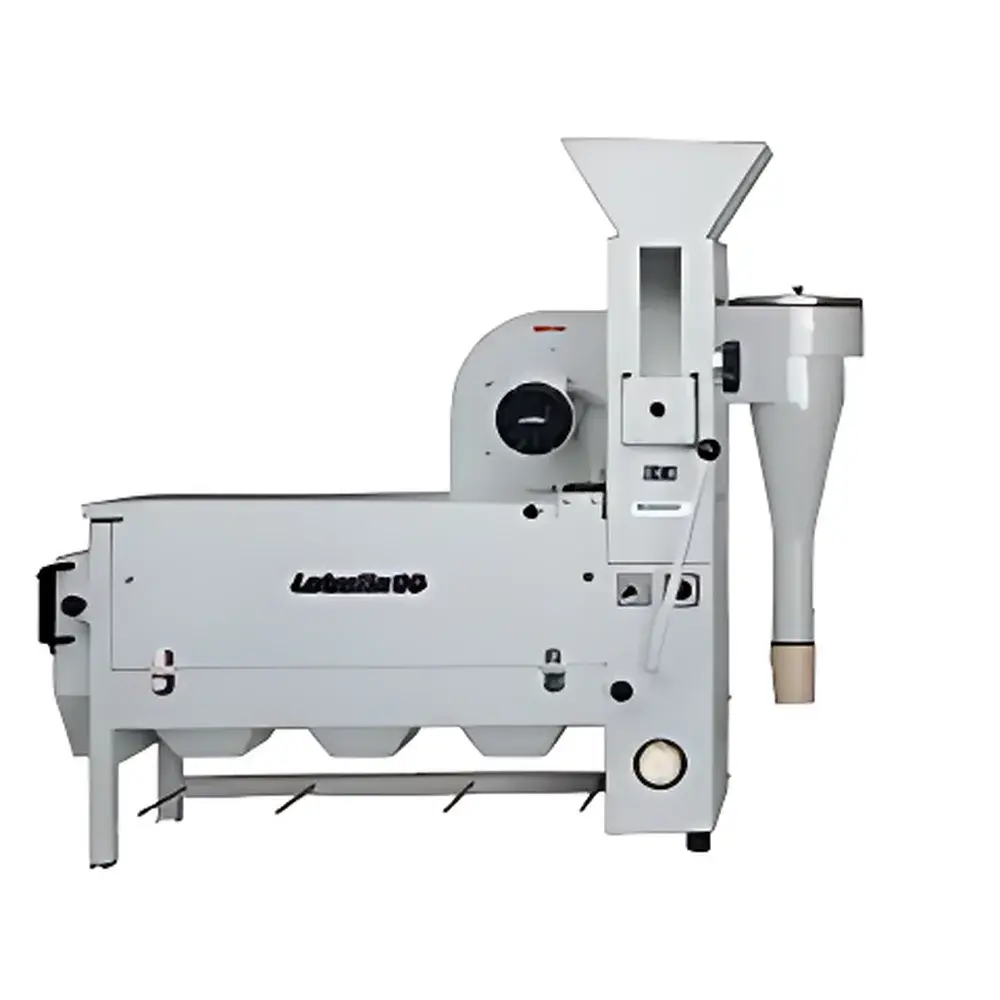
Brabender Labofix Miniature Cleaning and Grading Unit
| Brand | Brabender |
|---|---|
| Origin | Germany |
| Model | Labofix |
| Compliance | EC No. 824/2000 |
| Sample Throughput | ~50 kg/h (wheat) |
| Minimum Sample Mass | 50 g |
| Import Category | Imported Instrument |
Overview
The Brabender Labofix Miniature Cleaning and Grading Unit is a compact, fully integrated laboratory-scale system engineered for precise pre-milling cleaning and particle-size-based classification of granular agricultural commodities. Based on the physical separation principles of air classification, mechanical sieving (flat or cylindrical), and rotary drum fractionation, the Labofix replicates industrial-scale cleaning workflows in a benchtop format—enabling standardized, reproducible preparation of cereal grains and seed samples prior to milling, moisture analysis, protein determination, or rheological testing. Designed in accordance with the requirements of EC Regulation No. 824/2000 for impurity assessment in cereals, the unit delivers traceable, auditable results suitable for quality control laboratories operating under GLP or ISO/IEC 17025 frameworks. Its monolithic architecture houses all core separation modules—including adjustable aspiration airflow, interchangeable sieve decks, and motorized inclined drums—within a single acoustically damped enclosure, eliminating inter-unit variability and ensuring process consistency across sample batches.
Key Features
- Integrated multi-stage separation: Simultaneous or sequential operation of air classifier, flat/cylindrical sieve, and rotary drum within one chassis
- Micro-batch compatibility: Validated performance with sample masses as low as 50 g—maintaining same accuracy and repeatability as larger-scale processing
- Adjustable drum inclination (± angle): Enables controlled residence time modulation—critical for optimizing separation efficiency of fine chaff, broken kernels, or lightweight weed seeds
- Tool-free drum exchange: Patented quick-clamp mechanism allows sub-minute replacement of grading drums (e.g., for different aperture sizes or surface textures)
- Dust-tight design with sealed airflow path: Complies with EN 60335-1 and OSHA PEL guidelines for particulate exposure; includes HEPA-filtered exhaust recirculation option
- Low-noise operation (<65 dB(A) at 1 m): Achieved via balanced rotor dynamics, vibration-damped mounting, and acoustic insulation—suitable for shared lab environments
- Modular sieve configuration: Accepts standardized ASTM E11-compliant flat sieves (200–4000 µm) or cylindrical sieves (500–8000 µm) with positive-lock retention
Sample Compatibility & Compliance
The Labofix is validated for use with wheat (Triticum aestivum and durum), rye (Secale cereale), barley (Hordeum vulgare), oats (Avena sativa), maize (Zea mays), rice (Oryza sativa), sorghum (Sorghum bicolor), grass seeds, vegetable seeds, and flower seeds. It meets the functional specifications outlined in EC Regulation No. 824/2000 for quantitative determination of impurities—including dust, sand, stones, straw fragments, ergot, insect-damaged kernels, and other foreign matter—in raw cereals intended for food or feed use. The system supports method validation per ISO 712 (cereal moisture), ISO 2797 (protein by Kjeldahl), and ICC Standard Method No. 168 (impurity analysis). All mechanical components are constructed from food-grade stainless steel (AISI 304), compliant with EU Regulation (EC) No. 1935/2004 on materials in contact with foodstuffs.
Software & Data Management
While the Labofix operates as a standalone electromechanical instrument without embedded digital controls, it is fully compatible with external laboratory information management systems (LIMS) via RS-232 and optional USB-to-serial interface. Operational parameters—including drum rotation speed (10–60 rpm), inclination angle (−5° to +10°), air flow rate (adjustable via calibrated damper), and total run time—are manually set and recorded using Brabender’s standardized test sheet templates (available in English, German, and French). These records satisfy traceability requirements under FDA 21 CFR Part 11 when maintained in controlled electronic notebooks with audit trails. Optional integration with Brabender’s LabSoft Suite enables automated logging of operator ID, batch number, date/time stamp, and parameter settings for each run—supporting full GMP/GLP documentation compliance.
Applications
- Pre-milling cleaning of cereal samples for subsequent Farinograph, Extensograph, or Amylograph analysis
- Quantitative impurity profiling per EC 824/2000 for grain procurement and delivery certification
- Seed purity testing in plant breeding programs and certified seed production facilities
- Research into kernel density distribution, breakage susceptibility, and hull adhesion characteristics
- Calibration verification of inline optical sorters used in commercial milling lines
- Training platform for grain quality technicians—demonstrating separation physics without requiring pilot-scale infrastructure
FAQ
Does the Labofix meet regulatory requirements for official grain inspection?
Yes—it is routinely employed by national reference laboratories in EU member states for official impurity testing under EC 824/2000 and aligns with Annex I of Regulation (EU) 2017/1182 on common organization of the markets in agricultural products.
Can the Labofix be used for gluten-free grain screening?
It supports cross-contamination mitigation workflows—for example, verifying removal of wheat kernels from oat batches—but does not perform allergen detection; downstream ELISA or PCR analysis remains required.
What maintenance intervals are recommended?
Daily visual inspection of sieve integrity and drum bearings; monthly lubrication of drive shafts with NSF H1-certified grease; annual calibration of airflow meter and inclination angle indicator against NIST-traceable references.
Is third-party validation support available?
Brabender provides IQ/OQ documentation packages and assists accredited labs in developing PQ protocols aligned with ISO/IEC 17025 clause 6.4.1 for equipment fitness-for-purpose verification.





