
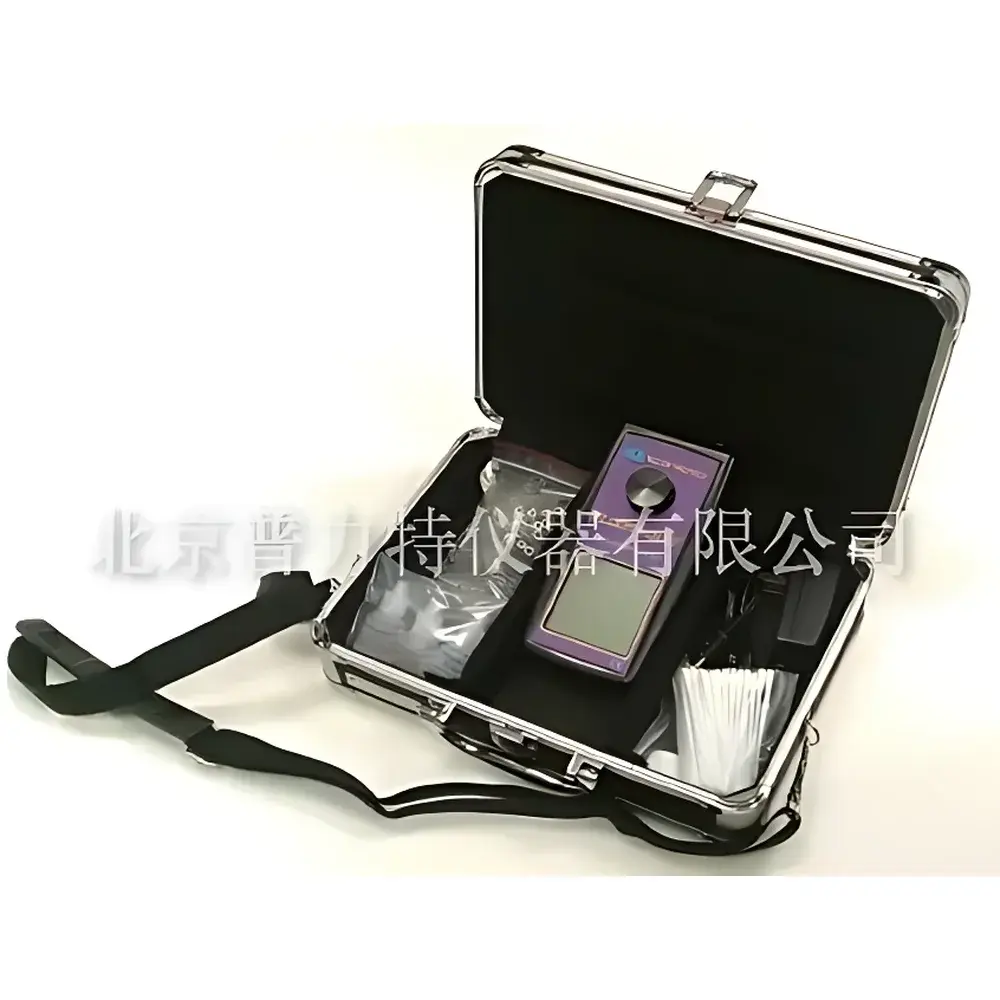
BactTest Portable Bacterial Detection System
| Origin | USA |
|---|---|
| Manufacturer Type | Authorized Distributor |
| Origin Category | Imported |
| Model | BactTest |
| Pricing | Available Upon Request |
Overview
The BactTest Portable Bacterial Detection System is a field-deployable, dual-channel fluorescence-based analyzer engineered for rapid, quantitative enumeration of viable bacteria in diverse environmental and industrial matrices. It operates on the principle of enzymatic bioluminescence/fluorescence detection—specifically leveraging β-glucuronidase (for Escherichia coli) and β-galactosidase (for total coliforms) or other Gram-negative bacterial enzymes that cleave proprietary fluorogenic substrates. This enzymatic hydrolysis releases highly fluorescent compounds, whose intensity—measured in relative fluorescence units (RFU)—correlates linearly with viable cell concentration across six orders of magnitude. Unlike culture-based methods requiring 24–48 h incubation, BactTest delivers quantitative CFU/mL results within 15–30 minutes post-sample introduction, making it suitable for real-time decision support in water safety verification, food processing hygiene monitoring, and environmental compliance screening.
Key Features
- Dual-wavelength excitation (360 nm and 470 nm) and emission detection (460 nm and 530 nm), enabling simultaneous, independent quantification of E. coli, total coliforms, and Gram-negative bacteria using species-specific substrate chemistry
- Compact, ruggedized design (185 × 90 × 35 mm) with IP54-rated enclosure for reliable operation in field conditions including wastewater treatment plants, coastal monitoring stations, and food production facilities
- Integrated touchscreen LCD interface with optional bilingual (English/Chinese) firmware—designed for intuitive navigation without external software dependency
- Flexible power architecture: operates continuously for >8 hours on four AA alkaline batteries or via regulated 5 V DC input—ideal for mobile labs, emergency response units, and remote sampling campaigns
- Onboard data storage supporting up to 240 discrete measurements (3 × 80 slots), each timestamped and tagged with assay type, sample ID, and calibration status
- USB 2.0 interface compliant with Windows/macOS/Linux for secure export of raw RFU values, calibrated CFU concentrations, and audit-ready metadata logs
Sample Compatibility & Compliance
The BactTest system accommodates liquid and swab-rinse samples across regulatory-relevant matrices: drinking water (per EPA Method 1604 and ISO 9308-1), raw milk and dairy beverages (aligned with ISO 4833-1 for aerobic plate count correlation), surface swabs from food contact equipment (validated per FDA Food Code Annex 3 guidelines), industrial effluents, groundwater, and marine coastal waters. Its detection limit of 1 CFU per assay aligns with WHO provisional guidelines for E. coli in recreational water and supports verification testing under HACCP plans. While not a replacement for ISO/IEC 17025-accredited reference methods, BactTest complies with GLP documentation requirements and enables traceable, repeatable screening consistent with USP , ASTM D6503, and EU Directive 2006/7/EC pre-screening protocols.
Software & Data Management
Data acquisition and reporting are managed through embedded firmware with built-in two-point calibration routines—requiring only low- and high-concentration standards traceable to NIST-certified reference cultures. Each measurement includes automatic background subtraction, auto-zeroing at startup, and dynamic range optimization to maintain linearity across 1–250,000 CFU/mL (E. coli). Exported datasets include RFU values, interpolated CFU concentrations, operator ID, date/time stamps, and instrument serial number—structured in CSV format for integration into LIMS platforms. The system supports FDA 21 CFR Part 11-compliant audit trails when paired with validated third-party data management software, fulfilling electronic record retention mandates for regulated QC environments.
Applications
- Rapid verification of disinfection efficacy in municipal water distribution systems and point-of-use filters
- Hygiene validation of CIP/SIP cycles on beverage bottling lines and dairy processing tanks
- Field-based assessment of fecal contamination in agricultural runoff and stormwater outfalls
- Real-time monitoring of biofilm formation potential on membrane filtration surfaces
- Emergency response screening during natural disasters or infrastructure failures affecting water supply integrity
- Research-grade enumeration of indicator organisms in marine microbiology and sediment pore-water studies
FAQ
What bacterial species can the BactTest system detect?
It is optimized for Escherichia coli, total coliforms, and broad-spectrum Gram-negative bacteria using enzyme-specific fluorogenic substrates.
Is method validation data available for regulatory submissions?
Yes—application notes and interlaboratory comparison reports aligned with ISO 16140-2 and AOAC PTM guidelines are provided upon request to qualified laboratories.
Can the instrument be recalibrated in the field?
Yes—two-point calibration is fully supported via onboard menu; certified reference standards are required for traceability.
Does the system meet any international electrical safety or EMC standards?
It conforms to IEC 61010-1 (Safety) and IEC 61326-1 (EMC) for laboratory and field use, with CE and FCC declarations of conformity included in the technical documentation package.
How is data integrity ensured during USB transfer?
All exported files include SHA-256 checksums and retain original timestamps and calibration flags—no post-transfer modification of raw RFU values is possible.
Related Products







