
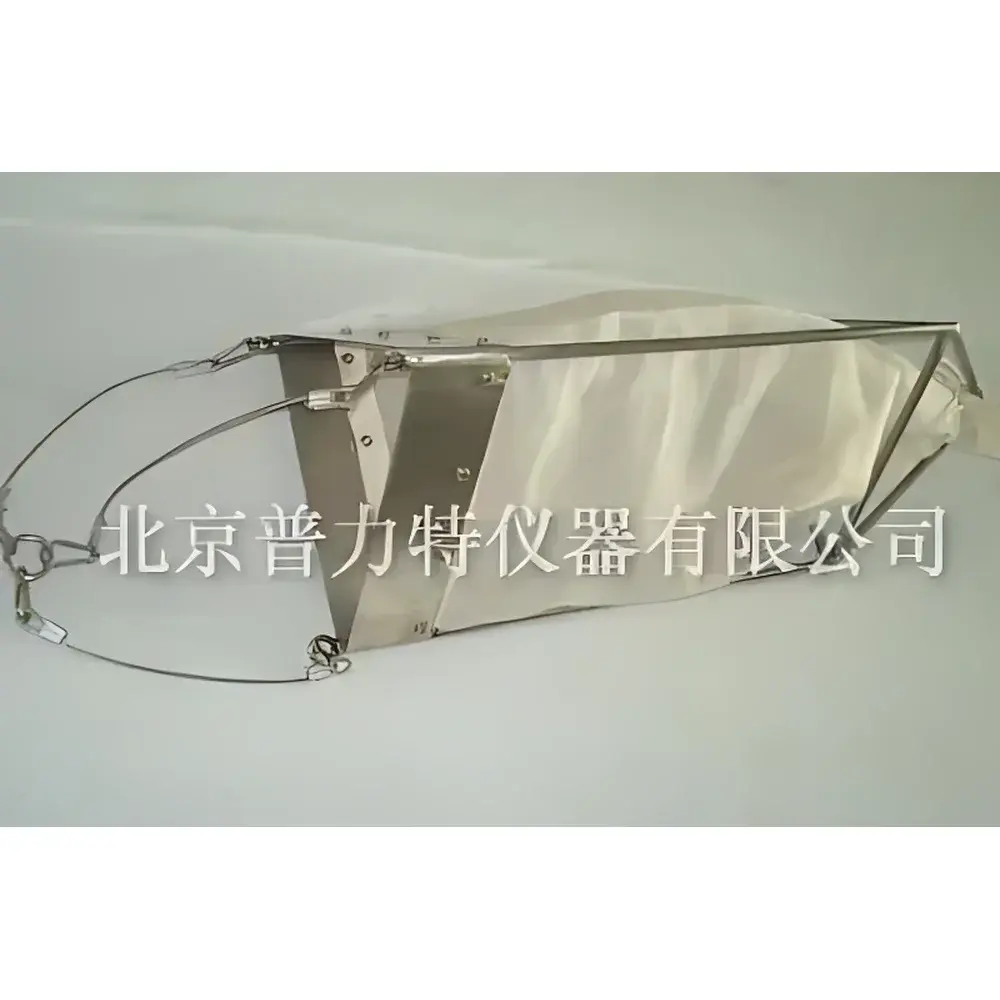
Triangular Bottom Trawl Sampler BD-T30
| Origin | Beijing |
|---|---|
| Manufacturer Type | Distributor |
| Origin Category | Domestic (China) |
| Model | BD-T30 |
| Price | Upon Request |
Overview
The Triangular Bottom Trawl Sampler BD-T30 is a purpose-built benthic sampling instrument engineered for qualitative collection of macroinvertebrates, epifaunal organisms, and associated sediment particles from soft-bottom aquatic environments. Designed in accordance with standard limnological and marine benthic survey protocols, the BD-T30 operates on the principle of mechanical traction—deployed from a vessel and towed along the sediment–water interface to entrain benthic fauna into the net cavity. Its rigid triangular frame ensures consistent mouth opening geometry and minimizes net collapse or deformation during towing, thereby enhancing sampling repeatability across heterogeneous substrates such as silt, clay, sand, and organic detritus. Unlike grab samplers or corers, the BD-T30 provides integrative, areal-scale biological capture rather than point-specific subsampling—making it particularly suitable for community-level biodiversity assessments, ecological status evaluation (e.g., WFD compliance), and long-term monitoring programs requiring taxonomic inventory.
Key Features
- Rigid equilateral triangular frame constructed from AISI 304 stainless steel—resistant to corrosion in freshwater, brackish, and coastal marine environments.
- Precisely dimensioned net aperture: 30 cm side length, ensuring standardized swept area per tow (≈0.39 m² theoretical opening area).
- High-strength nylon mesh (40 mesh count) with nominal pore size of 0.5 mm—optimized to retain benthic invertebrates ≥0.5 mm in maximum dimension while permitting efficient water passage and minimizing clogging.
- Modular design enables rapid disassembly for cleaning, inspection, and field replacement of worn components.
- Integrated towing eyes and reinforced attachment points compatible with standard winch systems and rope diameters (6–10 mm).
- No moving parts or power requirements—ensuring operational reliability, low maintenance, and full compatibility with manual or vessel-based deployment.
Sample Compatibility & Compliance
The BD-T30 is validated for use in lotic (rivers, streams), lentic (lakes, reservoirs), and estuarine ecosystems. It complies with methodological frameworks referenced in ISO 5667-12:2023 (Water quality — Sampling — Part 12: Guidance on sampling of bottom-living (benthic) organisms), as well as national technical specifications for aquatic ecological monitoring (e.g., HJ 970–2018, China). While not an analytical instrument per se, its sampling output supports downstream taxonomic identification, biomass quantification, and bioindicator analysis aligned with EU Water Framework Directive (WFD) metrics (e.g., BQI, BMWP), US EPA Rapid Bioassessment Protocols (RBPs), and national lake/river health assessment standards. The stainless-steel construction meets ASTM A240/A240M requirements for corrosion resistance in aqueous environments.
Software & Data Management
As a passive mechanical sampler, the BD-T30 does not incorporate embedded electronics, sensors, or onboard data logging. However, it integrates seamlessly into structured field data workflows via companion digital tools. Users commonly pair BD-T30 deployments with GPS-tagged tow logs (recorded via handheld GNSS units or vessel navigation systems), depth-sounder profiles, and environmental metadata capture using standardized electronic datasheets compliant with Darwin Core and ENVO ontologies. Raw catch data—including species composition, abundance, and sediment type—can be imported into ecological analysis platforms such as PRIMER-e, R (vegan, tidyverse), or EcoSAS for multivariate ordination, diversity indexing (Shannon, Simpson), and temporal trend analysis. Audit trails for sampling events may be maintained under GLP-aligned documentation practices when used in regulatory monitoring contexts.
Applications
- Baseline benthic community characterization prior to infrastructure development (e.g., hydropower, dredging, aquaculture siting).
- Post-disturbance recovery monitoring following sediment remediation or chemical spill events.
- Long-term ecological monitoring programs tracking shifts in benthic assemblages under climate or land-use change pressures.
- Taxonomic training and reference specimen collection for regional biodiversity databases.
- Validation of remote sensing–derived habitat maps through ground-truthing of substrate and biotic cover.
- Educational fieldwork in university limnology and marine biology curricula.
FAQ
What is the recommended towing speed for optimal benthic capture efficiency?
Towing speeds between 0.3–0.8 knots are empirically validated for fine- to medium-grained sediments; higher velocities increase sediment resuspension and may reduce retention efficiency for lightly attached taxa.
Can the BD-T30 be used in rocky or gravel substrates?
It is not recommended for coarse, highly heterogeneous, or armored substrates due to risk of frame damage, mesh abrasion, and reduced capture representativeness.
How should the net be cleaned and stored between deployments?
Rinse thoroughly with freshwater after each use; air-dry the nylon net away from direct UV exposure; wipe stainless-steel frame dry to prevent water-spotting and chloride-induced pitting.
Is calibration required before field use?
No instrument calibration is needed; however, users must verify net integrity, frame symmetry, and mesh tension prior to each deployment per SOP-BS-01 (Benthic Sampler Pre-Use Inspection Protocol).
Does the BD-T30 meet ISO or ASTM certification requirements?
While the device itself is not certified, its design and performance align with ISO 5667-12:2023 sampling principles and ASTM D5128–17 guidance for benthic macroinvertebrate collection methodology.
Related Products







