
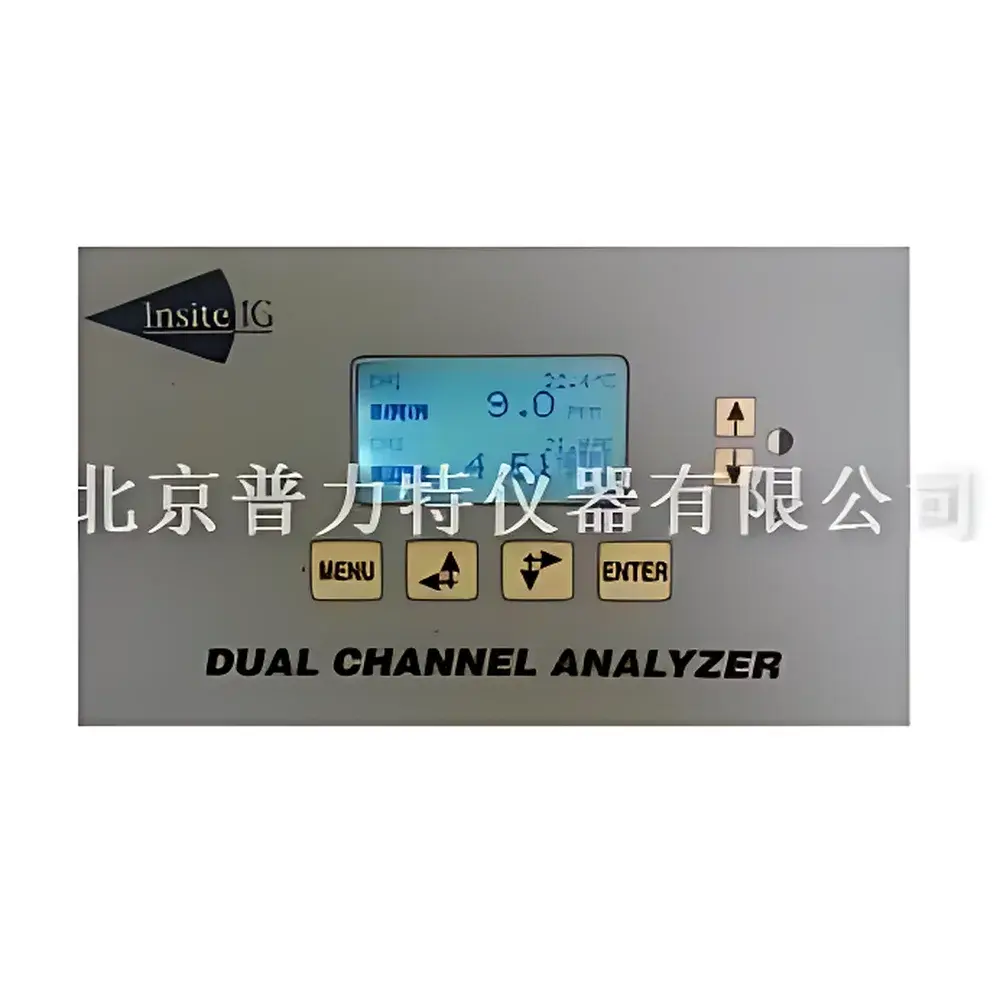
DCA Dual-Channel Online Water Quality Analyzer (DO/SS/pH/ORP)
| Origin | USA |
|---|---|
| Manufacturer Type | Authorized Distributor |
| Origin Category | Imported |
| Model | DCA |
| Instrument Type | Online |
| Price Range | USD 2,800 – 7,000 (FOB) |
| Key Specifications | DO Range 0–25 ppm (±1% or ±0.05 ppm), SS Range 0–30,000 mg/L (±3%), pH Range 2–12, ORP Range ±2000 mV, Temp. Compensation Built-in, NEMA 4X Enclosure, RS-485 Modbus RTU, Dual 4–20 mA Outputs, Self-Cleaning Relay, UV-Resistant LCD Display |
Overview
The DCA Dual-Channel Online Water Quality Analyzer is an engineered solution for continuous, multi-parameter monitoring of critical water quality indicators in municipal wastewater treatment plants, industrial effluent streams, aquaculture systems, and drinking water distribution networks. Designed and manufactured to U.S.-based engineering standards, the DCA integrates four core analytical functions—dissolved oxygen (DO), suspended solids (SS), pH, and oxidation-reduction potential (ORP)—within a single, compact NEMA 4X-rated enclosure. Its architecture follows a modular sensor interface principle: each connected probe is automatically recognized and configured upon insertion, eliminating manual calibration mapping and reducing commissioning time. The system operates on established physical measurement principles: DO is quantified via fluorescence quenching (no membrane or electrolyte required), SS is determined using near-infrared (NIR) optical scattering with chromatic error compensation, while pH and ORP employ flat-surface glass electrodes with dual-reference junctions and integrated temperature-compensated signal conditioning. All measurements are referenced to a built-in Pt1000 temperature sensor, ensuring thermally corrected outputs across operational ranges.
Key Features
- Fully automatic sensor recognition and configuration for DO, SS, pH, and ORP probes—no manual channel assignment required
- Fluorescence-based DO sensing: zero-maintenance design with no membrane replacement, electrolyte refilling, or polarization time
- NIR-based SS detection: minimizes interference from colored dissolved organic matter (CDOM) and turbidity artifacts common in conventional white-light or red-light sensors
- Flat-glass pH and ORP electrodes with dual-reference junctions and internal preamplification—optimized for fouling resistance in high-solids environments
- Dual independent 4–20 mA analog outputs assignable to any measured parameter or calculated value (e.g., % saturation, conductivity-derived TDS)
- Four relay outputs: two programmable setpoint relays (10 A resistive load), one dedicated alarm relay, and one self-cleaning control relay synchronized with sensor immersion cycles
- RS-485 serial interface compliant with Modbus RTU protocol for integration into SCADA, DCS, or PLC-based control systems
- UV-stabilized backlit LCD display with adjustable contrast—designed for readability under direct sunlight and low-light conditions
- Robust housing constructed from epoxy-coated aluminum, polyurethane gaskets, PVC wetted parts, and borosilicate glass—rated IP66/NEMA 4X for outdoor and washdown environments
- Extended sensor cable option up to 610 meters (2,000 ft) using shielded twisted-pair wiring with noise-immune signal conditioning
Sample Compatibility & Compliance
The DCA analyzer is validated for use in liquid-phase aqueous matrices including activated sludge, primary clarifier effluent, membrane bioreactor (MBR) permeate, cooling tower water, and surface runoff. It complies with standard environmental monitoring practices outlined in EPA Method 4500-OB (DO), ASTM D3223-19 (SS gravimetric correlation), and ISO 7888:2012 (pH). While not certified for regulatory reporting without site-specific validation, its measurement stability—<1% annual drift for DO and SS channels—and repeatability (±0.01 ppm DO, ±1% SS) support routine process control applications aligned with ISO 9001 and ISO/IEC 17025 quality frameworks. The device meets CE electromagnetic compatibility (EMC) Directive 2014/30/EU and RoHS 2011/65/EU material restrictions. Its analog and digital I/O architecture supports audit-ready data logging when paired with third-party historian software compliant with FDA 21 CFR Part 11 requirements for electronic records.
Software & Data Management
The DCA operates autonomously without external PC dependency; however, its Modbus RTU interface enables seamless integration with industry-standard data acquisition platforms such as Ignition SCADA, Siemens Desigo CC, or Emerson DeltaV. Configuration, calibration history, and diagnostic logs—including sensor impedance checks, signal-to-noise ratio (SNR) metrics, and cleaning cycle timestamps—are accessible via ASCII command set over RS-485. Optional firmware updates are delivered via secure USB flash drive import, maintaining integrity during field upgrades. Internal non-volatile memory retains >30 days of 1-minute interval data (configurable) with timestamped event logging for alarms, relay actuations, and sensor disconnection events. No cloud connectivity or proprietary cloud services are embedded—ensuring full data sovereignty and compatibility with air-gapped industrial networks.
Applications
- Real-time aeration basin control in activated sludge processes via dynamic DO setpoint modulation
- Suspended solids concentration trending in secondary clarifiers to preempt sludge blanket rise and optimize waste sludge pumping schedules
- pH/ORP profiling across anaerobic-anoxic-oxic (A2/O) bioreactors to verify denitrification and nitrification endpoints
- Pre-treatment monitoring of influent streams for early detection of toxic shock loads or pH excursions
- Recirculating aquaculture system (RAS) health management through concurrent DO sufficiency and metabolic byproduct tracking (via ORP trends)
- Compliance monitoring at NPDES outfall points where simultaneous DO, SS, and pH reporting is mandated
FAQ
What is the maximum recommended distance between the DCA analyzer and remote sensors?
Standard cabling is supplied at 10 meters; extended-length options up to 610 meters are available using 22 AWG shielded twisted-pair cable with proper grounding and noise suppression practices.
Does the DCA support automatic temperature compensation for all parameters?
Yes—integrated Pt1000 sensing provides real-time thermal correction for DO (percentage saturation), SS (density-dependent scattering), pH, and ORP measurements.
Can the DCA be used in pressurized piping applications?
The sensor body and flow-through housings are rated for continuous operation at up to 100 psi (6.9 bar); optional pressure-rated mounting kits are available for inline installation.
Is factory calibration traceable to NIST standards?
All reference calibrations for DO and pH modules are performed using NIST-traceable standards; calibration certificates with uncertainty budgets are provided upon request.
How often does the DO sensor require recalibration in typical wastewater applications?
Under normal operating conditions (0–35°C, <1000 mg/L SS), field verification is recommended every 90 days; annual sensor replacement is advised to maintain <1% drift specification.







