
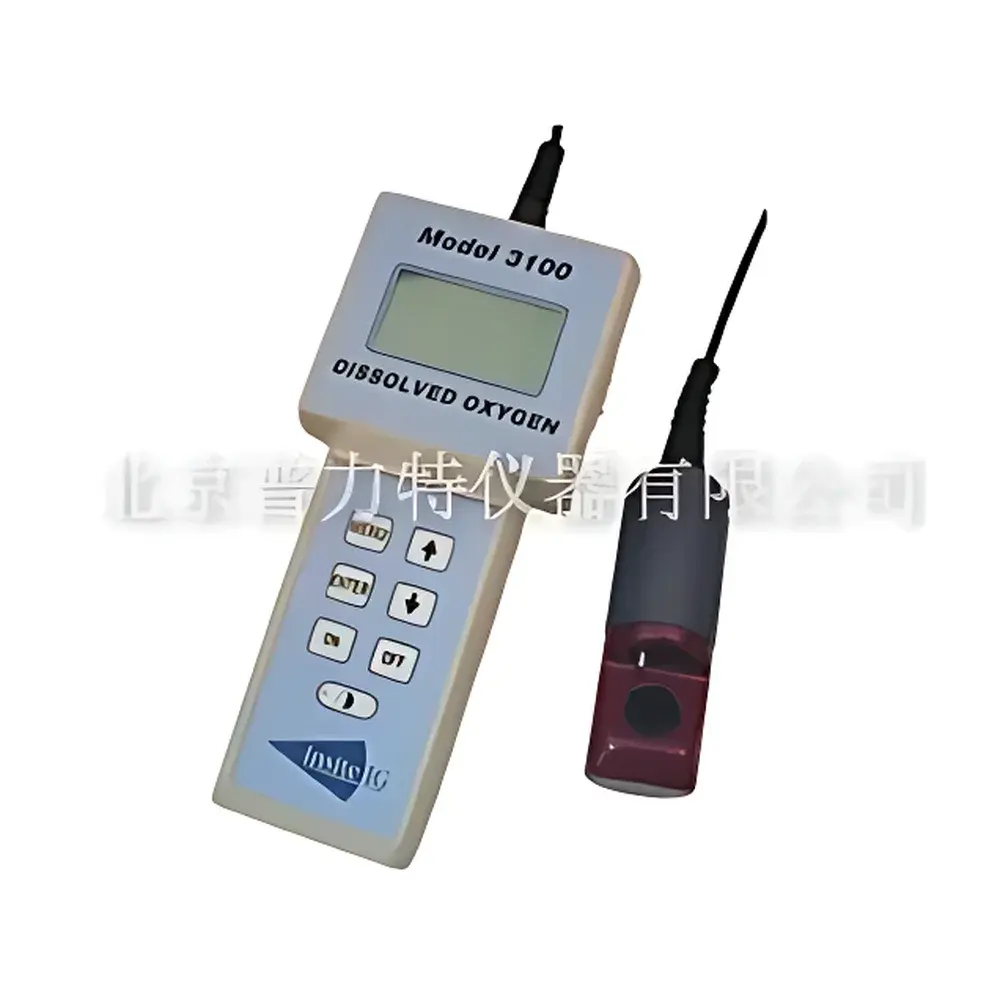
Hach 3100 Portable Dissolved Oxygen Meter
| Origin | USA |
|---|---|
| Manufacturer Type | Authorized Distributor |
| Origin Category | Imported |
| Model | 3100 |
| Instrument Type | Portable |
| Measurement Principle | Fluorescence Quenching |
| Measurement Range | 0–25 ppm |
| Accuracy | ±1% of reading or ±0.02 ppm (whichever is greater) |
| Repeatability | ±0.01 ppm |
| Detection Limit | 0.01 ppm |
| Sensor Drift | <1% per year |
| Response Time | ≤60 s |
| Operating Temperature | 0–60 °C |
| Storage Temperature | −20–70 °C |
| Relative Humidity | 0–100% RH |
| Enclosure Rating | NEMA 4X |
| Max Pressure Rating | 100 psi |
| Cable Length | 6.1 m (20 ft) |
| Weight | 1.8 kg (4 lb) |
| Display | Backlit, UV-resistant LCD with adjustable contrast |
| Data Output | RS232 serial interface |
| Data Logging | Internal memory with export capability |
| Power | Rechargeable internal battery |
Overview
The Hach 3100 Portable Dissolved Oxygen Meter is an engineered field-deployable instrument designed for high-fidelity, maintenance-free dissolved oxygen (DO) measurement in natural waters, wastewater streams, aquaculture systems, and industrial process monitoring. It employs solid-state fluorescence quenching technology—based on the oxygen-dependent decay kinetics of a ruthenium-based luminophore—to deliver stable, interference-resistant DO quantification without electrochemical consumption or membrane dependency. Unlike Clark-type amperometric sensors, the 3100’s optical sensor requires no electrolyte refills, membrane replacements, or polarization time. Its non-consumptive sensing mechanism eliminates flow-rate dependence and agitation requirements, making it especially suitable for low-flow or stagnant environments—including sediment pore water profiling, effluent discharge monitoring, and remote watershed surveys.
Key Features
- Solid-state fluorescence sensor with integrated optical excitation and detection optics—no consumables, no recalibration drift from membrane fouling or electrolyte depletion
- NEMA 4X-rated rugged housing constructed from UV-stabilized polycarbonate, epoxy-coated aluminum, and chemical-resistant PVC/urethane components
- Backlit, high-contrast, UV-resistant LCD display with intuitive menu navigation and real-time graphical trend view
- Internal rechargeable lithium-ion battery providing >16 hours of continuous operation under typical field conditions
- RS232 serial interface compliant with standard terminal emulation protocols for direct connection to PCs, data loggers, or SCADA systems
- Onboard data logging with timestamped storage for up to 10,000 measurements; exportable as CSV-compatible ASCII files via serial link
- Factory-calibrated at two points (0% and 100% saturation in air-saturated water); optional user calibration using Winkler titration or certified zero-oxygen solution
- Self-diagnostic firmware checks sensor integrity, signal-to-noise ratio, and photodiode response prior to each measurement cycle
- 6.1-meter (20 ft) armored sensor cable rated for submersion and abrasion resistance in municipal and industrial settings
Sample Compatibility & Compliance
The Hach 3100 is validated for use across freshwater, seawater (with salinity compensation), wastewater, activated sludge, and bioreactor effluents. It demonstrates immunity to common interferents—including hydrogen sulfide (H₂S), chlorine residuals, heavy metal ions (e.g., Cu²⁺, Fe³⁺), and pH fluctuations between 4.0 and 10.5—ensuring reliable performance in chemically aggressive matrices where electrochemical sensors fail. The instrument complies with ASTM D888-22 (Standard Test Methods for Dissolved Oxygen in Water) and supports GLP-compliant data capture when paired with Hach’s LogPro software (optional). Its design adheres to IEC 61000-6-2 (EMC immunity) and IEC 60529 (IP66 equivalent via NEMA 4X certification), enabling deployment in outdoor, wet, and corrosive ambient conditions.
Software & Data Management
Data acquisition and archival are supported through native RS232 communication using standard ASCII command sets (e.g., “READ”, “LOG ON/OFF”, “CALIBRATE”). When connected to a host PC running Hach LogPro v3.2 or later, users can configure automated sampling intervals, apply temperature/salinity compensation algorithms, generate audit-trail-enabled reports, and synchronize timestamps with NTP servers. All logged entries include metadata: date/time stamp, sensor ID, operator code (user-defined), temperature, atmospheric pressure (if external barometer is connected), and raw phase-difference values. Exported datasets meet FDA 21 CFR Part 11 requirements for electronic records when deployed with appropriate system validation documentation and access controls.
Applications
- Wastewater treatment plant monitoring: aeration basin DO profiling, return activated sludge (RAS) control, and final effluent compliance verification
- Environmental field studies: stream/river DO diurnal cycling, lake stratification mapping, and wetland health assessment
- Aquaculture operations: pond and recirculating aquaculture system (RAS) DO optimization to prevent hypoxia stress
- Drinking water distribution: residual DO tracking in storage reservoirs and pipeline networks
- Industrial cooling water systems: corrosion risk assessment via dissolved oxygen concentration trends
- Educational laboratories: hands-on instruction in optical sensing principles, environmental chemistry, and regulatory water quality methods
FAQ
Does the 3100 require daily calibration?
No—factory calibration remains stable for ≥12 months under normal use. Field verification against air-saturated water or a certified zero-oxygen standard is recommended before critical measurements.
Can the sensor be used in seawater?
Yes; salinity compensation is applied automatically using built-in conductivity input (when paired with compatible Hach multiparameter probes) or manually entered values per ASTM D888 Annex A3.
Is the sensor sensitive to biofouling?
The optical surface exhibits low adhesion characteristics; routine cleaning with soft lint-free cloth and deionized water is sufficient. No enzymatic or chemical cleaning agents are required.
What happens if the instrument is exposed to freezing temperatures?
While the operating range is 0–60 °C, short-term exposure down to −20 °C is permissible during transport/storage; however, measurements must not be performed below 0 °C to avoid condensation-induced optical path distortion.
How is traceability maintained for regulatory reporting?
Each unit ships with a NIST-traceable calibration certificate. Firmware logs include immutable timestamps, sensor serial number, and calibration history—enabling full audit trail reconstruction per ISO/IEC 17025 and EPA Method 360.5 requirements.
Related Products







