
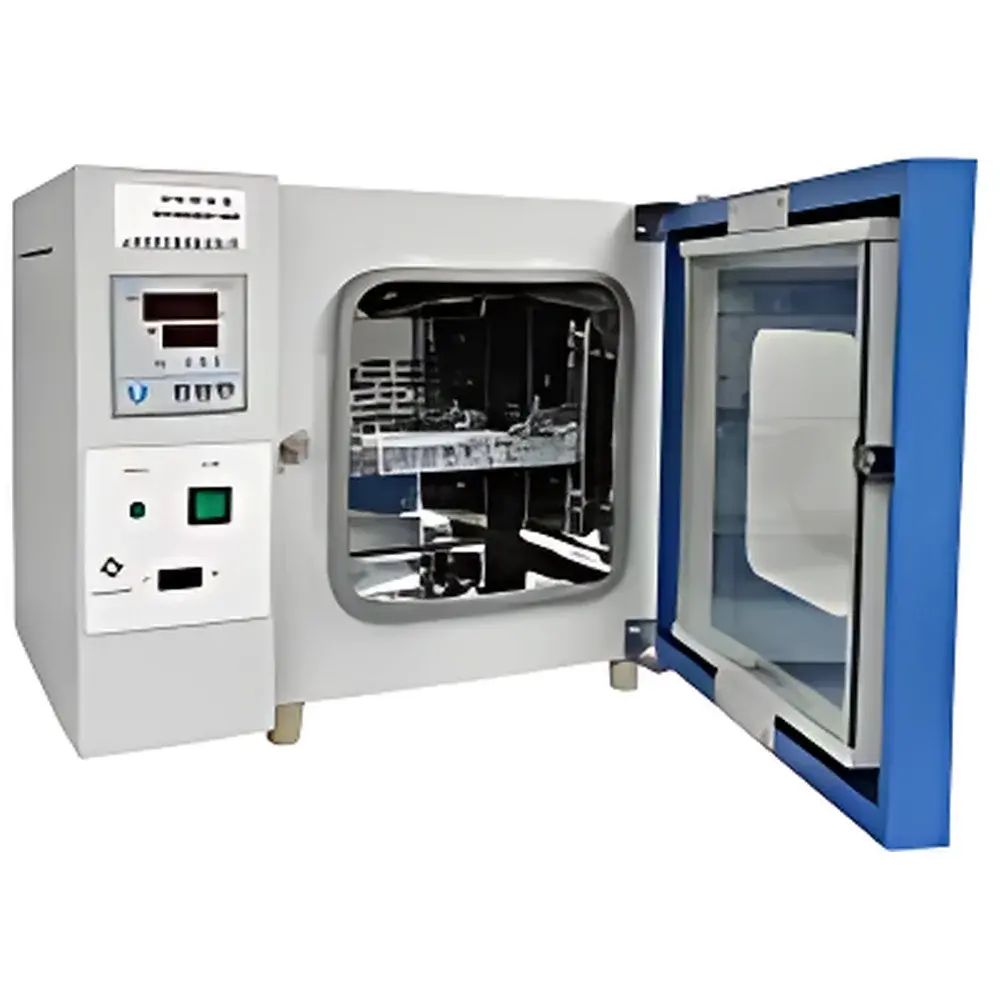
ZiQi DHG-9140A 136L Forced-Air Laboratory Drying Oven
| Brand | ZiQi |
|---|---|
| Origin | Shanghai, China |
| Manufacturer Type | Direct Manufacturer |
| Product Category | Domestic |
| Model | DHG-9140A (136 L Capacity) |
| Temperature Range | RT + 10 °C to 300 °C |
| Temperature Uniformity | ±3% at 100 °C |
| Temperature Fluctuation | ±1.0 °C |
| Temperature Resolution | 0.1 °C |
| Internal Chamber Dimensions (W×D×H) | 450 × 550 × 550 mm |
| External Dimensions (W×D×H) | 835 × 670 × 730 mm |
| Heating Method | Forced-Air Circulation |
| Inner Chamber Material | Mirror-Finish Stainless Steel (SUS304) |
| Operating Ambient Temperature | 5–40 °C |
| Power Supply | AC 220 V, 50 Hz |
| Rated Power | 2050 W |
| Standard Shelving | 4 adjustable stainless steel trays |
| Timer Range | 1–9999 minutes |
| Optional Features | Independent Over-Temperature Cut-Off Protection |
Overview
The ZiQi DHG-9140A is a precision-engineered forced-air laboratory drying oven designed for consistent thermal processing of samples in research, quality control, and production environments. Operating on the principle of convective heat transfer via a regulated axial fan and optimized internal air ducting, the DHG-9140A ensures uniform temperature distribution across its 136 L working chamber. Its operational range extends from ambient +10 °C to 300 °C—making it suitable for applications including moisture loss determination, polymer curing, glassware sterilization, pre-weighing desiccation, and accelerated stability testing. The unit complies with fundamental thermal safety and performance expectations aligned with ISO 17025-accredited laboratory practices and supports routine adherence to ASTM E145 and USP guidelines for drying and conditioning protocols.
Key Features
- Microprocessor-based digital temperature controller with intuitive LCD interface displaying real-time setpoint, actual temperature, and elapsed time—enabling multi-parameter visibility without menu navigation.
- Intelligent airflow management system featuring variable-speed fan control and proprietary baffle-guided air circulation, minimizing thermal stratification and achieving ±3% uniformity at 100 °C (per IEC 60068-3-5 test methodology).
- Mirror-finish SUS304 stainless steel inner chamber with radius-rounded corners and removable, height-adjustable shelving—facilitating complete cleaning, residue-free operation, and compatibility with aqueous or solvent-based sample handling.
- Dual-stage thermal protection: primary PID-controlled heating circuit plus an independent mechanical over-temperature cut-off (optional), automatically interrupting power if the chamber exceeds user-defined safety thresholds.
- Electrostatically coated cold-rolled steel exterior housing provides structural rigidity, corrosion resistance, and long-term dimensional stability under continuous duty cycles.
- RS485 serial interface (optional) enables integration with external data loggers or laboratory information management systems (LIMS) for audit-trail-compliant temperature recording per FDA 21 CFR Part 11 requirements.
Sample Compatibility & Compliance
The DHG-9140A accommodates standard laboratory vessels—including Petri dishes, weighing boats, crucibles, glass beakers, and aluminum pans—within its spacious 450 × 550 × 550 mm chamber. Its stainless steel interior resists oxidation and chemical attack from common solvents (e.g., ethanol, acetone, isopropanol) and weak acids encountered during preparatory drying workflows. While not certified for Class II biological safety or explosion-proof use, the oven meets general electrical safety standards (IEC 61010-1) and thermal stability benchmarks referenced in ISO/IEC 17025 clause 6.4.1 for equipment used in accredited testing laboratories. It is routinely deployed in GLP-regulated environments where traceable calibration, documented maintenance, and periodic verification of temperature accuracy are maintained.
Software & Data Management
The embedded microcontroller supports programmable timing (1–9999 min), auto-start delay, and deviation alarm triggering. When equipped with the optional RS485 module, the oven outputs timestamped temperature data at user-selectable intervals (default: 10 s) via Modbus RTU protocol. This allows seamless synchronization with third-party software platforms such as LabVIEW, MATLAB, or custom Python-based logging tools. All recorded datasets retain metadata—including operator ID, batch number, and environmental conditions—supporting full traceability for regulatory submissions or internal QA audits. No proprietary software installation is required; raw ASCII-formatted logs can be parsed directly into Excel or statistical analysis packages.
Applications
- Moisture content analysis per AOAC 950.46 and ISO 5530-1 using gravimetric drying methods.
- Pre-drying of filter papers, silica gel packs, and analytical standards prior to hygroscopic mass measurement.
- Curing of epoxy-coated substrates, printed circuit board laminates, and composite material precursors under controlled ramp-and-hold profiles.
- Conditioning of reference materials and calibration standards in metrology labs operating under ISO/IEC 17025 accreditation.
- Thermal stabilization of ceramic powders, catalysts, and metal oxides prior to XRD or BET surface area analysis.
- Routine sterilization of non-critical labware where steam autoclaving is impractical or incompatible with material composition.
FAQ
What is the maximum recommended continuous operating temperature?
The DHG-9140A is rated for sustained operation up to 300 °C; however, prolonged exposure above 250 °C may accelerate aging of gasket materials and reduce long-term calibration stability.
Can the oven be calibrated internally by the user?
Yes—the controller supports offset adjustment via built-in calibration mode using a NIST-traceable reference thermometer (e.g., Fluke 1523 or equivalent) placed at the geometric center of the chamber.
Is the stainless steel chamber electropolished or passivated?
The inner chamber uses standard mirror-finish SUS304 stainless steel; electropolishing is available as a factory-customized option upon request.
Does the unit include validation documentation?
Factory-installed units ship with a Certificate of Conformance and initial temperature uniformity report; IQ/OQ documentation templates and on-site validation support are available separately.
How often should temperature uniformity verification be performed?
Per ISO/IEC 17025 and internal QA policies, quarterly verification is recommended; frequency may increase based on usage intensity, criticality of application, or regulatory inspection findings.



