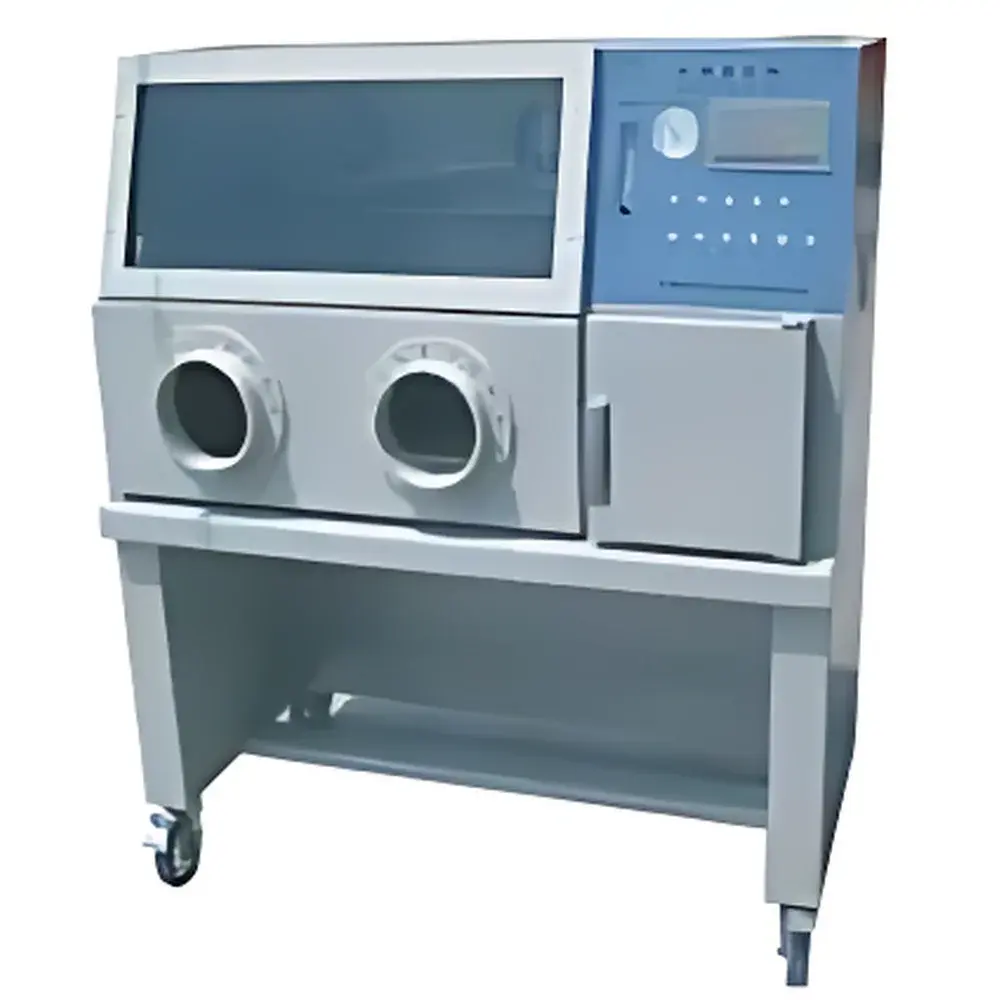
ZiQi YQX-II Manual Anaerobic Incubator
| Brand | ZiQi |
|---|---|
| Origin | Shanghai, China |
| Manufacturer Type | Direct Manufacturer |
| Country of Origin | China |
| Model | YQX-II |
| Instrument Type | Manual Anaerobic Incubator |
| Oxygen Concentration | <0.1% O₂ (Anaerobic Environment) |
| Temperature Control Range | Ambient +3°C to 60°C |
| Temperature Uniformity | ±1°C |
| Temperature Stability | ±0.3°C |
| Temperature Resolution | 0.1°C |
| Gas Mixture | 90% N₂ / 5% H₂ / 5% CO₂ |
| Chamber Dimensions (W×D×H) | 820 × 550 × 660 mm |
| External Dimensions (W×D×H) | 1200 × 730 × 1360 mm |
| Power Supply | AC 220 V, 50 Hz |
| Rated Power | 1500 W |
| Anaerobic Transition Time (Sample Chamber) | <5 min |
| Anaerobic Transition Time (Main Operating Chamber) | <60 min |
| Anaerobic Maintenance Duration (without gas replenishment) | >12 h |
| Timer Range | 1–9999 min or continuous operation |
Overview
The ZiQi YQX-II Manual Anaerobic Incubator is a purpose-engineered laboratory instrument designed for the cultivation, isolation, and manipulation of obligate and facultative anaerobic microorganisms under strictly controlled oxygen-free conditions. It operates on the principle of catalytic oxygen removal combined with gas-phase displacement—utilizing a precisely metered mixture of nitrogen (90%), hydrogen (5%), and carbon dioxide (5%) to establish and sustain an anaerobic atmosphere (<0.1% O₂). The system integrates a dual-chamber architecture: a primary operating chamber for extended incubation and manipulation, and an auxiliary sample transfer chamber enabling rapid, oxygen-minimized specimen introduction without compromising the integrity of the main anaerobic environment. Engineered for precision and operational reliability in clinical microbiology, food safety testing, pharmaceutical quality control, and academic research laboratories, the YQX-II complies with fundamental requirements outlined in ISO 11133:2014 (Microbiology of food and animal feeding stuffs — Guidelines for performance testing of culture media) and supports Good Laboratory Practice (GLP) workflows where environmental consistency and traceability are critical.
Key Features
- Stainless-steel construction throughout the operating and sample chambers ensures corrosion resistance, ease of decontamination, and long-term structural integrity under repeated sterilization cycles.
- Front window fabricated from impact-resistant, optically clear tempered glass enables real-time visual monitoring while maintaining atmospheric containment; integrated glove ports provide ergonomic, leak-tight access with minimal tactile resistance.
- High-precision digital temperature controller with 0.1°C resolution and ±0.3°C stability, coupled with independent over-temperature protection circuitry, guarantees reproducible thermal conditions across the full range (ambient +3°C to 60°C).
- Dual-stage catalytic deoxygenation system—including palladium-based catalyst and integrated desiccant—ensures rapid establishment (12 hours) of sub-0.1% O₂ environments even during brief interruptions in gas flow.
- UV germicidal lamp (254 nm) and HEPA-filtered gas inlet minimize bioburden ingress; internal LED illumination facilitates detailed observation without thermal load interference.
- Adjustable mass-flow gas regulators allow fine-tuned delivery of the N₂/H₂/CO₂ blend, supporting method-specific gas ratios required for fastidious species such as Clostridium difficile, Bacteroides fragilis, or Helicobacter pylori.
Sample Compatibility & Compliance
The YQX-II accommodates standard Petri dishes (up to 150 mm), anaerobic jars, blood culture bottles, and custom agar plates within its 820 × 550 × 660 mm working chamber. Its design supports CLSI M45-A3 (Methods for Antimicrobial Dilution and Disk Susceptibility Testing of Infrequently Isolated or Fastidious Organisms) and EUCAST guidelines for anaerobic susceptibility testing. While not certified to IEC 61010-1 for hazardous location use, the unit incorporates hydrogen-safe electrical isolation, flame arrestors in gas lines, and automatic H₂ shutoff upon door breach—aligning with general laboratory safety expectations for mixed-gas incubators. Documentation packages include factory calibration records and material compatibility statements suitable for internal audit trails under ISO/IEC 17025 or FDA-regulated environments.
Software & Data Management
As a manually operated platform, the YQX-II does not feature embedded software or network connectivity. All operational parameters—including temperature setpoint, timer duration, and gas flow rates—are configured via front-panel membrane switches and analog dials. Temperature data logging requires external recording devices (e.g., calibrated thermocouple-based dataloggers compliant with ASTM E74-22). The unit’s analog control architecture eliminates cybersecurity concerns associated with connected instruments and ensures uninterrupted function during IT infrastructure outages—a practical advantage in resource-constrained or regulated facilities where deterministic behavior is prioritized over automation.
Applications
- Clinical microbiology: Isolation and identification of anaerobic pathogens from wound, stool, and abscess specimens.
- Pharmaceutical microbiology: Environmental monitoring of cleanrooms and validation of sterility test isolators.
- Food and beverage testing: Enumeration of spoilage anaerobes (e.g., Clostridium botulinum) per ISO 15214 and AOAC Official Methods.
- Research applications: Host-microbe interaction studies requiring strict redox control, including gut microbiota modeling and biofilm development assays.
- Educational laboratories: Hands-on training in anaerobic technique, microbial physiology, and biosafety protocols.
FAQ
What gas mixture is required to operate the YQX-II?
A pre-mixed cylinder containing 90% nitrogen, 5% hydrogen, and 5% carbon dioxide is recommended. Custom blends must maintain ≥5% H₂ to ensure effective catalytic oxygen scavenging.
Can the YQX-II be used for microaerophilic cultures?
No—the system is optimized for strict anaerobiosis (<0.1% O₂). For microaerophilic conditions (e.g., 5–10% O₂), dedicated microaerobic workstations or gas-jar systems are advised.
Is hydrogen safety certification included with the unit?
The YQX-II incorporates passive safety features (catalyst-based H₂ oxidation, pressure-relief valves, and sealed electrical compartments), but formal ATEX or UL classification is not provided; local risk assessment per NFPA 55 or EN 13463-1 is required prior to installation.
How often should the palladium catalyst be replaced?
Under normal usage (8 hrs/day, 5 days/week), catalyst replacement is recommended every 12–18 months—or sooner if anaerobic transition time exceeds 90 minutes or residual O₂ readings exceed 0.5% during routine verification.
Does the unit support automated data export or remote monitoring?
No—this is a manually controlled instrument with no digital interface, USB port, or Ethernet capability. Process documentation must be maintained externally per GLP or ISO 17025 requirements.