
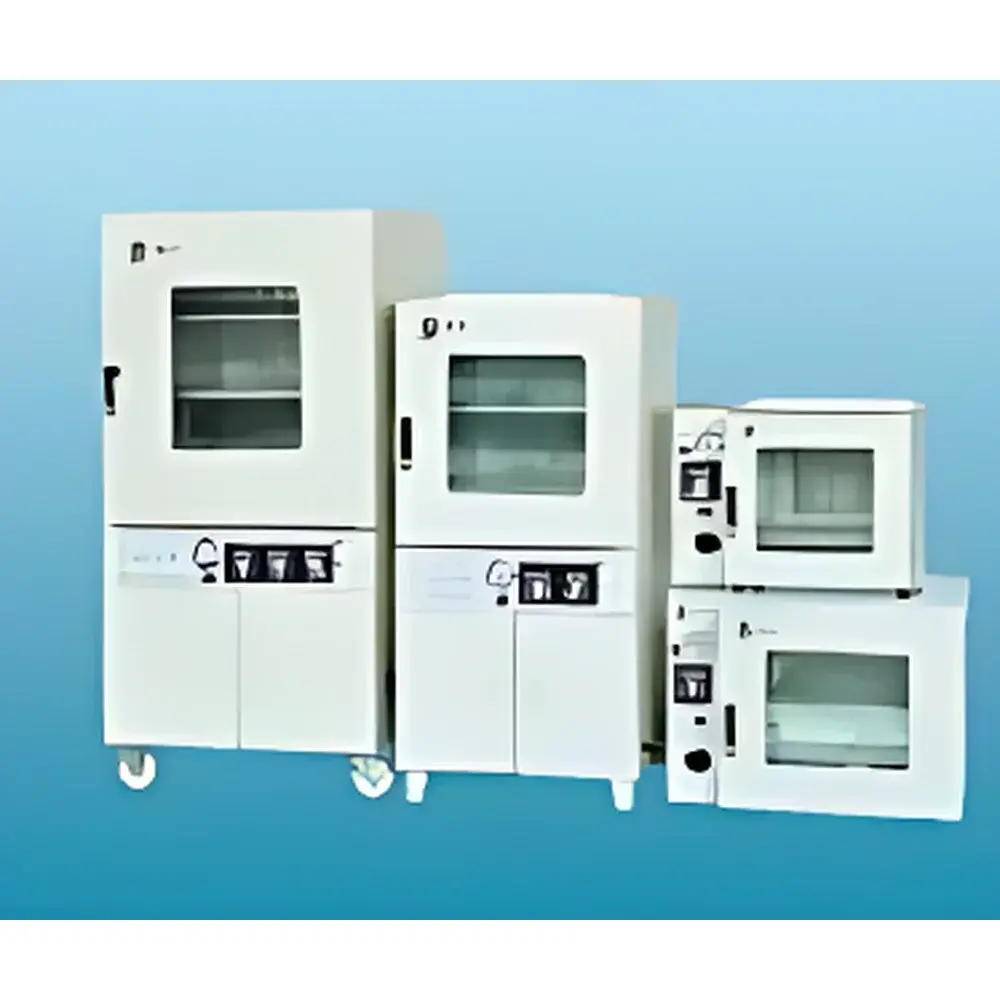
JingHong DZF-6020TG / DZF-6020TH Vacuum Drying Oven
| Brand | JingHong |
|---|---|
| Origin | Shanghai, China |
| Model | DZF-6020TG (DZF-6020), DZF-6020TH |
| Temperature Range | RT+10°C to 200°C |
| Temperature Uniformity | ±1°C |
| Temperature Resolution | 0.1°C |
| Vacuum Level | <133 Pa |
| Interior Dimensions | 300 × 300 × 275 mm |
| Exterior Dimensions | 580 × 420 × 450 mm |
| Interior Material | Stainless Steel (1Cr18Ni9Ti) |
| Heating Method | Forced Air Circulation |
| Operating Ambient Temperature | 5–40°C |
| Power Supply | AC 220 V, 50 Hz |
Overview
The JingHong DZF-6020TG and DZF-6020TH are benchtop vacuum drying ovens engineered for precision thermal processing under reduced-pressure conditions. These instruments operate on the fundamental principle of lowering the boiling point of solvents and moisture via vacuum application—enabling gentle, low-temperature drying of heat-sensitive, hygroscopic, or oxidation-prone samples. Unlike conventional convection ovens, vacuum drying minimizes thermal degradation, prevents surface hardening, and eliminates oxidative side reactions—making them indispensable in pharmaceutical stability studies, polymer dehydration, powder metallurgy pre-sintering, electronic component moisture removal, and analytical sample preparation prior to gravimetric or chromatographic analysis. The DZF-6020 series is designed for consistent performance across academic research labs, QC/QA departments in regulated manufacturing, and R&D facilities requiring repeatable, traceable drying protocols compliant with ISO 17025 and GLP environments.
Key Features
- Stainless steel (1Cr18Ni9Ti) interior chamber ensures corrosion resistance, easy cleaning, and long-term dimensional stability under repeated thermal cycling and vacuum stress.
- Double-layer tempered glass observation door with adjustable silicone rubber gasket provides clear visual monitoring while maintaining vacuum integrity up to <133 Pa.
- Microprocessor-based PID temperature controller with dual digital display (setpoint & actual temperature) enables precise setpoint programming, auto-tuning, and stable regulation within ±1°C uniformity across the working volume.
- Adjustable heating power ratio allows fine-grained thermal control at low setpoints (e.g., 40–60°C), eliminating overshoot and improving reproducibility for delicate biological or organic materials.
- Forced air circulation system enhances temperature homogeneity and accelerates moisture vapor transport toward the vacuum port without introducing turbulence-induced sample displacement.
- Front-panel mechanical vacuum gauge offers real-time analog pressure monitoring; compatible with external vacuum pumps (e.g., 2XZ-4 rotary vane pump, optional or user-supplied) for rapid evacuation and stable vacuum hold.
Sample Compatibility & Compliance
The DZF-6020TG/TH accommodates a broad range of sample formats—including Petri dishes, weighing boats, crucibles, glass vials, and custom trays—within its 24.6 L internal volume (300 × 300 × 275 mm). Its inert stainless steel chamber and absence of airflow-driven particulate generation make it suitable for ASTM E145-22 Class III drying applications and USP moisture determination procedures. The unit meets general safety requirements per IEC 61010-1 for laboratory electrical equipment. While not certified for FDA 21 CFR Part 11 out-of-the-box, its analog controls and manual operation support audit-ready documentation when integrated into validated workflows with external loggers and SOP-controlled vacuum pump operation.
Software & Data Management
This model operates via embedded hardware control without proprietary software dependency. All operational parameters—including set temperature, dwell time, and vacuum status—are manually configured and visually verified. For regulatory environments, users may integrate external data loggers (e.g., calibrated thermocouple arrays + pressure transducers) connected to PC-based acquisition platforms supporting CSV export and timestamped audit trails. Optional RS-485 interface modules (available as field upgrades) enable Modbus RTU communication for centralized lab equipment monitoring systems aligned with ISO/IEC 17025 Clause 7.7 requirements on measurement traceability.
Applications
- Pharmaceutical: Residual solvent removal from active pharmaceutical ingredients (APIs) and excipients prior to tablet compression or lyophilization cycle development.
- Materials Science: Dehydration of metal-organic frameworks (MOFs), ceramic precursors, and battery electrode slurries without structural collapse.
- Food & Agriculture: Moisture content determination in spices, herbs, and dairy powders per AOAC 950.46 methodology.
- Electronics: Degassing of conformal coatings and encapsulants to prevent void formation during curing.
- Academic Research: Solvent exchange in aerogel synthesis, polymer film annealing under inert vacuum, and catalyst activation protocols.
FAQ
What vacuum level can the DZF-6020TG/TH achieve?
The chamber maintains a base pressure of <133 Pa when paired with a compatible rotary vane vacuum pump such as the 2XZ-4 (not included by default on all configurations). Actual performance depends on pump capacity, seal integrity, and load outgassing rate.
Is the temperature uniformity validated across the entire chamber?
Yes—calibration data per manufacturer specifications confirms ±1°C deviation at steady state under no-load conditions at 105°C, measured at nine standardized points (per ISO 17025 Annex A.3 guidelines for oven qualification).
Can this oven be used for nitrogen-purged drying?
While not equipped with gas inlet ports, the chamber may be backfilled with inert gas after vacuum evacuation using an external needle valve and regulated supply—common practice for oxygen-sensitive applications.
Does the unit include a vacuum pump?
The DZF-6020TG and DZF-6020TH are sold as oven-only units. A 2XZ-4 vacuum pump is listed as optional or configurable upon order, depending on regional distribution agreements.
How is temperature calibration performed?
The PID controller supports offset calibration via front-panel menu. For metrological traceability, users perform periodic verification using NIST-traceable PT100 probes placed at defined chamber locations, documenting results in accordance with internal quality management system requirements.



