
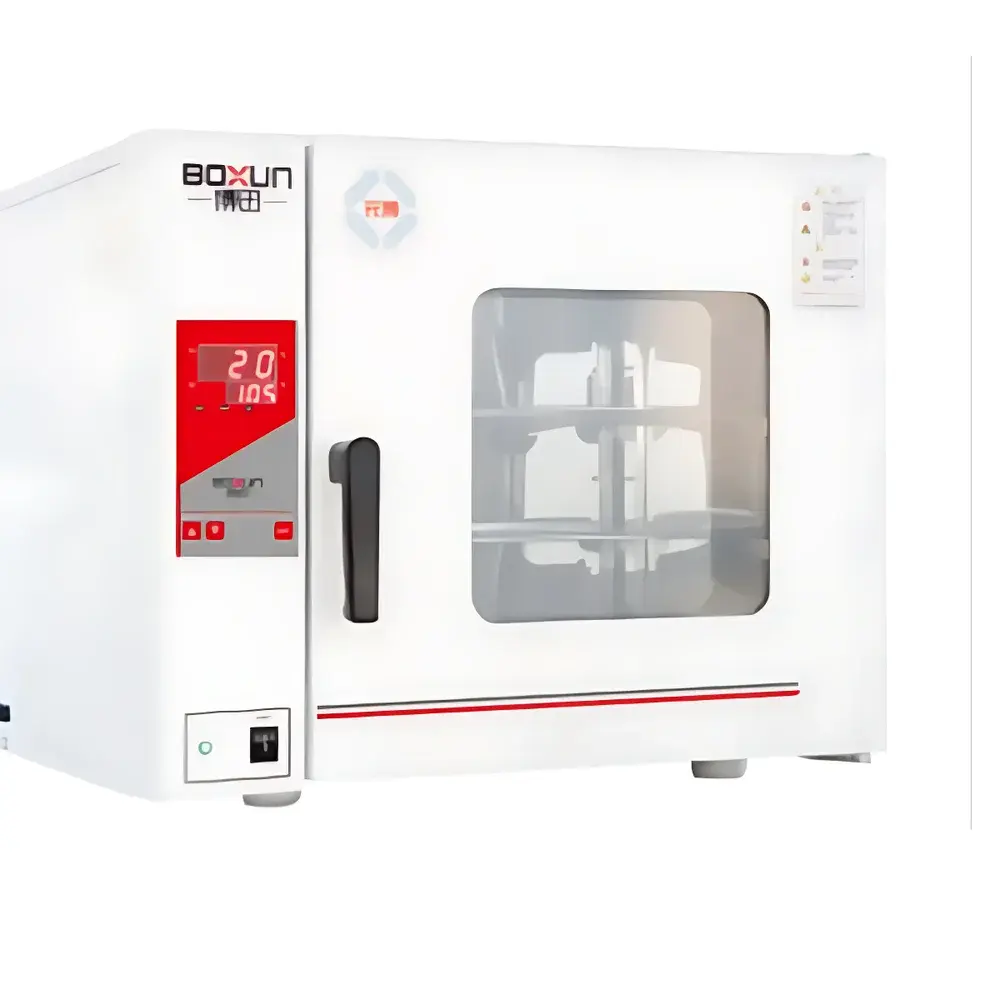
BOXUN GZX-9140MBE Forced-Air Drying Oven
| Brand | BOXUN |
|---|---|
| Origin | Shanghai, China |
| Model | GZX-9140MBE |
| Temperature Range | Ambient +5°C to 200°C |
| Temperature Uniformity | ±2.5% |
| Temperature Fluctuation | ±1°C (at 105°C) |
| Interior Dimensions (W×D×H) | 550 × 470 × 550 mm |
| Exterior Dimensions (W×D×H) | 840 × 696 × 705 mm |
| Interior Material | Mirror-Finish Stainless Steel |
| Heating Method | Forced-Air Convection with Imported Motor & Impeller |
| Control System | Microprocessor-Based PID Controller with Dual LED Display, Timer (0–999 h), Over-Temperature Alarm, and Power-Failure Data Retention |
| Resolution | 1°C |
| Operating Ambient Temperature | 5–40°C |
| Standard Shelving | 3 adjustable shelves (max. 7), 15 kg capacity per shelf |
| Input Power | 1750 W |
| Compliance | Designed for GLP-compliant laboratories |
Overview
The BOXUN GZX-9140MBE Forced-Air Drying Oven is a precision-engineered laboratory drying system designed for routine thermal processing tasks including moisture removal, sample conditioning, polymer curing, powder drying, and low-temperature sterilization of heat-stable instruments. It operates on the principle of forced convection—using a high-efficiency imported motor-driven blower to circulate heated air uniformly throughout the chamber—ensuring consistent thermal exposure across all load positions. Unlike natural convection ovens, this model maintains tight temperature uniformity (±2.5%) and minimal fluctuation (±1°C at 105°C), making it suitable for applications where reproducibility and traceability are critical, such as QC testing in pharmaceutical, chemical, food, and materials science laboratories. Its microprocessor-based control architecture supports stable setpoint maintenance across the full operating range (ambient +5°C to 200°C), with real-time monitoring and programmable timing functions essential for unattended operation.
Key Features
- Microprocessor-controlled PID temperature regulation with dual high-brightness LED display for simultaneous setpoint and actual temperature readout
- Intelligent power-failure recovery: automatically resumes previous settings—including timer status and temperature setpoint—after interruption
- Mirror-finish stainless steel interior chamber (550 × 470 × 550 mm) with rounded corners for ease of cleaning and resistance to corrosion
- Optimized airflow design featuring an imported centrifugal fan and multi-directional ducting to minimize thermal gradients
- Three standard adjustable stainless steel shelves (expandable up to seven), each rated for 15 kg loading capacity
- Large-view tempered glass observation window with nano-composite door seal for enhanced thermal insulation and visual monitoring
- Cold-rolled steel exterior with electrostatic epoxy-polyester coating for mechanical durability and chemical resistance
- Over-temperature cut-off protection with independent safety thermostat to prevent thermal runaway
Sample Compatibility & Compliance
The GZX-9140MBE accommodates a broad spectrum of sample types—including Petri dishes, weighing boats, glassware, metal trays, and polymer substrates—without risk of cross-contamination or surface degradation, thanks to its inert stainless steel chamber and absence of catalytic surfaces. It complies with foundational thermal equipment standards referenced in ISO 17025:2017 (Clause 6.4.2 on environmental condition control) and supports validation protocols aligned with ASTM E2296 (Standard Guide for Validation of Thermal Processing Equipment). While not certified for medical device sterilization under ISO 17665, it fulfills general-purpose dry-heat decontamination requirements per USP for non-critical instrumentation. The unit’s stable thermal profile enables routine use in GLP-regulated environments when paired with external calibration records and periodic performance qualification (PQ) per IQ/OQ protocols.
Software & Data Management
This model does not include embedded data logging or PC connectivity as standard. However, its robust analog-digital hybrid control system ensures deterministic behavior under variable line voltage (AC 220 V ±10%, 50 Hz ±2%), supporting integration into lab-wide power management systems. For audit-ready documentation, users may pair the oven with external calibrated thermocouple loggers (e.g., compliant with NIST-traceable Class I accuracy) and record temperature profiles during PQ runs. All operational parameters—including elapsed time, active setpoint, and alarm events—are retained in volatile memory with battery-backed retention, satisfying basic FDA 21 CFR Part 11 expectations for electronic record integrity when used in conjunction with documented SOPs.
Applications
- Moisture content determination per AOAC 950.46 and ASTM D2231 for agricultural, pharmaceutical, and polymer samples
- Drying of filter papers, crucibles, and desiccants prior to gravimetric analysis
- Curing of coatings, adhesives, and composite prepregs in R&D labs
- Conditioning of hygroscopic reference standards before calibration
- Low-temperature depyrogenation of glassware and stainless steel tools (≥160°C for ≥2 hours)
- Preheating of samples prior to TGA, DSC, or XRD analysis to eliminate ambient humidity artifacts
FAQ
What is the maximum recommended operating temperature for continuous use?
The GZX-9140MBE is rated for sustained operation up to 200°C; however, prolonged use above 180°C may accelerate aging of door gaskets and reduce long-term uniformity stability.
Can this oven be validated for ISO/IEC 17025 compliance?
Yes—its thermal performance characteristics support IQ/OQ/PQ execution using third-party calibrated sensors and documented test protocols per ISO/IEC 17025:2017 Annex A.3.
Is the interior volume sufficient for standard ISO drying trays?
With an internal volume of ~142 L and floor dimensions of 550 × 470 mm, it accommodates two ISO 6781-2 drying trays (300 × 300 mm) side-by-side with adequate airflow clearance.
Does the unit meet CE or UL safety certification requirements?
It conforms to GB/T 15470–2002 (Chinese national standard for electric heating ovens) and carries CCC certification; CE marking is not applicable as it is manufactured for domestic and export markets without EU-specific conformity assessment.
How often should temperature uniformity be verified?
Per ISO/IEC 17025 guidance, uniformity verification should occur at installation, after major maintenance, and at least annually—or more frequently if used for regulated testing—using a minimum of nine-point sensor mapping per ASTM E2296.



