
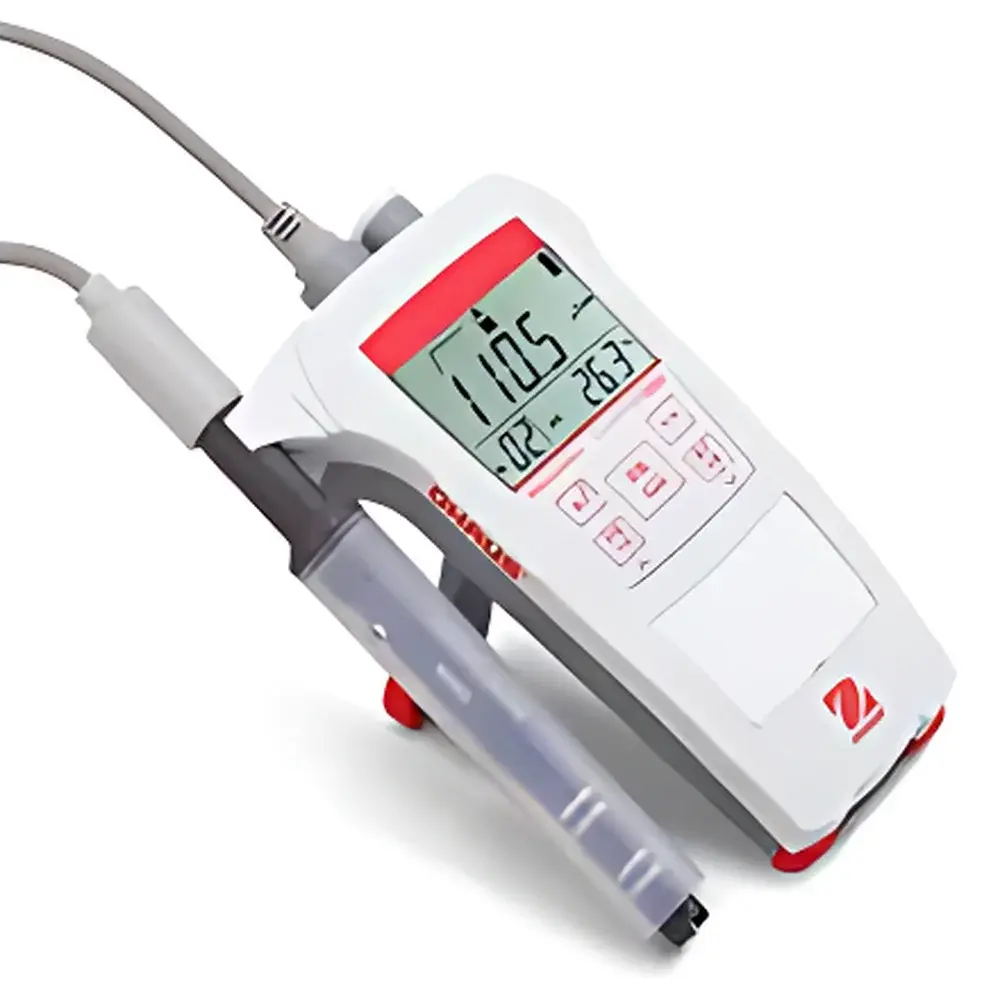
OHAUS STARTER 300C Portable Conductivity Meter
| Brand | OHAUS |
|---|---|
| Origin | USA |
| Model | STARTER 300C (ST300C) |
| Portability | Portable |
| Application Environment | Laboratory |
| Conductivity Range | 0.00 µS/cm to 199.9 mS/cm |
| TDS Range | 0.1 mg/L to 199.9 g/L |
| Temperature Range | 0 °C to 100 °C |
| Accuracy | ±0.5% F.S. |
| Minimum Conductivity Resolution | 0.01 µS/cm |
| Temperature Resolution | 0.1 °C |
| Power Supply | 4 × AAA batteries |
| Battery Life | Up to 250 hours |
| Dimensions (H×L×W) | 33 mm × 170 mm × 90 mm |
| Net Weight | 0.16 kg |
| Auto-Off Delay | 10 minutes |
| Temperature Compensation | Automatic, adjustable β coefficient (0.0–10.0 %/°C) |
| Sensor Type | Integrated 30 kΩ NTC thermistor |
| Operating Environment | 5 °C to 40 °C, ≤80% RH (non-condensing) |
Overview
The OHAUS STARTER 300C Portable Conductivity Meter is an engineered solution for field-deployable and benchtop conductivity and total dissolved solids (TDS) measurements in quality control, environmental monitoring, education, and routine laboratory applications. Based on the principle of two-electrode or four-electrode conductometric measurement—depending on cell configuration—the instrument determines solution conductivity by applying an alternating current across a calibrated electrode and measuring the resulting voltage drop. Conductivity values are automatically temperature-compensated using a built-in 30 kΩ NTC thermistor, with user-adjustable compensation coefficients (β = 0.0–10.0 %/°C) to accommodate diverse sample chemistries including high-ionic-strength brines, ultrapure water, and wastewater effluents. Its compact form factor, ergonomic grip, and integrated stand/wrist strap enable reliable single-hand operation in both controlled lab settings and variable outdoor conditions.
Key Features
- True portable architecture: lightweight (0.16 kg), palm-sized housing (33 × 170 × 90 mm) with textured anti-slip surface and recessed keypad for tactile feedback under gloves or wet conditions.
- Four-ring conductivity probe included as standard—eliminates need for multiple two-ring cells across conductivity ranges; supports direct measurement from ultra-low (0.00 µS/cm) to high-conductivity (199.9 mS/cm) samples without manual range switching.
- Intuitive LCD interface with contextual icons and real-time status indicators—including battery level, measurement stability flag, and auto-endpoint confirmation—reducing operator training time and interpretation error.
- Programmable automatic temperature compensation (ATC) with adjustable β coefficient ensures traceable accuracy across non-linear thermal response profiles typical of industrial process streams and natural waters.
- Energy-efficient design: powered by four standard AAA alkaline batteries delivering up to 250 hours of continuous operation; auto-power-off after 10 minutes of inactivity preserves battery integrity and supports GLP-compliant usage logs.
- Robust mechanical construction compliant with IP65-rated ingress protection against dust and low-pressure water jets—suitable for humid environments and transport between sampling sites.
Sample Compatibility & Compliance
The STARTER 300C is validated for aqueous solutions across pH 2–12 and conductivity ranges spanning deionized water (≤0.1 µS/cm) to saturated NaCl brines (>150 mS/cm). It meets general-purpose metrological requirements per ISO 8665:2021 (water quality — determination of electrical conductivity) and aligns with ASTM D1125-22 (Standard Test Methods for Electrical Conductivity and Resistivity of Water). While not certified for regulated GMP manufacturing environments, its stable calibration retention, documented temperature compensation algorithm, and audit-ready auto-off behavior support documentation workflows required under GLP and ISO/IEC 17025-accredited laboratories. Calibration verification is performed using traceable NIST-traceable KCl standards (e.g., 1413 µS/cm, 12.88 mS/cm).
Software & Data Management
The STARTER 300C operates as a standalone instrument with no embedded data logging or PC connectivity. All measurement data remain on-device only during active use; results are not stored upon power-down. This architecture ensures electromagnetic compatibility in electrically noisy field environments and eliminates cybersecurity concerns associated with networked instrumentation. For regulatory traceability, users are advised to manually record readings alongside calibration dates, standard IDs, and environmental conditions in bound lab notebooks or LIMS-integrated electronic records. The device supports dual-unit display (µS/cm/mS/cm and mg/L/g/L) and allows TDS conversion factors (0.4–1.0) to be set per application—enabling consistency with USP , EPA Method 120.1, and local regulatory frameworks.
Applications
- Environmental field testing: river, lake, and groundwater conductivity profiling for salinity assessment and pollution source identification.
- Pharmaceutical water system monitoring: periodic checks of purified water (PW) and water for injection (WFI) conductivity per USP Stage 1 and Stage 2 limits.
- Educational laboratories: hands-on instruction in electrochemistry fundamentals, colligative properties, and sensor calibration methodology.
- Aquaculture and hydroponics management: real-time tracking of nutrient solution ionic strength to optimize plant growth or fish health parameters.
- Industrial cooling water and boiler feedwater analysis: rapid screening for scaling potential and corrosion risk indicators.
- Food & beverage QC: verification of rinse water purity, brine concentration in pickling operations, and post-CIP conductivity validation.
FAQ
Does the STARTER 300C support GLP-compliant calibration documentation?
No—it lacks timestamped calibration memory or export functionality. Users must maintain external calibration records referencing date, standard used, and measured deviation.
Can the included electrode be used for high-temperature measurements above 50 °C?
The probe is rated for continuous use up to 60 °C; extended exposure above this threshold may accelerate electrode drift and reduce lifespan.
Is the TDS conversion factor fixed or adjustable?
It is fully adjustable (0.40–1.00) to match ion composition assumptions—critical when measuring seawater, fertilizer solutions, or wastewater with unknown anion/cation ratios.
What is the recommended calibration frequency for routine QC use?
Daily calibration is advised before first use; additional verification is required after electrode cleaning, temperature shifts >5 °C, or when measuring samples outside the 0.1–20 mS/cm range.
Does the meter comply with FDA 21 CFR Part 11 requirements?
No—lack of electronic signature capability, audit trail, and secure data storage precludes Part 11 compliance. It is intended for non-GxP supporting roles only.
Related Products





