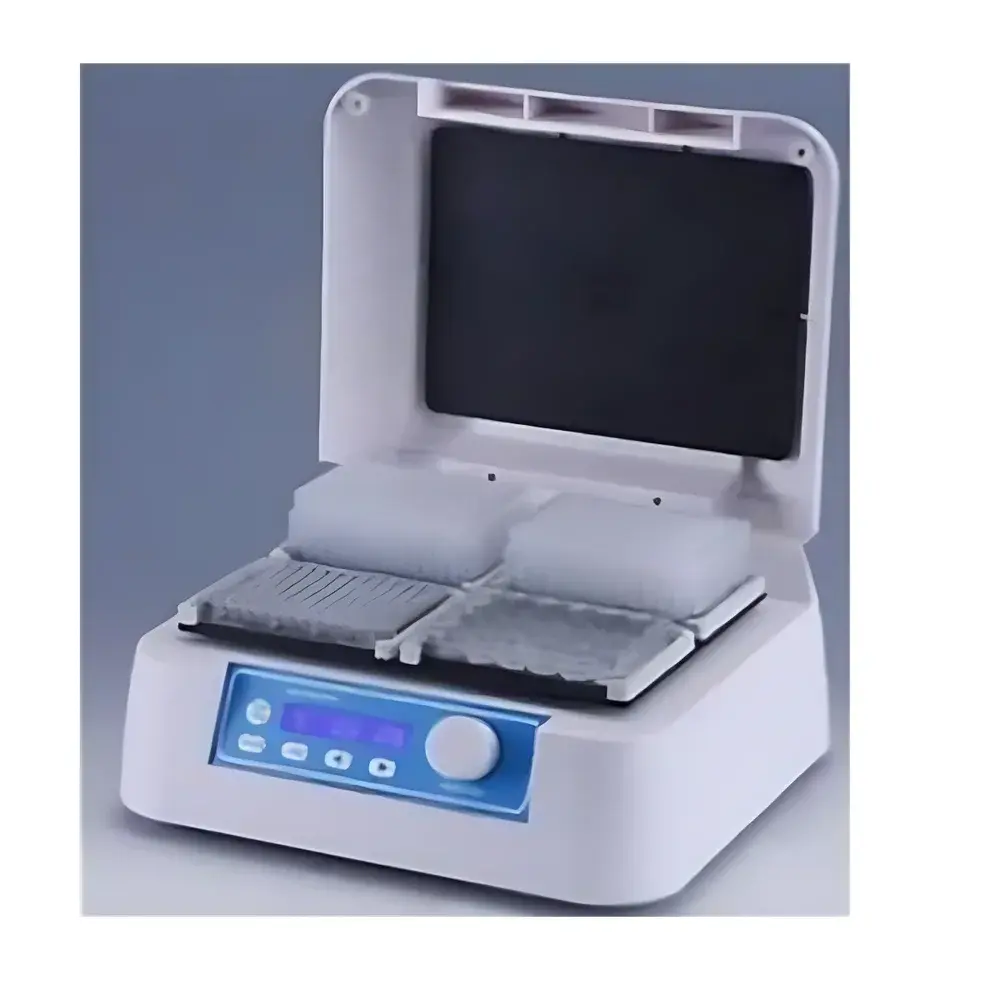
ZiQi ZQMO-4 Microplate Shaker Incubator
| Brand | ZiQi |
|---|---|
| Origin | Shanghai, China |
| Manufacturer Type | Direct Manufacturer |
| Model | ZQMO-4 |
| Display Type | Digital Control Panel |
| Function | Temperature-Controlled Oscillation |
| Speed Range | 200–1350 rpm |
| Orbit Diameter | 3 mm |
| Sample Capacity | Up to 4 standard microplates (e.g., 96-well, 384-well) or deep-well plates |
| Operating Time | 1 min – 99 h 59 min |
| Temperature Range | Ambient +5°C to 80°C |
| Temperature Accuracy | ≤ ±0.5°C |
| Temperature Uniformity | ≤ ±0.5°C |
| Heating Time | ≤15 min (from ambient to 80°C) |
| Power Supply | AC 220 V, 50–60 Hz, 300 W |
| Dimensions (W×D×H) | 340 × 320 × 200 mm |
| Weight | 11 kg |
Overview
The ZiQi ZQMO-4 Microplate Shaker Incubator is an integrated benchtop instrument engineered for precise temperature-controlled orbital shaking of microplates in life science laboratories. Combining PID-based thermal regulation with digitally adjustable rotational oscillation, it enables reproducible incubation and mixing of biological samples under tightly controlled thermal and mechanical conditions. Its core operational principle relies on horizontal circular motion (3 mm orbit diameter) synchronized with uniform conductive heating across the plate platform—ideal for applications requiring both thermal stability and homogeneous agitation, such as antigen-antibody binding kinetics, ELISA development, cell-based assays, and nucleic acid hybridization protocols. Designed for compatibility with ANSI/SLAS-standard microplates—including 96-well, 384-well, 24-well, and deep-well formats—the ZQMO-4 supports parallel processing of up to four plates simultaneously without cross-contamination risk or mechanical interference.
Key Features
- Digital PID temperature control with real-time feedback loop ensures stable thermal environment; accuracy maintained within ±0.5°C across the entire working range (ambient +5°C to 80°C).
- Orbital shaking mechanism delivers consistent 3 mm horizontal rotation at programmable speeds from 200 to 1350 rpm (10 rpm increments), minimizing shear stress while maximizing solution homogeneity.
- Integrated thermal lid design reduces evaporation during extended incubations and supports automatic pre-heating functionality to minimize ramp time.
- Dual-layer safety architecture includes hardware-based overtemperature cutoff and software-monitored thermal fail-safes, compliant with IEC 61010-1 laboratory equipment safety standards.
- User interface displays simultaneous real-time values for setpoint/actual temperature, elapsed/run time, and current oscillation speed—enabling full experimental traceability without external logging.
- Power-loss recovery function automatically resumes operation at the previously configured parameters following unexpected power interruption, preserving assay integrity.
- Compact footprint (340 × 320 × 200 mm) and low acoustic emission (<55 dB(A)) support integration into laminar flow hoods, biosafety cabinets, and shared core facilities.
Sample Compatibility & Compliance
The ZQMO-4 accommodates standard microplate formats conforming to ANSI SLAS-1–2017 dimensions, including 96-well flat-bottom, U/V-bottom, and 384-well plates, as well as 24-, 48-, and 96-well cell culture plates and deep-well storage plates (up to 2 mL capacity). All plate-holding fixtures are non-magnetic stainless steel with anti-slip silicone inserts to prevent lateral displacement during high-speed shaking. The device meets CE marking requirements for electromagnetic compatibility (EN 61326-1) and electrical safety (EN 61010-1). While not certified for GLP/GMP environments out-of-the-box, its audit-ready parameter logging, calibration traceability (via built-in temperature offset adjustment), and configurable alarm outputs support validation per ISO/IEC 17025 and FDA 21 CFR Part 11 when deployed with validated SOPs.
Software & Data Management
The ZQMO-4 operates via an embedded microcontroller with non-volatile memory storing up to 10 user-defined protocols. Each protocol retains independent settings for temperature setpoint, oscillation speed, duration, and auto-start delay. Although no PC connectivity or remote control interface is provided, all operational data—including start time, end time, peak temperature deviation, and cumulative run hours—is retained in internal event logs accessible via front-panel navigation. Temperature calibration can be performed using NIST-traceable reference thermometers, and the system supports user-initiated offset correction to maintain long-term accuracy. Audit trail capabilities include timestamped records of parameter changes and alarm events, supporting documentation requirements for quality assurance workflows.
Applications
- ELISA and immunoassay plate washing and incubation steps requiring uniform agitation and thermal consistency.
- Cell-based assays involving adherent or suspension cultures where gentle mixing enhances nutrient/gas exchange without compromising viability.
- Molecular biology workflows including PCR plate pre-incubation, probe hybridization, and enzymatic reaction optimization (e.g., kinase assays, ligase cycling).
- Drug discovery screening platforms utilizing multi-plate kinetic readouts under controlled thermal profiles.
- Quality control testing of diagnostic reagents where batch-to-batch reproducibility depends on standardized shaking and incubation parameters.
- Academic research in virology, immunology, and stem cell biology where precise environmental control directly impacts assay sensitivity and dynamic range.
FAQ
What microplate formats are supported by the ZQMO-4?
Standard ANSI/SLAS-compliant plates including 96-well, 384-well, 24-well, 48-well, and deep-well formats—up to four plates simultaneously.
Does the ZQMO-4 support programming multiple sequential steps (e.g., ramp-and-hold temperature profiles)?
No—it executes single-step temperature and speed protocols only; multi-stage thermal profiles require external scheduling or manual intervention.
Is temperature calibration traceable to international standards?
Yes—users may perform offset calibration using NIST-traceable reference thermometers, and the system stores calibration history in non-volatile memory.
Can the ZQMO-4 be used inside a CO₂ incubator or cold room?
It is rated for ambient operation between 15°C and 30°C; use outside this range may affect thermal accuracy and is not recommended without environmental validation.
What safety certifications does the ZQMO-4 hold?
CE-marked per EN 61010-1 (safety) and EN 61326-1 (EMC); no UL or CSA certification is included.