
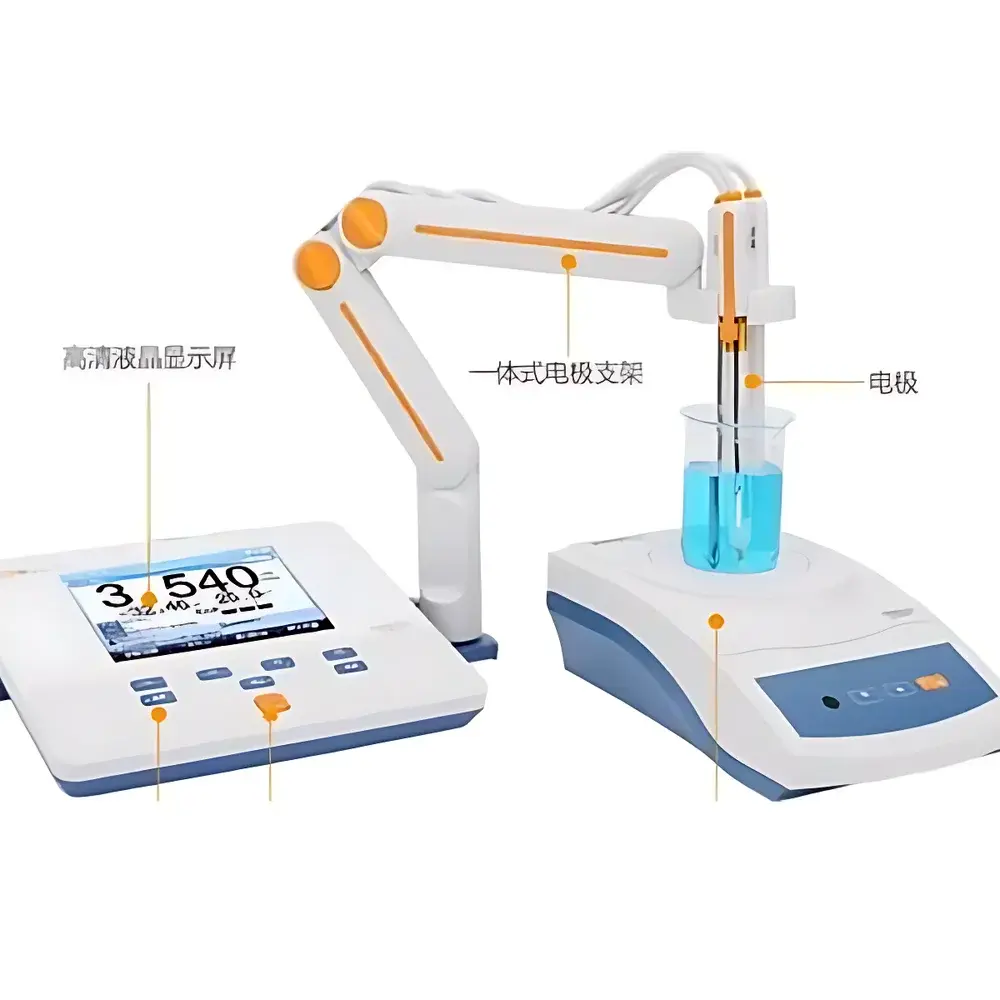
Leici PXSJ-216F Ion Meter
| Key | Brand: Leici |
|---|---|
| Model | PXSJ-216F |
| Accuracy Class | 0.001 |
| mV Range | (−2000.00 to +2000.00) mV |
| mV Resolution | 0.01 mV |
| pH Range | (−2.000 to 20.000) pH |
| pH Resolution | 0.001 pH |
| pX Range | (−2.000 to 20.000) pX |
| pX Resolution | 0.001 pX |
| Ion Concentration Range | 0–19990 (units: mol/L, mmol/L, g/L, mg/L, µg/L) |
| Temp Range | −10.0 to 135.0 °C |
| Temp Resolution | 0.1 °C |
| Temp Accuracy | ±0.1 °C |
| Interface | RS-232, USB |
| Data Storage | 500 datasets |
| IP Rating | IP54 |
| Dimensions | 242 × 195 × 68 mm |
| Weight | 0.9 kg |
Overview
The Leici PXSJ-216F Ion Meter is a high-precision electrochemical analyzer engineered for laboratory and quality control environments requiring accurate, traceable ion activity and concentration measurements. Based on potentiometric measurement principles—utilizing ion-selective electrodes (ISEs) in conjunction with reference electrodes—the instrument determines ion activity via the Nernst equation, enabling quantitative analysis of monovalent and multivalent ions including F−, Cl−, Na+, K+, NH4+, and others. Its 0.001-class accuracy complies with international metrological standards for analytical instrumentation, supporting rigorous method validation under GLP and GMP frameworks. Designed for reproducibility across routine and research-grade applications, the PXSJ-216F integrates temperature-compensated electrode response modeling, automatic endpoint detection, and multi-point calibration protocols to minimize operator-dependent variability.
Key Features
- High-resolution color LCD display with three selectable resolution modes: 0.001/0.01/0.1 pX and 0.01/0.1/1 mV, optimized for both fine-tuning and rapid screening
- Comprehensive temperature compensation: manual or automatic (via integrated Pt1000 or thermistor probe), with dual-unit support (°C/°F) and ±0.1 °C accuracy
- Multi-mode ion quantification: direct concentration reading, standard addition, sample addition, and Gran plot analysis—enabling robust determination in complex matrices
- Advanced calibration architecture: supports 1–5 point pH calibration with auto-recognition of GB, DIN, NIST, and USA buffer sets; allows user-defined buffers and custom calibration groups
- IP54-rated enclosure ensures resistance to dust ingress and incidental water splashes, suitable for shared lab benches and production-floor QC stations
- Built-in data integrity safeguards: power-failure recovery, factory reset, boot-time self-diagnosis, and firmware upgradability via USB for long-term functional extensibility
Sample Compatibility & Compliance
The PXSJ-216F accommodates aqueous and low-viscosity non-aqueous samples compatible with standard ISEs and combination electrodes. It ships with a fluorine-selective electrode, Ag/AgCl double-junction reference electrode, and temperature sensor—validated for use in environmental water testing (e.g., EPA Method 300.0), pharmaceutical excipient analysis, food safety monitoring (e.g., salt content, nitrate), and industrial process control. All measurement data adhere to Good Laboratory Practice (GLP) requirements: each record includes timestamp, electrode ID, calibration history, temperature, and operator annotation. Audit trails are preserved locally and exportable, satisfying documentation needs for ISO/IEC 17025-accredited labs and FDA-regulated environments operating under 21 CFR Part 11 guidelines for electronic records.
Software & Data Management
- Local storage of up to 500 complete measurement datasets—including raw mV, calculated pX/pH, concentration values, temperature, and calibration metadata
- RS-232 interface enables direct connection to serial printers (e.g., Epson TM-U220) with configurable print formats: minimal report, full calibration log, or GLP-compliant certificate
- USB port facilitates bidirectional communication with Windows-based PCs using Leici’s dedicated communication software, supporting batch export to CSV or Excel for statistical analysis and LIMS integration
- Data review, selective deletion, and chronological sorting are accessible directly from the front panel—no external software required for routine QA/QC verification
Applications
The PXSJ-216F serves critical roles in regulated and research settings where ion-specific quantification is essential. Typical use cases include fluoride monitoring in drinking water per WHO and EU Directive 98/83/EC; chloride determination in concrete admixtures (ASTM C1157); ammonium quantification in wastewater effluent (ISO 7150-1); sodium and potassium profiling in clinical serum standards; and nitrate/nitrite analysis in agricultural runoff. Its GRAN plot functionality supports precise equivalence point detection in titration-like ISE assays, while the standard addition method compensates for ionic strength effects in high-salinity samples such as seawater or brine solutions.
FAQ
What ion-selective electrodes are compatible with the PXSJ-216F?
The meter supports all commercially available potentiometric ISEs with BNC or DIN connectors and output impedances ≤1012 Ω, including single- and double-junction reference electrodes.
Does the instrument meet regulatory requirements for audit trail generation?
Yes—each stored measurement includes immutable timestamps, electrode identification, calibration parameters, ambient temperature, and user-defined notes, fulfilling core GLP and 21 CFR Part 11 data integrity criteria.
Can the PXSJ-216F perform automatic temperature compensation without an external probe?
No—automatic temperature compensation requires connection of the supplied Pt1000 or thermistor temperature electrode; manual entry is supported if probe integration is unavailable.
Is firmware update capability field-accessible?
Yes—updates are delivered via USB flash drive using Leici’s official firmware package and require no service technician intervention.
What is the maximum measurable ion concentration in mol/L mode?
The instrument displays up to 19990 units in any selected concentration format; actual upper detection limit depends on electrode selectivity, slope stability, and sample matrix interference—not instrument electronics alone.
Related Products





