
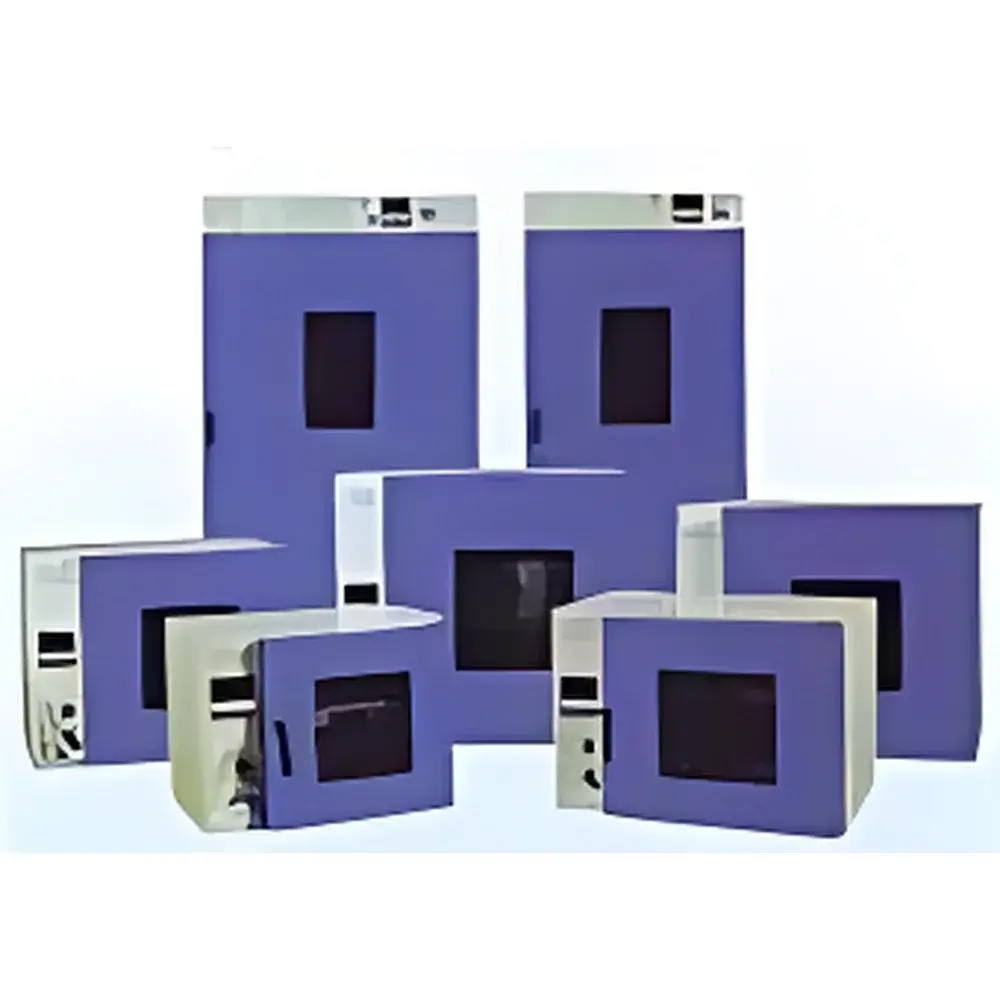
Yiheng DHG-9240A Forced-Air Drying Oven
| Brand | Yiheng |
|---|---|
| Origin | Shanghai, China |
| Model | DHG-9240A |
| Temperature Range | RT+10°C to 200°C / RT+10°C to 250°C |
| Temperature Uniformity | ±3% (at 100°C) |
| Temperature Fluctuation | ±1.0°C |
| Temperature Resolution | 0.1°C |
| Chamber Dimensions (W×D×H) | 600×500×750 mm |
| External Dimensions (W×D×H) | 880×630×930 mm |
| Inner Chamber Material | Mirror-Finish Stainless Steel |
| Heating Method | Forced-Air Circulation |
| Operating Ambient Temperature | +5°C to +40°C |
| Power Supply | AC 220 V, 50 Hz |
| Rated Power | 2450 W |
| Standard Shelving | 4 Adjustable Stainless Steel Trays |
| Timer Range | 1–9999 minutes |
Overview
The Yiheng DHG-9240A Forced-Air Drying Oven is a precision-engineered laboratory drying system designed for consistent thermal processing of samples in research, quality control, and production environments. Utilizing forced-air convection heating—where a high-temperature-rated centrifugal blower circulates heated air through calibrated ducts—the oven ensures rapid heat-up times and stable thermal distribution across its 220 L working chamber. Its operational temperature range extends from ambient +10°C up to 250°C (selectable configuration), supporting applications such as moisture loss determination, pre-weighing sample conditioning, polymer curing, glassware sterilization, and residual solvent removal. The unit complies with fundamental safety and performance expectations outlined in IEC 61010-1 (Safety Requirements for Electrical Equipment for Measurement, Control, and Laboratory Use) and aligns with general Good Laboratory Practice (GLP) infrastructure requirements for traceable, repeatable thermal treatment.
Key Features
- Mirror-finish stainless steel inner chamber (A-series specification) fabricated via argon arc welding—resistant to corrosion, easy to clean, and compliant with ISO 14644-1 Class 8 cleanroom-compatible surface standards.
- Microprocessor-based P.I.D. temperature controller with digital display, offering 0.1°C resolution, ±1.0°C fluctuation tolerance, and programmable timer (1–9999 min) for unattended operation.
- Independent over-temperature protection circuit—hardware-based limit switch that cuts power when user-defined threshold is exceeded, satisfying EN 60519-1 requirements for thermal process safety.
- Adjustable air inlet and exhaust dampers on the front control panel enable fine-tuning of internal airflow dynamics to accommodate varying sample loads and evaporation rates.
- High-efficiency silicone rubber door gasket rated for continuous operation at 250°C, ensuring long service life and minimal heat leakage (tested per ASTM E145 Annex A3).
- Four-tier adjustable stainless steel shelving system included as standard; load capacity per shelf: ≤15 kg (evenly distributed).
Sample Compatibility & Compliance
The DHG-9240A accommodates a broad spectrum of non-volatile, thermally stable materials—including metal parts, ceramic substrates, pharmaceutical excipients, soil specimens, filter papers, and polymer pellets—within its validated uniformity envelope (±3% deviation at 100°C, per DIN 12880 methodology). It is not intended for flammable solvents, biological cultures requiring sterile containment, or pyrophoric substances. While not certified for explosion-proof use, optional RS485 interface enables integration into centralized facility monitoring systems compliant with FDA 21 CFR Part 11 data integrity protocols when paired with validated third-party SCADA software. All electrical components meet CE marking directives (EMC Directive 2014/30/EU and Low Voltage Directive 2014/35/EU).
Software & Data Management
The base configuration includes local parameter logging via the onboard controller’s real-time display and manual timestamped recording. Optional accessories expand digital functionality: an embedded thermal printer provides hard-copy audit trails of setpoint, actual temperature, and elapsed time; the RS485 port supports Modbus RTU protocol for bidirectional communication with LabVIEW™, MATLAB®, or custom LIMS platforms. When used with compliant data acquisition software, the system supports electronic signature, user access levels, and audit trail generation—fulfilling core ALCOA+ principles (Attributable, Legible, Contemporaneous, Original, Accurate, Complete, Consistent, Enduring, Available) required under GxP-regulated workflows.
Applications
- Moisture content analysis per AOAC 950.46 and ASTM D2231 (for textiles) or D4457 (for coatings).
- Pre-drying of crucibles, volumetric flasks, and desiccators prior to gravimetric analysis.
- Curing of epoxy resins and powder coatings during material qualification testing.
- Accelerated aging studies for packaging materials under controlled thermal stress (ISO 11607-1 Annex B).
- Drying of HPLC vials, GC autosampler trays, and filtration assemblies in analytical laboratories.
- Conditioning of reference standards per USP “Statistical Tools for Procedure Validation” guidelines.
FAQ
What is the maximum recommended operating temperature for continuous use?
The DHG-9240A is rated for continuous operation up to 250°C. Sustained use above this temperature may compromise gasket integrity and sensor calibration stability.
Can the oven be validated for IQ/OQ/PQ protocols?
Yes—its mechanical design, sensor layout, and control architecture support formal qualification. Users must perform thermocouple mapping (per ISO/IEC 17025 clause 5.8.2) and document alarm response times, recovery profiles, and uniformity across three load conditions.
Is the stainless steel interior electropolished?
No—the inner chamber features a mechanically polished mirror-finish stainless steel (SUS304), suitable for routine cleaning but not classified as electropolished per ASTM B912.
Does the unit include a calibration certificate?
Factory calibration is performed using NIST-traceable reference thermometers; however, a formal accredited calibration certificate is available upon request at additional cost and requires separate scheduling.
What maintenance intervals are recommended?
Blower motor lubrication and door seal inspection should occur every 6 months under daily use; temperature sensor verification is advised quarterly using a calibrated handheld probe per ISO/IEC 17025 Section 6.5.



