
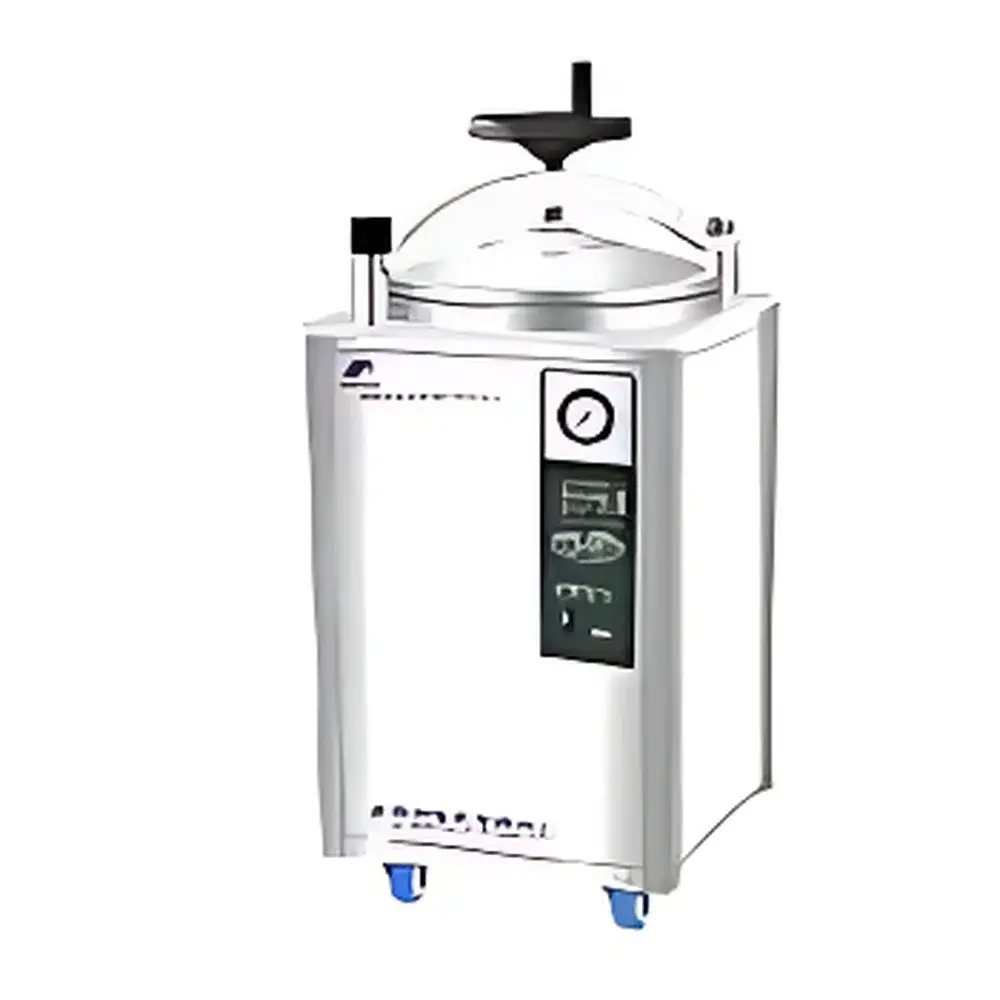
Shen’an LDZH-150L Vertical High-Pressure Steam Sterilizer
| Brand | Shen'an / She Medical Devices |
|---|---|
| Origin | Shanghai, China |
| Model | LDZH-150L |
| Chamber Volume | 150 L |
| Maximum Temperature | 134 °C |
| Maximum Pressure | 0.24 MPa |
| Chamber Dimensions | Φ500 × 760 mm |
| External Dimensions | 630 × 700 × 1400 mm |
| Power Supply | 380 V / 6 kW |
| Construction | Full Stainless Steel (3.0 mm wall thickness) |
| Weight | 213 kg |
| Sterilization Temperature Range | 50–134 °C |
| Time Setting Range | 0–99 h |
| Safety Features | Interlocked door mechanism, low-water cutoff, self-sealing gasket, triple-stage exhaust (full / micro / no exhaust), dual-scale Class II pressure gauge, automatic end-of-cycle alarm |
| Control System | Microprocessor-based with LED digital display |
Overview
The Shen’an LDZH-150L is a vertically oriented, fully stainless steel high-pressure steam sterilizer engineered for reliable, repeatable terminal sterilization of heat-stable laboratory and clinical materials. Operating on the principle of saturated steam under controlled pressure and temperature, it achieves microbial inactivation—including bacterial spores—through moist-heat denaturation of proteins and nucleic acids. Designed to meet fundamental requirements of ISO 17665-1 (Sterilization of health care products — Moist heat — Part 1: Requirements for the development, validation and routine control of a sterilization process for medical devices), the LDZH-150L delivers consistent performance across diverse load configurations within its 150 L chamber. Its vertical architecture optimizes floor space utilization while maintaining structural integrity under sustained operating pressures up to 0.24 MPa (equivalent to ~2.4 bar or ~35 psi), with validated sterilization cycles at 121 °C (15–20 min) and 134 °C (3–5 min) per standard protocols.
Key Features
- Microprocessor-controlled cycle management with LED digital display for real-time monitoring of temperature, pressure, time, and phase status.
- Interlocked safety door system preventing accidental opening during pressurized operation; integrated mechanical and electronic interlocks comply with EN 61010-1 requirements for laboratory equipment safety.
- Triple-stage programmable exhaust: full exhaust for rapid depressurization, micro-exhaust for moisture-sensitive loads, and no-exhaust mode for liquid sterilization to prevent boil-over.
- Self-expanding silicone gasket ensures leak-tight sealing across repeated thermal cycles without manual torque adjustment.
- Dual-scale Class II pressure gauge provides redundant verification of chamber pressure—critical for audit readiness and GLP-compliant documentation.
- Low-water cut-off protection prevents heater dry-firing and extends heating element service life.
- Adjustable sterilization parameters: temperature range 50–134 °C; time range 0–99 hours—supporting both routine autoclaving and extended hold cycles for validation studies.
- Full stainless steel construction (AISI 304, 3.0 mm wall thickness) resists corrosion from repeated exposure to condensate and cleaning agents.
Sample Compatibility & Compliance
The LDZH-150L accommodates a broad spectrum of sterilizable items including glassware, metal instruments, wrapped surgical packs, porous loads (e.g., textiles), and liquid media in sealed containers. Chamber geometry (Φ500 × 760 mm) supports stacking of standard autoclave trays and compatibility with ISO/IEC 17025-accredited validation fixtures. The unit conforms to national safety standards GB 8599–2008 (Horizontal and vertical steam sterilizers for medical use) and incorporates design elements aligned with FDA guidance on steam sterilization validation (2022). While not pre-certified to ASME BPVC Section VIII Div. 1, its pressure vessel design follows applicable Chinese regulatory frameworks for Class I sterilization equipment. Routine operation requires adherence to local institutional biosafety policies and documented preventive maintenance per manufacturer-recommended intervals.
Software & Data Management
The LDZH-150L operates via embedded firmware without external PC dependency. All cycle parameters—including setpoints, actual profiles, and event logs (door open/close, alarm triggers, pressure/temperature deviations)—are stored internally with timestamping. Data export is not supported via USB or network interface; however, printed cycle records can be generated using optional external thermal printers connected via RS232. For laboratories requiring 21 CFR Part 11 compliance, third-party data loggers with audit-trail capability may be deployed alongside the unit to capture and archive critical process variables. Cycle documentation meets minimum traceability requirements for ISO 9001 internal audits and basic GMP environments where electronic signatures are not mandated.
Applications
- Routine decontamination of reusable labware (pipette tips, Petri dishes, flasks) in academic and industrial research settings.
- Sterilization of culture media, agar solutions, and buffered saline preparations prior to aseptic handling.
- Preparation of sterile surgical kits and instrument sets in small-scale clinical or veterinary facilities.
- Validation support for sterilization process development—particularly for establishing D-value and F0 calculations under defined load configurations.
- Biosafety Level 1 and 2 (BSL-1/2) containment labs requiring verified pathogen inactivation of waste streams and contaminated equipment.
FAQ
What is the maximum allowable working pressure and corresponding temperature?
The LDZH-150L is rated for a maximum design pressure of 0.24 MPa, enabling stable operation at 134 °C for accelerated sterilization cycles.
Does the unit support automated cycle validation or calibration reporting?
No—the LDZH-150L does not include built-in validation software or calibration certificate generation. Third-party thermocouple mapping and pressure transducer verification are required for formal validation.
Is the chamber volume nominal or effective?
The stated 150 L capacity refers to the geometric internal volume; effective load volume is approximately 120–130 L depending on tray configuration and steam penetration requirements.
Can this sterilizer be used for liquid media sterilization?
Yes—when configured in “no-exhaust” mode with appropriate ramp/hold profiles, it safely sterilizes liquids while minimizing turbulence-induced container breakage.
What electrical infrastructure is required for installation?
A dedicated 380 V AC, 3-phase, 6 kW supply with proper grounding and circuit protection (≥25 A breaker) is mandatory. Voltage fluctuations exceeding ±5% require an external stabilizer.



