
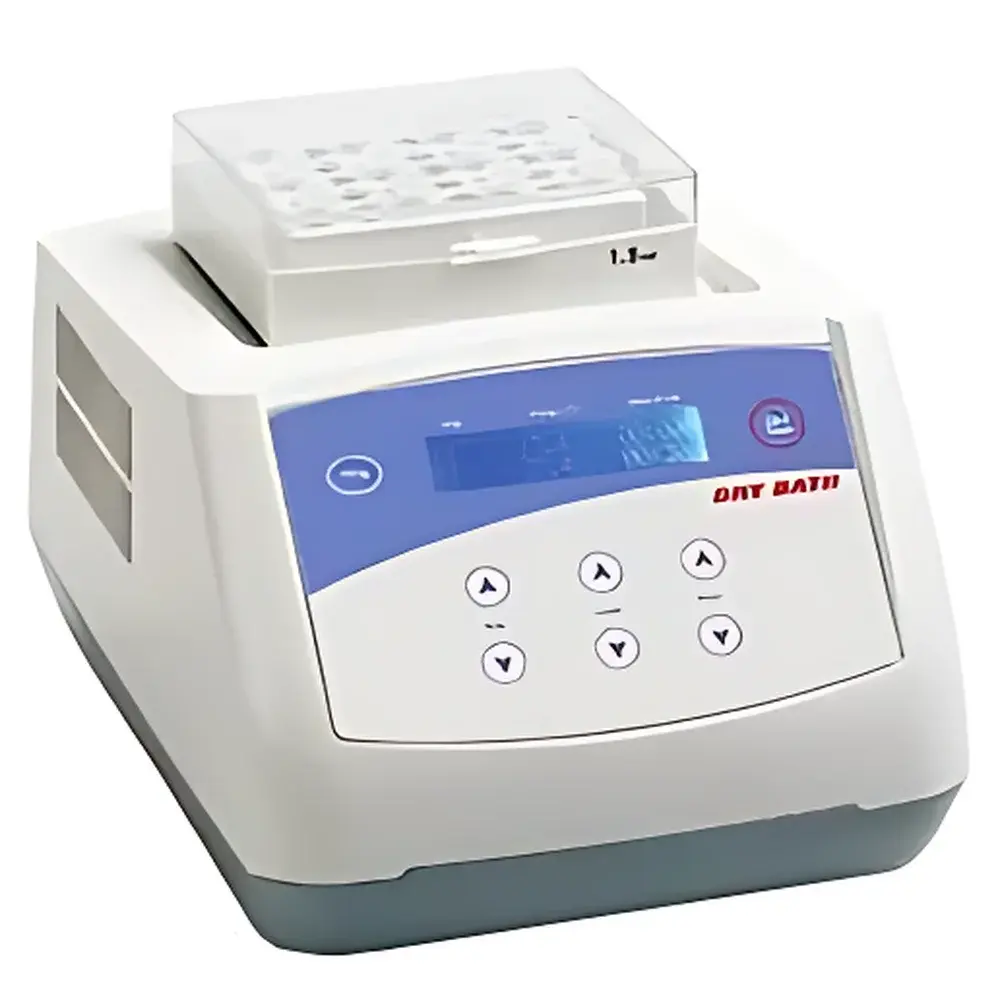
Yiheng TU-100C Peltier-Cooled Precision Metal Block Thermostat
| Key | Brand: Yiheng |
|---|---|
| Origin | Shanghai, China |
| Model | TU-100C |
| Temperature Range | −10 °C to 100 °C |
| Temperature Accuracy | ±0.5 °C |
| Display Resolution | 0.1 °C |
| Temperature Uniformity (within block) | ≤±0.5 °C |
| Heating Time (20 °C → 100 °C) | ≤25 min |
| Cooling Time (20 °C → 0 °C) | ≤25 min |
| Power Consumption | 200 W |
| Timer Range | 0–99 h 59 min |
Overview
The Yiheng TU-100C is a microprocessor-controlled, Peltier-cooled metal block thermostat engineered for precise thermal management of biological and chemical samples in research and quality control laboratories. Unlike conventional water baths—prone to evaporation, contamination, and inconsistent temperature gradients—the TU-100C utilizes solid-state thermoelectric (Peltier) technology to deliver bidirectional temperature control across a wide operational range of −10 °C to 100 °C. Its aluminum alloy heating/cooling block ensures rapid thermal response, high thermal conductivity, and excellent spatial uniformity (≤±0.5 °C across the block surface), making it suitable for applications requiring strict thermal reproducibility—including enzyme incubation, PCR pre-denaturation, serum coagulation assays, and controlled sample storage prior to downstream analysis.
Key Features
- Integrated Peltier module enabling both heating and active cooling without external chillers or refrigerants—reducing footprint, maintenance, and environmental impact.
- High-resolution 0.1 °C LED display with simultaneous real-time temperature readout and countdown timer (0–99 h 59 min), supporting unattended operation for extended protocols.
- Interchangeable, anodized aluminum sample blocks (standard E-module included) designed for compatibility with common tube formats (e.g., 0.2 mL, 0.5 mL, 1.5 mL, 2.0 mL microcentrifuge tubes and 0.2 mL PCR strips); blocks are autoclavable and chemically resistant.
- Dual safety architecture: independent over-temperature cutoff (hardware-based thermal fuse) plus software-driven fault detection—automatically halting operation and triggering audible alarm upon sensor failure, power anomaly, or thermal runaway.
- Optically transparent polycarbonate lid minimizes ambient heat exchange while permitting visual monitoring without lid removal—critical for maintaining thermal stability during sensitive enzymatic or nucleic acid workflows.
- Calibration offset function allows user-adjustable correction of block temperature against traceable reference standards, supporting internal instrument qualification per GLP and ISO/IEC 17025 requirements.
Sample Compatibility & Compliance
The TU-100C accommodates standard laboratory consumables via its modular block system. The supplied E-module supports up to 48 × 0.2 mL tubes or 24 × 1.5/2.0 mL tubes, with optional modules available for deep-well plates and larger vessels. All contact surfaces are non-porous and corrosion-resistant, eliminating cross-contamination risks associated with water baths. The device complies with IEC 61010-1:2010 for electrical safety in laboratory equipment and meets electromagnetic compatibility (EMC) requirements per EN 61326-1. While not certified for clinical diagnostics under FDA 21 CFR Part 820, its design supports audit-ready documentation for GMP-relevant processes—including temperature mapping reports, calibration logs, and alarm event records.
Software & Data Management
The TU-100C operates as a standalone instrument with no proprietary software dependency. All settings and status data—including setpoint, actual block temperature, elapsed/remaining time, and alarm history—are retained locally on the embedded controller. For integration into lab-wide digital workflows, users may log temperature outputs manually or via external USB data loggers (not included). The device supports periodic verification using NIST-traceable thermistors or RTDs, and its calibration offset feature facilitates alignment with metrology-grade references—enabling compliance with ISO 17025 clause 6.5 (measurement traceability) and USP guidelines for analytical instrument qualification.
Applications
- Thermal pre-treatment of clinical specimens (e.g., serum coagulation at 37 °C; cold-induced precipitation inhibition).
- PCR setup stages: hot-start polymerase activation, template denaturation (95 °C), and hold steps at 4 °C or −10 °C for reagent stabilization.
- Enzyme kinetics studies requiring stable sub-ambient incubation (e.g., restriction digests at 16 °C or phosphatase reactions at 25 °C).
- Controlled thawing of cryopreserved cell suspensions or protein stocks to minimize thermal shock.
- Standardization of sample equilibration prior to HPLC injection, mass spectrometry sample prep, or ELISA plate coating steps.
FAQ
Does the TU-100C support external temperature probes for validation?
No—the unit relies solely on its integrated PT1000 sensor embedded in the aluminum block. For formal temperature mapping or IQ/OQ, third-party calibrated probes must be placed directly in sample wells.
Can the E-module be sterilized in an autoclave?
Yes—standard E-modules are rated for repeated autoclaving at 121 °C, 15 psi for 20 minutes. Verify post-sterilization thermal uniformity before critical use.
Is firmware upgrade capability available?
No—firmware is fixed at time of manufacture. Functional updates are implemented only through hardware revision cycles (e.g., TU-100C v2.0).
What is the expected service life of the Peltier element under continuous operation?
Rated for ≥20,000 hours at 50% duty cycle. Actual longevity depends on ambient temperature, ventilation, and thermal load cycling frequency.
Does the device meet FDA 21 CFR Part 11 requirements for electronic records?
No—it lacks audit trail generation, electronic signatures, or secure user authentication. It may be used in Part 11 environments only when paired with validated external logging systems.



