
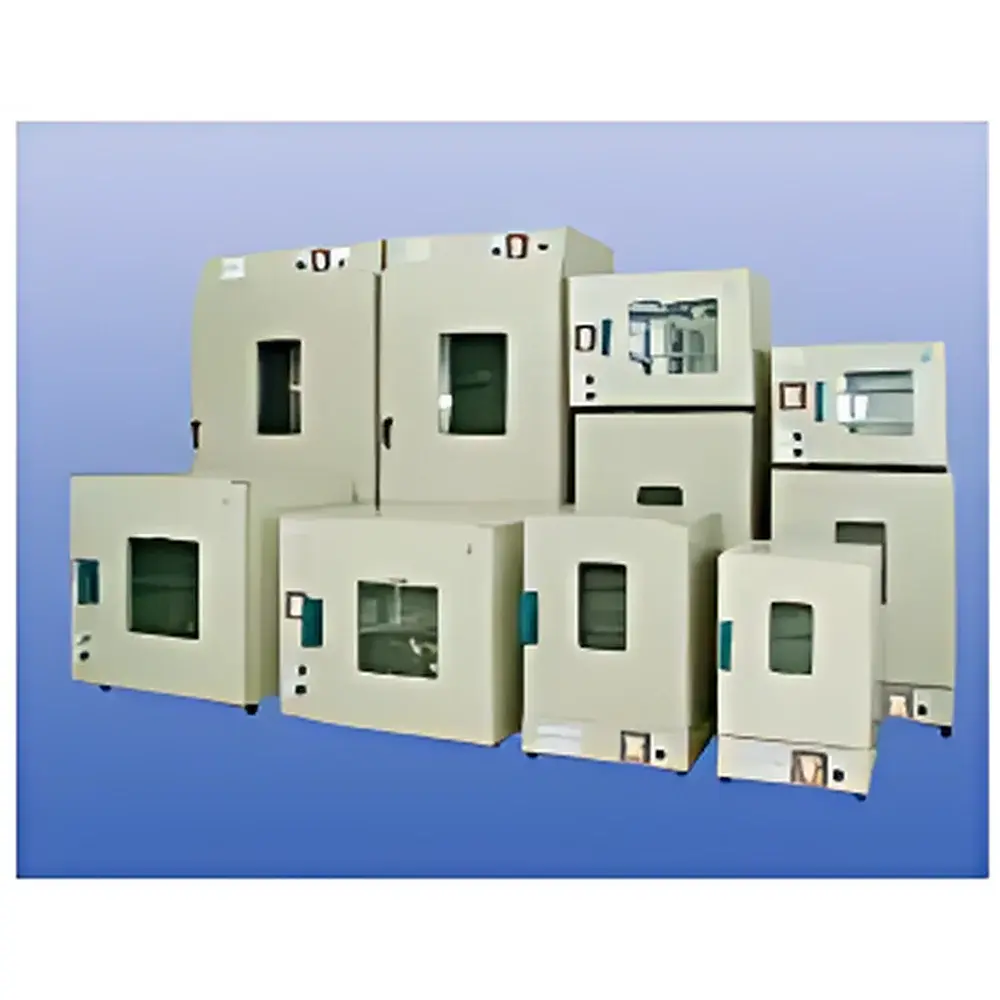
JingHong DHG-9023A Forced-Air Laboratory Drying Oven
| Brand | JingHong |
|---|---|
| Origin | Shanghai, China |
| Model | DHG-9023A |
| Temperature Range | RT+10°C to 200°C |
| Temperature Uniformity | ±1°C |
| Temperature Resolution | 0.1°C |
| Chamber Dimensions (W×D×H) | 300×280×275 mm |
| External Dimensions (W×D×H) | 596×500×445 mm |
| Chamber Material | Stainless Steel (SUS304) |
| Heating Method | Forced-Air Convection |
| Operating Ambient Temperature | 5–40°C |
| Instrument Type | General-Purpose Benchtop Drying Oven |
Overview
The JingHong DHG-9023A Forced-Air Laboratory Drying Oven is an entry-level yet rigorously engineered convection drying system designed for routine thermal processing in academic laboratories, quality control environments, and industrial R&D settings. It operates on the principle of forced-air convection—where a low-noise centrifugal blower circulates heated air uniformly across the chamber—ensuring consistent heat transfer and minimizing thermal gradients. Unlike natural-convection ovens, this design delivers improved temperature uniformity (±1°C at setpoint), faster equilibration times, and enhanced repeatability for applications requiring precise thermal exposure, including moisture loss determination, polymer curing validation, sample pre-conditioning prior to gravimetric analysis, and low-temperature sterilization of non-critical labware.
Key Features
- Stainless steel (SUS304) interior chamber—resistant to corrosion, easy to clean, and compliant with general laboratory hygiene standards.
- Microprocessor-based PID temperature controller with dual digital display: one for setpoint, one for real-time chamber temperature—enabling intuitive operation and immediate verification of thermal status.
- Integrated timer function with up to 999-minute programmable duration, supporting unattended operation for standardized drying protocols.
- Self-tuning PID algorithm automatically optimizes heating response to load variation and ambient fluctuations, maintaining stable thermal conditions without manual recalibration.
- Adjustable airflow baffle and rear-mounted circulation fan ensure laminar, directional air movement—critical for achieving ≤±1°C uniformity across the full working volume.
- Benchtop footprint (596 × 500 × 445 mm) accommodates standard lab bench layouts while providing a usable chamber volume of ~23 L (300 × 280 × 275 mm).
Sample Compatibility & Compliance
The DHG-9023A is suitable for drying, baking, annealing, and low-temperature sterilization of non-volatile, non-hazardous solid or powder samples—including filter papers, ceramic crucibles, metal coupons, polymer films, and pharmaceutical excipients. It is not rated for flammable solvents, biological containment, or Class I/II biosafety applications. While not certified to UL/CSA or CE for hazardous location use, its construction and control architecture align with baseline safety expectations outlined in IEC 61010-1 for electrical equipment used in laboratory environments. For GLP-compliant workflows, users may implement external calibration logs and periodic verification using NIST-traceable thermocouples (e.g., ASTM E220, ISO/IEC 17025 traceability pathways).
Software & Data Management
This model operates via standalone hardware controls without embedded data logging or network connectivity. All operational parameters—including set temperature, elapsed time, and current chamber reading—are displayed locally. For regulatory traceability, laboratories are advised to integrate the oven into documented procedures that include manual recording of start/end times, observed temperatures (using calibrated handheld thermometers), and operator identification. When deployed in FDA-regulated environments (e.g., USP drying validation), it supports IQ/OQ documentation when paired with third-party validation kits and temperature mapping studies per ISO 14644-3 or EU GMP Annex 15 guidelines.
Applications
- Moisture content determination per AOAC 950.46, ASTM D2231, or ISO 4611 for plastics and composites.
- Drying of analytical filters and crucibles prior to gravimetric ash analysis (e.g., EPA Method 1631, ISO 11923).
- Curing of epoxy-coated substrates and solvent-free polymer films under controlled thermal profiles.
- Pre-conditioning of reference standards and calibration weights in metrology labs (per ISO 5725 guidance).
- Low-risk sterilization of glassware and stainless-steel tools where steam autoclaving is impractical.
- Accelerated aging studies for packaging materials under ICH Q1A(R2) stability testing frameworks.
FAQ
What is the maximum safe operating temperature for the DHG-9023A?
The unit is rated for continuous operation up to 200°C. Exceeding this limit may compromise sensor accuracy, insulation integrity, and long-term heater element life.
Does the oven support ramp-soak programming?
No—this model features only fixed-setpoint control with timer-based termination. Multi-step thermal profiles require external programmable controllers.
Can the DHG-9023A be used for drying samples containing volatile organic compounds?
Not recommended. The forced-air system lacks explosion-proof construction or solvent exhaust integration; use only with non-flammable, low-volatility materials.
Is the stainless steel chamber electropolished or passivated?
The interior uses standard mill-finish SUS304 stainless steel. Electropolishing is not included but can be specified as a custom option upon request.
How often should temperature uniformity be verified?
Per ISO/IEC 17025 and internal SOPs, quarterly verification is typical for routine use; more frequent checks are required after maintenance or relocation.



