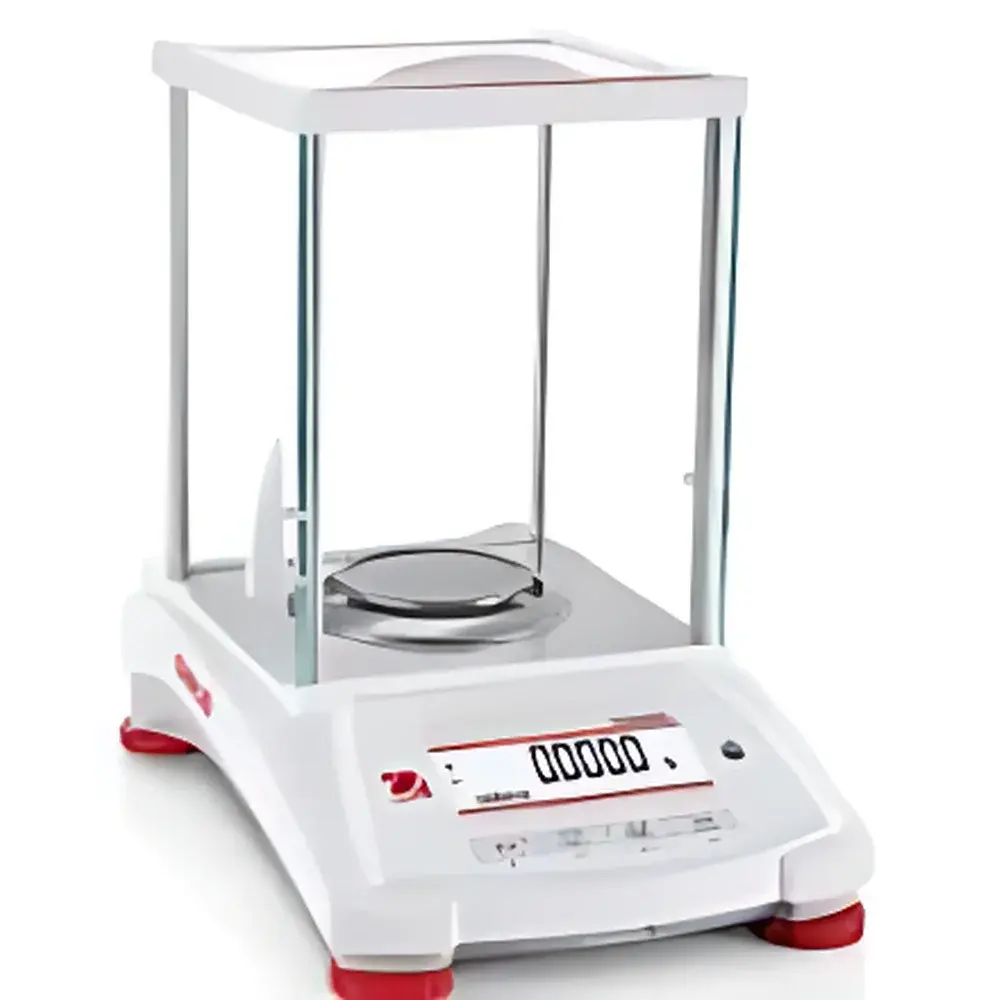
OHAUS PX124ZH/E Precision Analytical Balance
| Key | Brand: OHAUS |
|---|---|
| Origin | USA |
| Model | PX124ZH/E |
| Max Capacity | 120 g |
| Readability | 0.1 mg (1 × 10⁻⁴ g) |
| Repeatability | 0.1 mg |
| Calibration | External |
| Construction | Aluminum die-cast base, removable stainless-steel pan, glass draft shield |
| Display | Backlit dual-line LCD with status indicators and capacity bar |
| Connectivity | RS232 and USB interfaces |
| Compliance | GLP/GMP-ready with real-time clock, audit trail support, and user-defined ID/project fields |
| Operating Environment | 10–30 °C, ≤80% RH at ≤30 °C |
| Dimensions (W × D × H) | 209 × 321 × 309 mm |
| Net Weight | 5 kg |
Overview
The OHAUS PX124ZH/E Precision Analytical Balance is an entry-level high-resolution analytical instrument engineered for reproducible mass measurement in regulated and non-regulated laboratory environments. Designed to replace the legacy AR-series balances, the PX124ZH/E operates on electromagnetic force compensation (EMFC) principle — a standard architecture for modern analytical balances — delivering stable, drift-compensated readings under controlled ambient conditions. With a maximum capacity of 120 g and readability of 0.1 mg (1 × 10⁻⁴ g), it meets the definition of a “four-decimal-place” balance per ISO/IEC 17025 and USP criteria for analytical weighing applications. Its performance envelope — including repeatability of ±0.1 mg (standard deviation), linearity error of ±0.0002 g, and stabilization time of ≤10 s — ensures suitability for routine QC testing, formulation work, sample preparation, and educational use where traceable, repeatable mass data is required.
Key Features
- Robust mechanical architecture: Die-cast aluminum base provides vibration damping and thermal stability; removable stainless-steel weighing pan (Ø 90 mm) and full-height glass draft shield minimize air current interference.
- Intuitive dual-line backlit LCD: Primary line displays net weight and unit; secondary line shows contextual prompts (e.g., “TARE”, “CAL”, “STABLE”) in four selectable languages — English, Spanish, French, and German — eliminating reliance on printed manuals.
- ESR electrostatic discharge mitigation: Integrated red ESD bar above the weighing chamber actively neutralizes static charge on samples and containers, reducing measurement bias in low-humidity or dry-powder handling scenarios.
- Configurable operational parameters: Adjustable auto-tare delay, display brightness, auto-dimming timeout, environmental drift compensation (temperature/humidity), and programmable calibration point selection.
- Secure user management: Software lockout prevents unauthorized menu access; customizable User ID and Project Name fields support traceability requirements under GLP and GMP frameworks.
- Dedicated mechanical keypad: Four tactile keys enable rapid mode switching between basic weighing, piece counting, percentage weighing, checkweighing, animal weighing, and density determination.
Sample Compatibility & Compliance
The PX124ZH/E accommodates standard laboratory vessels — including crucibles, vials, beakers, and weighing boats — within its 90 mm pan diameter and 220 mm clearance beneath the draft shield. Its external calibration design requires use of certified Class M1 or Class F1 weights (e.g., 100 g or 120 g), traceable to NIST or equivalent national metrology institutes. The balance complies with international standards relevant to analytical instrumentation, including ISO 9001 (quality management), ISO/IEC 17025 (testing and calibration laboratories), and USP (balance verification). While not inherently 21 CFR Part 11 compliant out-of-the-box, its real-time clock, user authentication fields, and event logging capability (via connected PC software) provide foundational infrastructure for Part 11 implementation when paired with validated third-party data acquisition systems.
Software & Data Management
Data export and integration are enabled via native RS232 and USB-B ports, supporting ASCII-based communication protocols compatible with LIMS, ELN, and SCADA platforms. The balance timestamps all weighings using its built-in real-time clock, enabling chronological traceability. When connected to OHAUS’s free Acquire software (or generic terminal emulators), users can capture raw data streams, generate CSV logs, and configure automatic printouts to serial printers. All data transfers include metadata such as user ID, project name, date/time stamp, gross/net/tare values, and stability flag — satisfying minimum documentation requirements for GLP audits and internal SOPs. No proprietary drivers are required; USB CDC class compliance ensures plug-and-play operation on Windows, macOS, and Linux hosts.
Applications
This balance supports diverse workflows across pharmaceutical, chemical, food, and academic sectors. Typical use cases include: quantitative sample preparation for HPLC or ICP-MS analysis; active pharmaceutical ingredient (API) dispensing in pre-formulation studies; tablet weight uniformity testing per USP ; gravimetric moisture content determination; density calculation of solids using Archimedean displacement; and piece-counting of small components in electronics manufacturing. Its 0.1 mg resolution and ≤20 mg minimum weight (per USP , K=2, U=0.10%) make it suitable for weighing reference standards, catalysts, and micro-dosed reagents — provided environmental controls (vibration isolation, temperature stability, and ESD mitigation) are maintained.
FAQ
Is the PX124ZH/E internally calibrated?
No — the “E” suffix denotes external calibration. Internal calibration models in the PX series carry the “D” designation (e.g., PX124DZH).
What is the minimum weight this balance can reliably measure?
Per USP guidelines (K = 2, uncertainty target U = 0.10%), the minimum weight is 20 mg. This value assumes proper calibration, stable environment, and correct handling technique.
Does the balance meet FDA 21 CFR Part 11 requirements?
The hardware provides essential elements (user IDs, timestamps, audit-ready data output), but full Part 11 compliance requires validation of the entire electronic record workflow — including software, network configuration, and procedural controls.
Can the draft shield be removed for large samples?
Yes — the glass draft shield is fully detachable and designed for tool-free removal, allowing unshielded weighing when environmental conditions permit and regulatory constraints allow.
What power supply does the PX124ZH/E require?
It operates via an included universal AC adapter (input: 100–240 VAC, 50–60 Hz; output: 12 VDC / 0.5 A), making it suitable for global deployment without voltage conversion.