
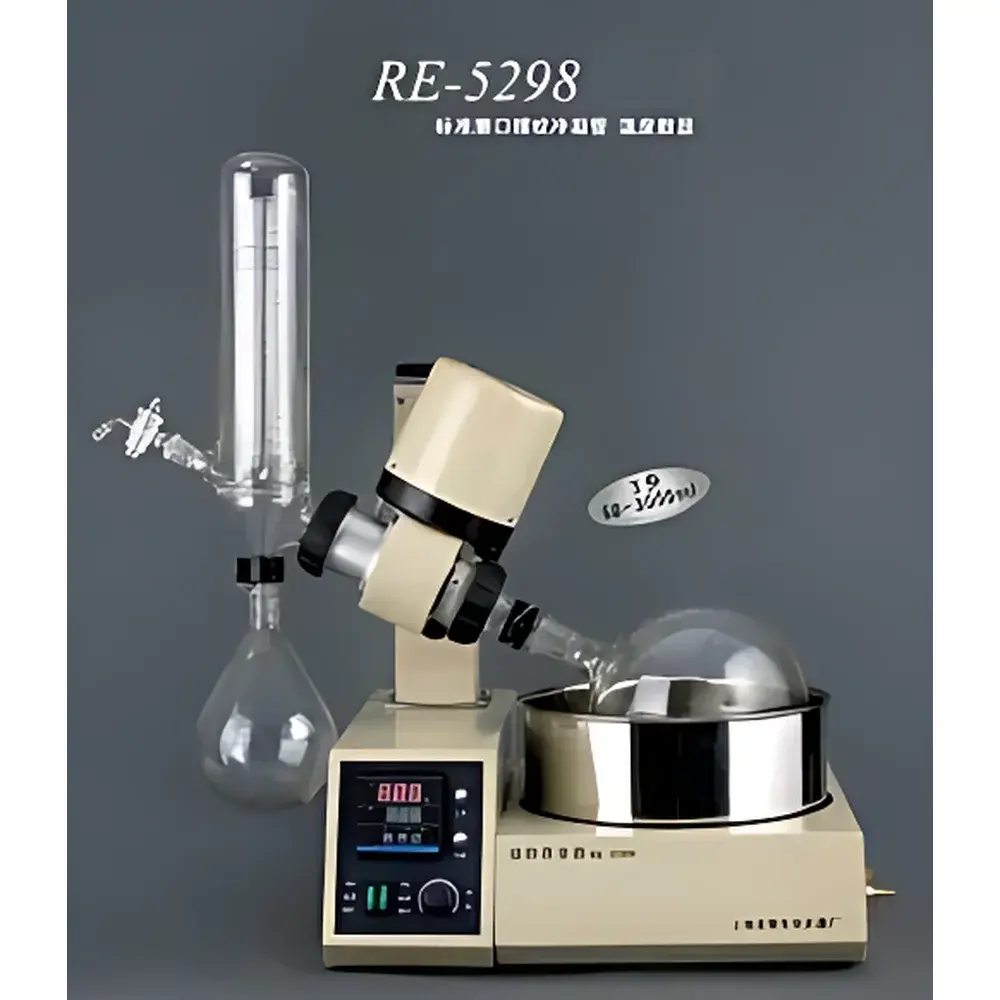
Yarong RE-5299 Automatic Lifting Rotary Evaporator
| Brand | Yarong |
|---|---|
| Origin | Shanghai, China |
| Model | RE-5299 (2 L) |
| Ultimate Vacuum | 399.9 Pa |
| Rotational Speed | 0–130 rpm |
| Bath Temperature Range | Ambient to 99 °C |
| Evaporation Flask Capacity | 2 L |
| Heating Bath Material | Stainless Steel with PTFE Coating |
| Power Rating | 1000 W |
| Voltage/Frequency | 220 V / 50 Hz |
| Cooling Condenser | Vertical Double-Pass with Ice Jacket Port |
| Feed Tube | Valve-Controlled Continuous Addition Port |
| Safety Features | Motorized Vertical Lift with Mechanical Limit Switch and Overload Protection |
| Heating Bath Dimensions | 220 × 115 mm |
Overview
The Yarong RE-5299 Automatic Lifting Rotary Evaporator is an engineered solution for efficient solvent removal, concentration, and recovery under reduced pressure in research laboratories, pharmaceutical QC environments, and academic chemistry departments. It operates on the principle of rotary evaporation—rotating a sample-containing flask in a temperature-controlled water bath while simultaneously applying vacuum to lower the boiling point of solvents. This configuration maximizes surface area exposure, enhances heat transfer uniformity, and improves mass transfer kinetics—critical for preserving thermally sensitive compounds during gentle, scalable evaporation. Designed for routine use in GLP-compliant workflows, the RE-5299 integrates mechanical precision with operational safety, supporting reproducible batch processing of organic extracts, reaction mixtures, natural product fractions, and synthetic intermediates.
Key Features
- Motor-driven vertical lift mechanism with programmable height adjustment and integrated mechanical limit switches—ensures precise, repeatable positioning of the evaporation flask relative to the heating bath and condenser.
- PTFE-coated stainless steel heating bath (220 × 115 mm) offering corrosion resistance, thermal stability, and uniform heat distribution across the full temperature range (ambient to 99 °C).
- Vertical double-pass condenser with external ice jacket port—enables rapid vapor condensation even for low-boiling solvents such as diethyl ether, dichloromethane, or ethyl acetate.
- Valve-controlled feed tube permitting continuous or intermittent addition of solvent or reaction mixture without breaking vacuum or interrupting rotation.
- Electronic stepless speed control (0–130 rpm) with digital display—ensures stable rotational torque and minimizes bumping or foaming during volatile solvent removal.
- Transparent polycarbonate safety shield surrounding the heating bath—provides splash protection, thermal insulation, visual monitoring, and contamination prevention without obstructing operator access.
- Overload protection circuitry and automatic motor cutoff upon mechanical obstruction—complies with IEC 61010-1 safety requirements for laboratory electrical equipment.
Sample Compatibility & Compliance
The RE-5299 accommodates standard 2 L round-bottom flasks (ISO 2785 taper) and is compatible with common laboratory solvents including alcohols, ketones, esters, hydrocarbons, and chlorinated compounds. Its vacuum performance (≤399.9 Pa) supports efficient evaporation of solvents with boiling points up to ~120 °C at atmospheric pressure. The unit meets structural and electrical safety benchmarks outlined in IEC 61010-1:2010 and conforms to general laboratory equipment requirements under ISO/IEC 17025:2017 for method validation support. While not certified for GMP manufacturing environments per se, its design facilitates audit-ready documentation when paired with external loggers (e.g., calibrated PT100 probes and vacuum transducers) for traceable process records.
Software & Data Management
The RE-5299 is a standalone analog-digital hybrid instrument with no embedded microprocessor or data logging capability. All operational parameters—including bath temperature, rotation speed, and lift position—are manually set and visually monitored via front-panel LED displays and mechanical indicators. For regulatory traceability, users are advised to integrate external validated sensors and record data manually or via third-party DAQ systems compliant with FDA 21 CFR Part 11 (when electronic signatures and audit trails are required). Optional accessories include calibrated digital thermometers (±0.2 °C), vacuum gauges with analog output (0–10 V), and RS-485 interface modules for centralized lab equipment monitoring.
Applications
- Solvent recovery and reuse in synthetic organic chemistry workflows.
- Concentration of natural product extracts (e.g., plant alkaloids, flavonoids, essential oils) without thermal degradation.
- Drying and purification of peptide synthesis crude products post-cleavage.
- Removal of residual solvents from polymer solutions prior to film casting or rheological characterization.
- Preparative-scale isolation of active pharmaceutical ingredients (APIs) during early-stage development.
- Standardization of reference material preparation in metrology labs requiring consistent evaporation endpoints.
FAQ
Is the RE-5299 suitable for use with corrosive solvents such as concentrated HCl or HF?
No—the PTFE-coated bath provides resistance to mild organic and aqueous solvents but is not rated for strong mineral acids or fluorinated etchants. Use only with chemically compatible media per ASTM D543 guidelines.
Can the lift function be operated while the flask is rotating?
Yes—motorized lifting is fully interlocked with rotation and vacuum systems; vertical movement is permitted at any speed setting without risk of mechanical disengagement.
What is the recommended maintenance interval for the vacuum seal and condenser gaskets?
Inspect silicone and Viton gaskets every 6 months or after 200 operating hours; replace if cracked, flattened, or exhibiting vacuum leakage >10 Pa/min drift under static test conditions.
Does the unit include a built-in vacuum pump or controller?
No—the RE-5299 requires an external vacuum source (e.g., diaphragm or water aspirator pump) and optional vacuum regulator for fine pressure control.
Is the heating bath temperature accuracy traceable to NIST standards?
The factory-calibrated thermostat has ±1.5 °C tolerance at 60 °C; for NIST-traceable operation, users must validate with an external Class A PT100 probe and documented calibration certificate.



