
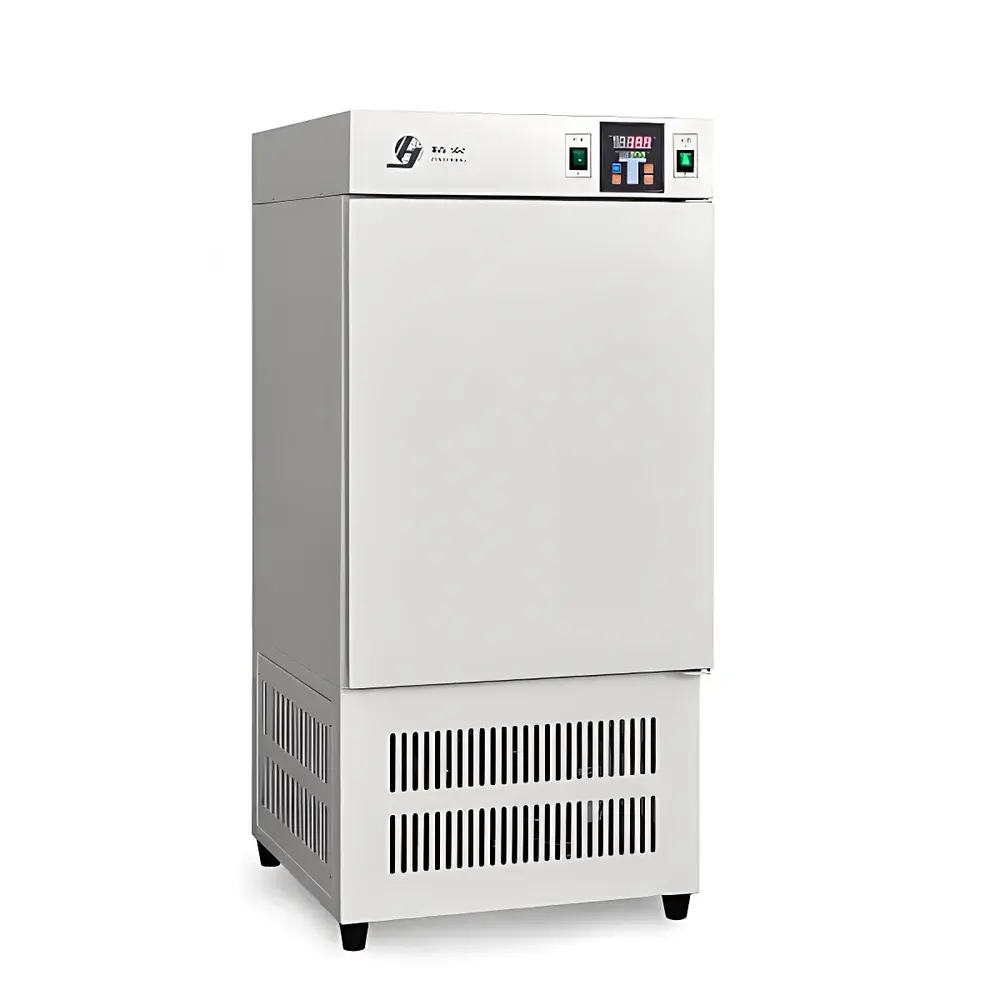
JingHong SHP-150 Biochemical Incubator
| Brand | JingHong |
|---|---|
| Origin | Shanghai, China |
| Refrigeration Method | Compressor-based cooling |
| Air Circulation | Forced convection |
| Temperature Range | 0–60 °C |
| Temperature Accuracy | ±0.1 °C |
| Temperature Uniformity | ±0.5 °C |
| Chamber Capacity | 150 L |
| External Dimensions | 630 × 660 × 1325 mm |
| Inner Chamber Material | Mirror-finish stainless steel |
| Control System | Microprocessor-based PID controller with dual digital display (setpoint & actual temperature) |
| Insulation | Dual-layer high-density polyurethane foam |
| Door Design | Full tempered glass inner door with outer insulated door |
| Safety Features | Delayed compressor start-up, high/low pressure protection circuit |
Overview
The JingHong SHP-150 Biochemical Incubator is a precision-engineered environmental chamber designed for stable, reproducible temperature-controlled cultivation of microorganisms, cell cultures, and biological samples in research laboratories, quality control facilities, and academic institutions. Operating on the principle of forced-air convection with compressor-based refrigeration, the SHP-150 maintains precise thermal conditions across its 150-liter working volume—enabling consistent growth kinetics, metabolic assays (e.g., BOD determination), and long-term sample preservation. Its operational range of 0–60 °C supports both ambient and sub-ambient applications, including psychrophilic culture maintenance and accelerated stability testing. The unit complies with fundamental design expectations for GLP-compliant incubation environments, including uniform heat distribution, minimal thermal overshoot during setpoint transitions, and robust mechanical architecture suitable for continuous 24/7 operation.
Key Features
- Mirror-finish stainless-steel interior chamber with seamless, radius-corner construction—resistant to corrosion and compatible with standard laboratory disinfectants; facilitates complete residue-free cleaning and reduces microbial retention.
- Microprocessor-based PID temperature controller with dual digital LED display—simultaneously shows setpoint and real-time chamber temperature; supports auto-tuning functionality for optimal response across varying load conditions.
- Dual-layer insulation system using high-density polyurethane foam—minimizes thermal bridging and improves energy efficiency while maintaining external surface temperatures within safe handling limits.
- Full tempered glass inner door combined with an insulated outer door—allows non-intrusive visual monitoring without significant thermal disturbance or condensation buildup.
- Modular compressor refrigeration assembly with built-in safeguards—including delayed startup logic, high-pressure cut-off, and low-pressure lockout—to extend component service life and ensure operational continuity under variable ambient conditions.
- Adjustable stainless-steel shelving system—supports flexible configuration for varied vessel heights (e.g., Petri dishes, flasks, multi-well plates) while preserving laminar airflow integrity.
Sample Compatibility & Compliance
The SHP-150 accommodates standard microbiological and biochemical sample formats, including agar plates, liquid culture tubes, Erlenmeyer flasks (up to 2 L), and stacked multi-tier racks. Its forced convection design ensures uniform temperature distribution (±0.5 °C) throughout the chamber volume, meeting performance benchmarks referenced in ISO 15190:2020 (Laboratory safety) and supporting adherence to CLSI M22-A4 (Quality assurance for microbiological culture media). While not certified to IEC 61010-1 for hazardous location use, the unit conforms to general electrical safety requirements for Class II laboratory equipment. It is routinely deployed in settings requiring traceable temperature records for regulatory submissions—including environmental monitoring per EPA Method 1681 and pharmaceutical stability studies aligned with ICH Q5C guidelines.
Software & Data Management
The SHP-150 operates via embedded firmware without proprietary PC software; however, its analog voltage output (0–5 V DC) and RS-485 communication interface (Modbus RTU protocol) enable integration into centralized building management systems (BMS) or third-party data loggers compliant with FDA 21 CFR Part 11 requirements when paired with validated audit-trail-enabled acquisition hardware. Optional external chart recorders or Ethernet-connected IoT gateways may be used to generate time-stamped temperature logs with user-defined alarm thresholds (e.g., deviation > ±1.0 °C for >2 minutes), supporting GxP-aligned documentation practices.
Applications
- Biochemical oxygen demand (BOD) incubation per APHA Standard Methods 5210B and ISO 5815-1.
- Cultivation and maintenance of bacteria, yeasts, molds, and other mesophilic or psychrotolerant strains.
- Environmental water quality analysis, including coliform enumeration and nutrient cycling assays.
- Plant tissue culture initiation and callus propagation under controlled thermal conditions.
- Stability testing of diagnostic reagents, vaccines, and biologics during pre-formulation development.
- Supporting ISO/IEC 17025-accredited testing laboratories performing microbiological enumeration in food, cosmetics, and pharmaceutical raw materials.
FAQ
What is the minimum operating temperature of the SHP-150?
The unit achieves stable operation down to 0 °C, enabled by its dedicated compressor-based refrigeration module.
Does the SHP-150 support humidity control?
No—this model is a dry incubator; relative humidity is uncontrolled and follows ambient conditions. For humidified applications, consider JingHong’s SHH series.
Is the temperature sensor calibrated traceable to NIST standards?
The factory calibration certificate includes as-found/as-left data against a reference thermometer accredited to ISO/IEC 17025; end users must perform periodic verification using a secondary standard.
Can the SHP-150 be installed in a room without air conditioning?
Ambient operating conditions should remain between 10–30 °C and ≤80% RH (non-condensing); sustained exposure above 30 °C may reduce refrigeration efficiency and increase compressor duty cycle.
Are spare parts such as shelves and gaskets available through international distributors?
Yes—standard consumables and wear components are stocked by authorized regional partners and shipped with OEM part numbers for cross-reference compatibility.



