
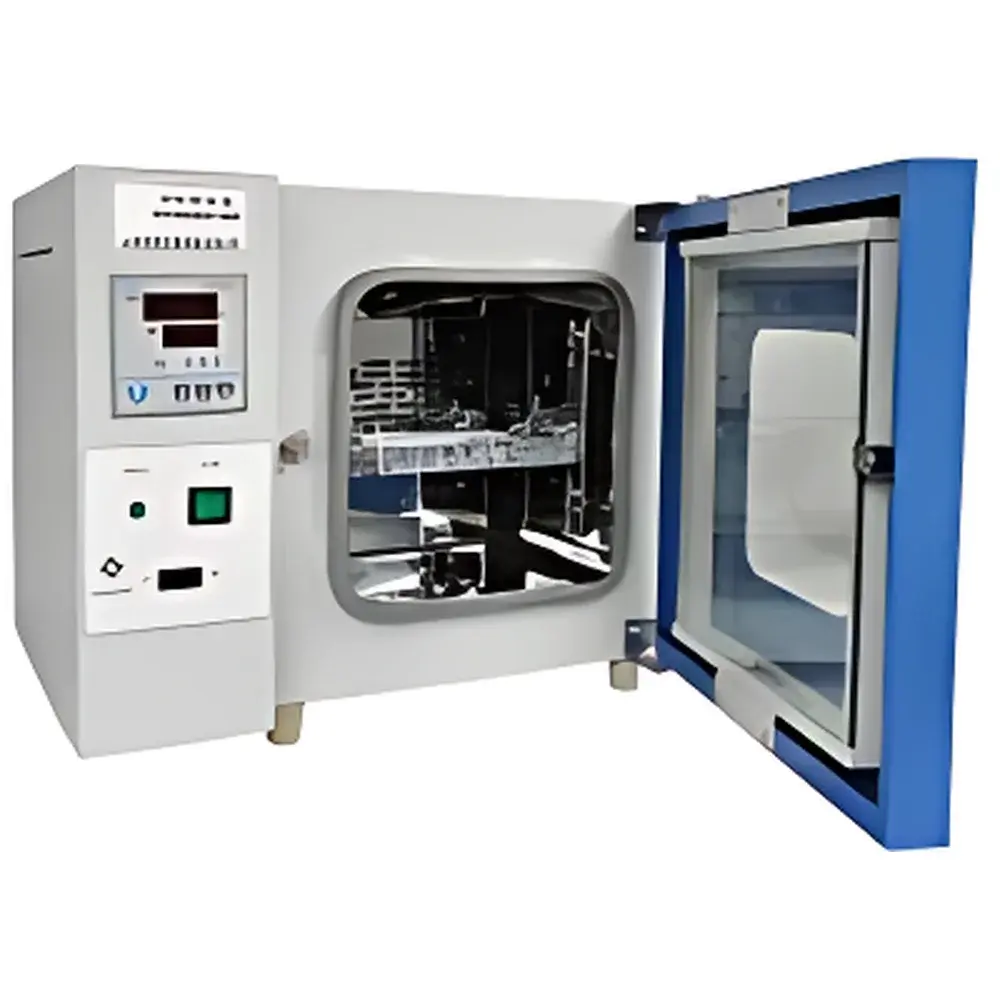
ZiQi DHG-9070A 70L Forced-Air Drying Oven
| Brand | ZiQi |
|---|---|
| Origin | Shanghai, China |
| Manufacturer Type | Direct Manufacturer |
| Product Category | Domestic |
| Model | DHG-9070A (70L) |
| Instrument Type | High-Temperature Drying Oven |
| Temperature Range | RT+10°C to 300°C |
| Temperature Fluctuation | ±1.0°C |
| External Dimensions | 735 × 615 × 630 mm |
| Control Range | RT+10°C to 300°C |
| Interior Chamber Dimensions | 450 × 350 × 450 mm |
| Temperature Resolution | 0.1°C |
| Operating Ambient Temperature | 5–40°C |
| Interior Material | Mirror-Finish Stainless Steel (SUS304) |
| Heating Method | Forced-Air Circulation |
| Temperature Uniformity | ±3% (measured at 100°C) |
Overview
The ZiQi DHG-9070A is a precision-engineered forced-air drying oven designed for routine and regulated laboratory applications requiring stable thermal environments from ambient +10°C up to 300°C. Utilizing a robust convection-based heating architecture with an integrated axial fan and optimized airflow ducting, the DHG-9070A ensures rapid heat-up times and consistent thermal distribution across its 70-liter stainless steel chamber. Its core function—controlled evaporation, moisture removal, sterilization, preheating, and thermal conditioning—is grounded in ISO 17025-aligned thermal management principles, making it suitable for QC laboratories operating under GLP or GMP frameworks where traceable, repeatable temperature control is essential.
Key Features
- Mirror-finish SUS304 stainless steel interior chamber with rounded corners and removable, adjustable stainless steel shelving—designed for easy cleaning, corrosion resistance, and long-term dimensional stability under repeated thermal cycling.
- Microprocessor-based PID temperature controller with 0.1°C resolution, real-time digital display, and dual-stage safety logic: primary setpoint control plus independent overtemperature cut-off circuitry (optional) compliant with IEC 61000-4-2 ESD immunity standards.
- Intelligent air velocity modulation system—fan speed dynamically adjusted based on load conditions and setpoint deviation—to maintain ±1.0°C temperature fluctuation and ±3% uniformity (verified at 100°C per ASTM E2207).
- Self-venting air duct design actively expels condensate and residual moisture during operation, eliminating manual vent adjustment and reducing cross-contamination risk between sequential drying cycles.
- Electrostatically coated cold-rolled steel exterior housing provides mechanical durability and chemical resistance in multi-user lab environments; front-access door with double-layer silicone gasket ensures thermal integrity and minimal heat leakage.
- Optional RS485 serial interface supports integration with external data loggers or LIMS platforms, enabling time-stamped temperature logging aligned with FDA 21 CFR Part 11 requirements for electronic records and signatures.
Sample Compatibility & Compliance
The DHG-9070A accommodates standard laboratory glassware (e.g., Petri dishes, weighing bottles, crucibles), polymer samples, pharmaceutical excipients, soil specimens, and metal-coated substrates—provided they are thermally stable below 300°C. It complies with general safety requirements outlined in EN 61010-1:2010 for electrical equipment used in laboratory settings. While not certified to UL or CE as a standalone medical device, its construction meets baseline criteria for use in non-clinical analytical labs conducting ASTM D2244 (color measurement), ISO 5630-3 (paper aging), or USP (sterile processing validation support). Chamber volume (70 L) and internal dimensions (450 × 350 × 450 mm) permit simultaneous processing of ≥12 standard 100-mm Petri dishes or four 250-mL volumetric flasks.
Software & Data Management
The embedded controller operates without external software dependencies but supports optional firmware-upgradable protocols via RS485. When interfaced with third-party data acquisition systems (e.g., LabVIEW, WinCC, or custom Python-based SCADA), users can configure automated temperature ramp/soak profiles, generate CSV-formatted audit trails with timestamps, and implement user-level access controls. All logged data retain metadata including operator ID, start/end time, maximum deviation from setpoint, and alarm event history—satisfying minimum ALCOA+ (Attributable, Legible, Contemporaneous, Original, Accurate) data integrity expectations for regulated environments.
Applications
- Moisture content determination per AOAC 950.46 and ISO 712 for food, feed, and agricultural commodities.
- Drying of filter papers and gravimetric precipitates prior to ashing or weighing in environmental testing (EPA Method 1664, APHA 2540B).
- Curing of epoxy-coated substrates and thermal stabilization of reference standards in calibration labs.
- Preconditioning of hygroscopic materials (e.g., lithium-ion battery cathode powders) prior to XRD or BET surface area analysis.
- Accelerated aging studies of packaging films under controlled thermal stress (ASTM F1980).
FAQ
What is the maximum allowable continuous operating temperature?
The DHG-9070A is rated for sustained operation at 300°C; however, prolonged exposure above 250°C may reduce sensor longevity and require more frequent recalibration.
Is the temperature uniformity validated across the entire chamber volume?
Yes—uniformity is verified at nine spatial points (per ASTM E2207 Annex A2) at 100°C; results demonstrate ≤±3% deviation from mean temperature. For critical applications, users may perform in-house mapping using NIST-traceable thermocouples.
Can the oven be used for sterilization?
No—it lacks HEPA filtration, vacuum capability, or steam generation; it is not a Class II biological safety cabinet or autoclave. It supports dry-heat depyrogenation only when operated ≥160°C for ≥2 hours per USP .
Does the unit include calibration documentation?
Factory calibration certificates (traceable to CNAS-accredited labs) are available upon request; field recalibration requires a Class A platinum RTD probe and external reference standard.
What maintenance intervals are recommended?
Fan motor lubrication every 12 months; gasket inspection quarterly; interior cleaning after each high-residue application; annual verification of overtemperature cutoff functionality.



