
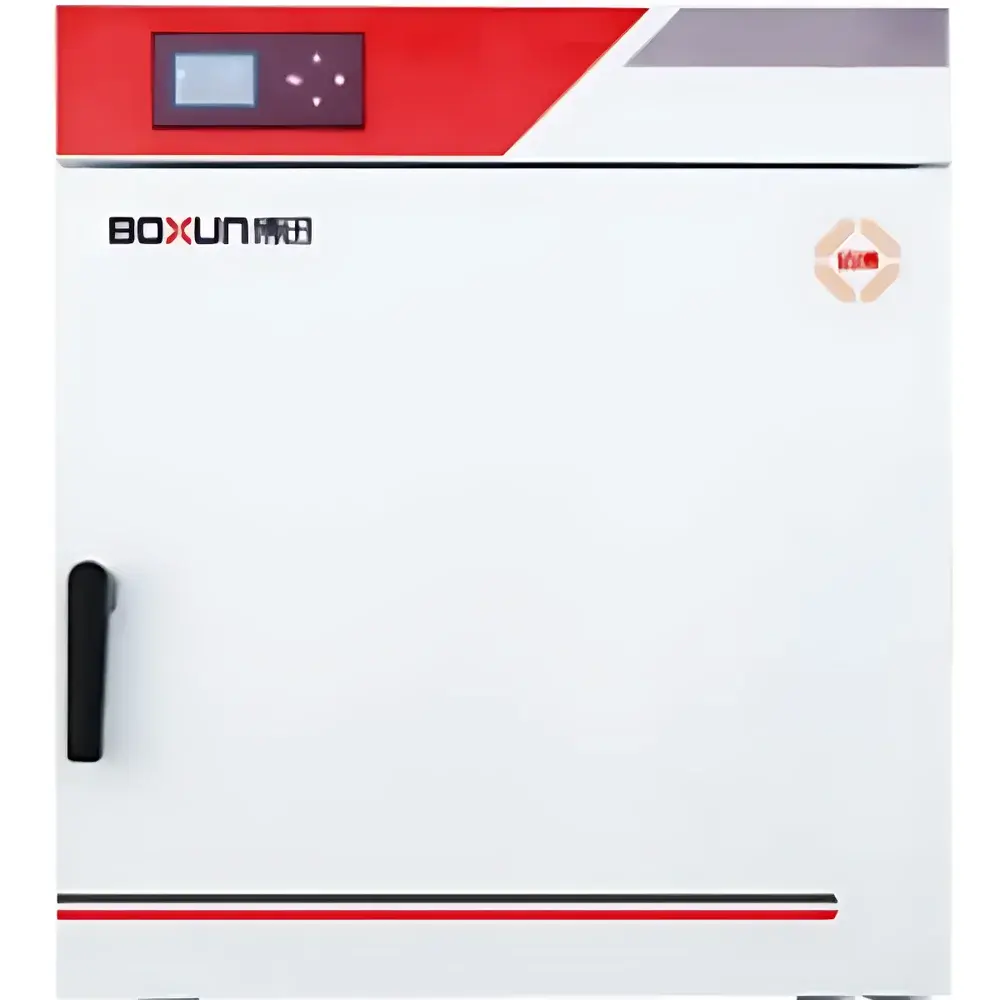
BOXUN BGZ-146 Forced-Air Drying Oven
| Key | Brand: BOXUN |
|---|---|
| Origin | Shanghai, China |
| Model | BGZ-146 |
| Temperature Range | Ambient +5°C to 300°C |
| Temperature Uniformity | ±2% |
| Temperature Fluctuation | ±0.8°C at 105°C |
| Temperature Resolution | 0.1°C |
| Internal Chamber Dimensions (W×D×H) | 570×400×570 mm |
| External Dimensions (W×D×H) | 715×616×842 mm |
| Heating Method | Forced-air convection with adjustable fan speed (6-speed) |
| Chamber Material | Mirror-finish stainless steel (AISI 304) |
| Insulation | High-density mineral fiber |
| Control System | PMMA II touchscreen interface with programmable logic |
| Programming Capacity | 10 segments × 100 cycles |
| Timer Range | 0–9999 min/h (configurable) |
| Power Supply | AC 220 V ±10%, 50 Hz ±2% |
| Input Power | 2150 W |
| Operating Ambient | 5–40°C |
| Compliance | GB/T 30435–2013 |
Overview
The BOXUN BGZ-146 Forced-Air Drying Oven is a precision-engineered laboratory drying and thermal processing instrument designed for consistent, reproducible heat treatment of samples across industrial quality control, pharmaceutical stability testing, materials science, and academic research environments. It operates on the principle of forced convection—circulating heated air via a high-efficiency, multi-speed blower system—to ensure rapid thermal equilibration and uniform temperature distribution throughout the chamber. Unlike natural-convection ovens, the BGZ-146 actively homogenizes airflow using a preheated air inlet duct and rear-mounted axial fan, minimizing thermal stratification and reducing time-to-setpoint by over 30% compared to passive designs. Its operational envelope spans from ambient +5°C to 300°C, making it suitable not only for routine drying and moisture removal but also for depyrogenation validation studies, polymer curing, and low-temperature sterilization protocols where precise thermal dosing is critical.
Key Features
- Stainless steel interior (AISI 304, mirror-polished) with seamless welded corners and removable, adjustable shelving—enabling full cavity access for cleaning and compliance with ISO 14644 cleanroom maintenance standards.
- High-performance thermal insulation using ≥80 mm thick mineral wool, achieving surface temperature rise <35°C above ambient at maximum setpoint—reducing energy consumption and improving lab safety.
- PMMA II intelligent control system featuring a 7-inch color TFT-LCD touchscreen, real-time graphical display of chamber temperature vs. setpoint, and dual-mode operation (manual/programmed).
- Programmable thermal profiles supporting up to 100 cycles across 10 user-defined segments—including ramp, soak, and cooling phases—with independent slope control and hold-on-alarm functionality.
- 6-step variable-speed fan control, allowing optimization of airflow velocity to prevent particle dispersion in powder-based or lyophilized samples—critical for GLP-compliant residual solvent analysis.
- Integrated RS-485 communication port (Modbus RTU protocol) for integration into centralized laboratory information management systems (LIMS) or supervisory control and data acquisition (SCADA) platforms.
- Auto-recovery function preserves active programs and logged data during power interruption; non-volatile memory retains calibration offsets and user preferences indefinitely.
- Dual-stage rotary door latch with silicone gasket compression ensures >95% sealing efficiency at elevated temperatures, validated per ASTM E145–22 Annex A3 for thermal leakage.
Sample Compatibility & Compliance
The BGZ-146 accommodates standard laboratory vessels—including Petri dishes, weighing boats, glass desiccators, aluminum trays, and stainless steel mesh baskets—within its 129 L working volume. Its chamber geometry (570 × 400 × 570 mm) supports ISO/IEC 17025 traceable placement of NIST-traceable thermocouples for mapping studies. The oven conforms to GB/T 30435–2013 (General Technical Requirements for Electric Hot Air Ovens), and its construction meets IEC 61010–1:2010 safety requirements for electrical equipment used in laboratory settings. When operated within defined parameters, it satisfies thermal validation prerequisites for USP dry-heat sterilization, FDA 21 CFR Part 11 audit trail readiness (via optional software logging), and ISO 13485 manufacturing process controls.
Software & Data Management
While the BGZ-146 operates autonomously via its embedded PMMA II controller, optional PC-based BOXUN LabLink software enables remote monitoring, real-time data export (CSV/Excel), and automated report generation compliant with 21 CFR Part 11 electronic records requirements—including user authentication, electronic signatures, and immutable audit trails. All temperature logs are timestamped with millisecond resolution and stored internally for ≥30 days. Data export supports both continuous streaming and event-triggered capture (e.g., alarm activation, program completion). The RS-485 interface supports daisy-chaining up to 32 units on a single bus for multi-oven fleet management in large-scale QC laboratories.
Applications
- Moisture content determination per AOAC 950.46 and ASTM D2298 for food, feed, and pharmaceutical raw materials.
- Thermal aging studies of polymers, adhesives, and composites under controlled isothermal conditions.
- Pre- and post-weighing sample conditioning in gravimetric analysis workflows (e.g., ash content, volatile matter).
- Depyrogenation of glassware and stainless-steel components at ≥250°C for parenteral manufacturing environments.
- Stability-indicating assays requiring precise thermal stress exposure (ICH Q1A–Q1E guidelines).
- Pre-drying of filters, membranes, and chromatography media prior to analytical use.
FAQ
What is the maximum allowable load weight per shelf?
Each adjustable shelf supports up to 15 kg uniformly distributed; total chamber loading must not exceed 45 kg to maintain airflow integrity and thermal uniformity.
Does the BGZ-146 support external data logging without optional software?
Yes—the built-in RS-485 interface allows direct connection to third-party data loggers or PLCs using standard Modbus RTU commands; no proprietary drivers required.
Can the oven be validated for GMP environments?
Yes—its design supports IQ/OQ/PQ execution per ASTM E2500 and EU Annex 15; qualification packages include temperature mapping templates, alarm response verification, and sensor calibration traceability documentation.
Is the stainless steel chamber electropolished or passivated?
The interior uses mechanically polished AISI 304 stainless steel with a Ra ≤ 0.8 µm surface finish, followed by citric acid passivation per ASTM A967 to enhance corrosion resistance and reduce particulate shedding.
How often does the unit require recalibration?
Annual calibration is recommended using NIST-traceable Class A PT100 probes; the controller supports two-point offset adjustment accessible via service mode with password protection.



