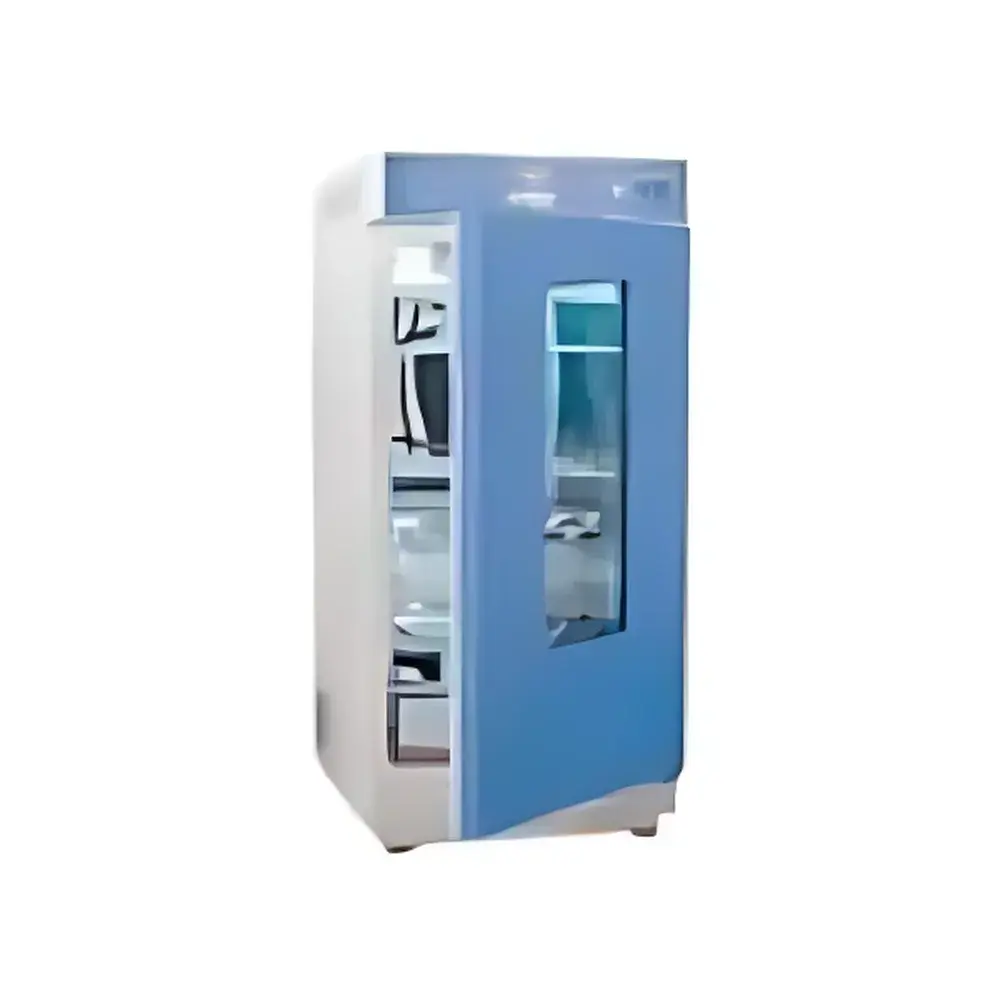
Yiheng LRH-150F Biochemical Incubator
| Brand | Yiheng |
|---|---|
| Origin | Shanghai, China |
| Refrigeration | Compressor-based (R134a) |
| Air Circulation | Forced convection |
| Temperature Range | 0–60 °C |
| Temperature Resolution | 0.1 °C |
| Temperature Uniformity | ±1.5 °C at 25 °C |
| Temperature Fluctuation | ±0.5 °C (high temp), ±1.0 °C (low temp) |
| Capacity | 150 L |
| External Dimensions | 600 × 630 × 1360 mm |
| Power Input | 600 W |
| Operating Ambient | +5 to +30 °C |
| Display | LCD controller (F-series) |
| Compliance | Designed for GLP-aligned laboratory workflows |
| Optional | RS485 interface, thermal printer port, independent over-temperature cut-off |
Overview
The Yiheng LRH-150F Biochemical Incubator is an engineered environmental chamber optimized for stable, reproducible temperature-controlled cultivation of microorganisms, cell cultures, and biological samples in academic, pharmaceutical, and industrial quality control laboratories. It operates on a precision forced-air convection principle—using a low-turbulence axial fan system and thermally balanced internal airflow pathways—to ensure uniform thermal distribution without inducing sample desiccation or mechanical stress. Unlike natural-convection units, the LRH-150F maintains consistent heat transfer across all shelf levels, critical for BOD testing, bacterial colony enumeration, fungal propagation, and seed germination studies where spatial thermal variance directly impacts metabolic rate and growth kinetics. Its compressor-based refrigeration system—charged with environmentally compliant R134a refrigerant—enables reliable sub-ambient operation down to 0 °C while meeting international energy efficiency benchmarks for Class II laboratory incubators.
Key Features
- Mirror-finish stainless steel interior (304 grade) with seamless, radius-corner construction for corrosion resistance, easy decontamination, and compliance with ISO 14644-1 cleanroom-compatible maintenance protocols.
- Microprocessor-based PID temperature controller with LCD interface (F-series designation), offering 0.1 °C resolution, programmable ramp-hold profiles, and real-time deviation monitoring.
- Intelligent fan-speed modulation: motor speed dynamically adjusts to setpoint and load conditions, minimizing convective drying of agar plates, liquid cultures, and hydrated tissue specimens.
- Dual-stage thermal safety architecture: primary control loop backed by independent mechanical over-temperature cutoff (adjustable limit, factory-set default: 65 °C), certified per IEC 61010-1 for lab equipment safety.
- Modular I/O options include RS485 serial interface (Modbus RTU protocol) for integration into centralized lab monitoring systems and optional thermal line printer support for audit-ready temperature logging.
- Three adjustable stainless steel shelves (standard configuration), each rated for ≥15 kg static load; shelf spacing optimized for standard Petri dish stacks (90 mm diameter), multi-well plates, and 500 mL Erlenmeyer flasks.
Sample Compatibility & Compliance
The LRH-150F accommodates common life science sample formats including microbiological culture media (agar, broth, slants), plant tissue explants, enzymatic reaction vessels, and environmental water samples for biochemical oxygen demand (BOD5) analysis per ASTM D5210 and ISO 5815-1. Its temperature uniformity specification (±1.5 °C at 25 °C, measured per ISO 15378 Annex C methodology) supports validation requirements for QC labs operating under GLP or GMP frameworks. While humidity control is not integrated (non-humidified design), the chamber’s sealed gasketed door and low air-exchange rate (<0.5 air changes/min) minimize evaporative loss during extended incubations—validated for 72-hour uninterrupted BOD assays and 14-day fungal sporulation studies.
Software & Data Management
The embedded controller stores up to 16 user-defined programs with start/stop timestamps and cycle counters. Via RS485, the unit interfaces with third-party SCADA platforms (e.g., Ignition, LabVIEW) or LIMS systems using standard Modbus register mapping—enabling automated data capture of setpoint, actual temperature, runtime, and alarm events. Optional thermal printer output provides hard-copy traceability compliant with FDA 21 CFR Part 11 Annex 11 expectations for “print-on-demand” audit trails. All temperature logs retain millisecond-level timestamp resolution and are exportable as CSV for statistical process control (SPC) analysis in JMP or Minitab.
Applications
- Environmental testing: BOD5 determination per APHA Standard Methods 5210B and EPA Method 1060.
- Microbiology: Aerobic/anaerobic bacterial culture (E. coli, S. aureus), yeast propagation (S. cerevisiae), and filamentous fungus maintenance (Aspergillus spp.).
- Pharmaceutical QC: Stability testing of raw materials per ICH Q1A(R2) guidelines at controlled temperature (no humidity control required for short-term accelerated studies).
- Agricultural research: Seed viability assays, rhizobial inoculant production, and pesticide degradation kinetics under defined thermal regimes.
- Educational labs: Undergraduate microbiology practicums requiring reliable, entry-level incubation platforms with regulatory-aware design fundamentals.
FAQ
Does the LRH-150F support humidity control?
No—this is a non-humidified incubator. Relative humidity is unregulated and will equilibrate with ambient lab conditions (typically 30–60% RH at 20–25 °C). For humidity-dependent applications (e.g., mammalian cell culture), consider Yiheng’s HH series CO₂ incubators.
What validation documentation is provided?
Factory calibration certificate (NIST-traceable Pt100 sensor), IQ/OQ checklist template, and temperature mapping protocol guidance per ISO 14644-3 are included. Full PQ support requires on-site verification using calibrated data loggers.
Is the RS485 interface enabled by default?
Yes—the port is hardware-present and functional out-of-box; no firmware activation is required. Modbus register map and wiring diagram are supplied in the technical manual.
Can the unit operate continuously at 4 °C?
Yes—compressor duty cycle remains stable within the full 0–60 °C range. Continuous operation at 4 °C is validated for ≥30 days with ≤±0.8 °C fluctuation (load: three fully loaded shelves, ambient 25 °C/50% RH).
What is the mean time between failures (MTBF) for the compressor?
Based on accelerated life testing per IEC 60068-2-64, the Danfoss BD35F compressor exhibits MTBF >35,000 hours under nominal lab-use conditions (8 hrs/day, 5 days/week, 25 °C ambient).