
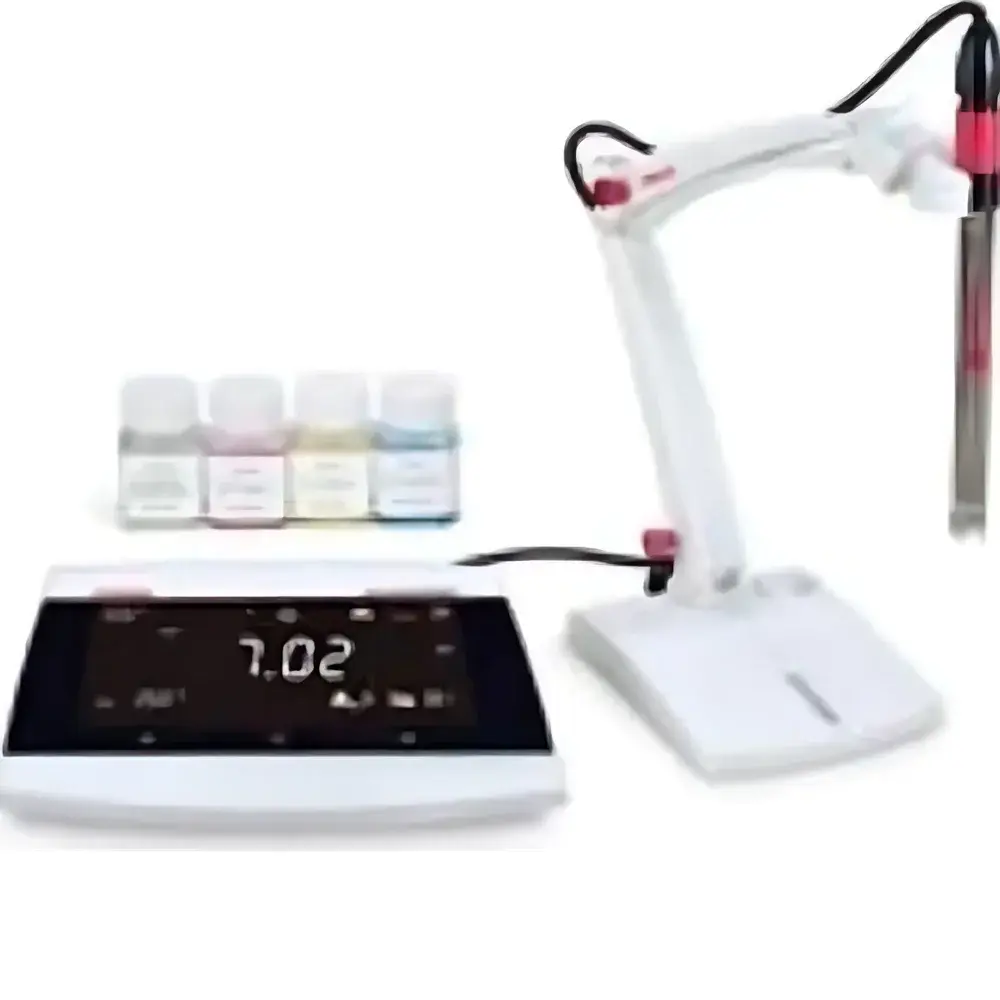
OHAUS AB33PH-F ZH Benchtop pH Meter (Successor to ST3100)
| Brand | OHAUS |
|---|---|
| Origin | Jiangsu, China |
| Model | AB33PH-F ZH (formerly ST3100) |
| Instrument Type | Benchtop |
| Parameter Types | pH / mV / Temperature |
| Measurement Accuracy | ±0.01 pH |
| Measurement Range | 0.00–14.00 pH |
| Resolution | 0.01 pH |
| Calibration Buffers | USA-type (also supports Chinese & European buffer sets) |
| Data Storage | 99 measurement records + last calibration data |
| Temperature Compensation | Automatic or manual (NTC 30 kΩ sensor) |
| Input Interfaces | BNC pH input (input impedance >10¹² Ω), Cinch temperature input, 2-mm reference electrode socket |
| Communication | RS232 output (compatible with OHAUS printers) |
| Power Supply | 110–240 V AC, 50 Hz / DC 12 V |
| Dimensions | 220 × 175 × 78 mm (W × D × H) |
| Weight | 0.75 kg |
| Housing Material | ABS |
| Compliance | CE, ISO 9001, CMC certified, GLP/GMP-ready audit trail support |
Overview
The OHAUS AB33PH-F ZH Benchtop pH Meter is the direct successor to the widely deployed STARTER 3100 series, engineered for precision electrochemical measurement in routine laboratory environments. It operates on the fundamental principle of potentiometric pH determination: measuring the potential difference between a pH-sensitive glass electrode and a stable reference electrode immersed in an aqueous sample, converting the Nernstian voltage response (mV) into a calibrated pH value. Designed for robust daily use, the instrument integrates dual-mode temperature compensation—either automatic via integrated NTC 30 kΩ sensor or manual entry—to correct for solution temperature effects on electrode response and buffer calibration points. Its benchtop form factor, compact ABS housing, and modular mounting bracket ensure stable placement on lab benches or integration into QC workflows without requiring dedicated enclosures.
Key Features
- Triple-parameter capability: simultaneous high-resolution measurement of pH (0.00–14.00), redox potential (−1999 to +1999 mV), and temperature (0–100 °C)
- Calibration flexibility: supports three pre-programmed buffer group standards—USA (4.01, 7.00, 10.01), China (4.00, 6.86, 9.18), and European (4.01, 7.00, 9.21)—with automatic recognition during multi-point calibration
- Intelligent endpoint detection: selectable auto-read (stable-signal hold) or manual freeze mode for operator-controlled reading confirmation
- GLP/GMP-compliant data handling: stores up to 99 measurement records with timestamps and retains full calibration history—including date, buffer values used, slope (%), and offset (mV)—accessible for internal audits
- RS232 serial interface enables direct connection to OHAUS-compatible thermal printers for hard-copy documentation, satisfying traceability requirements under ISO/IEC 17025 and FDA 21 CFR Part 11 (when paired with compliant software and access controls)
- High-impedance BNC input (>10¹² Ω) ensures minimal loading error with standard pH electrodes; dedicated 2-mm reference electrode socket and Cinch temperature probe connector provide secure, low-noise signal paths
Sample Compatibility & Compliance
The AB33PH-F ZH is validated for use with standard aqueous solutions across pharmaceutical, food & beverage, environmental, and academic laboratories. It accommodates common single-junction and double-junction pH electrodes, as well as combination electrodes with integrated temperature sensors. The instrument meets CE marking requirements per Directive 2014/30/EU (EMC) and 2014/35/EU (LVD), complies with ISO 9001:2015 quality management system standards, and holds China Metrology Certification (CMC) for legal metrological use within PRC-regulated applications. Its firmware architecture supports audit-trail generation for calibration and measurement events—critical for laboratories operating under GLP (OECD Principles) or GMP (ICH Q7, USP ) frameworks.
Software & Data Management
While the AB33PH-F ZH operates autonomously via its built-in LCD interface, its RS232 port allows seamless integration with third-party laboratory information systems (LIMS) or custom data acquisition platforms using standard ASCII protocol commands. All stored measurements include date/time stamps, parameter identifiers (pH/mV/°C), and unit annotations. Calibration logs record slope (typically 95–105 % for fresh electrodes), asymmetry potential, and deviation from theoretical mV/pH slope (−59.16 mV/pH at 25 °C), enabling predictive maintenance and electrode performance trending. No proprietary software is required for basic operation, but optional OHAUS data logging utilities support CSV export and report formatting aligned with internal SOPs.
Applications
This meter serves critical roles in quality control laboratories performing raw material verification (e.g., buffer stock pH validation per USP ), finished product testing (e.g., topical pharmaceutical pH per EP 2.2.3), wastewater effluent monitoring (EPA Method 150.1), and educational titration labs. Its 0.01 pH resolution and ±0.01 pH accuracy meet specifications for Class II pH meters defined in DIN 19265 and ASTM E70. The wide mV range supports non-aqueous redox assessments and ion-selective electrode (ISE) compatibility when used with appropriate adapters and reference systems.
FAQ
Does the AB33PH-F ZH support automatic buffer recognition for all three regional buffer sets?
Yes—the instrument detects and applies the correct theoretical pH values based on selected buffer group (USA, China, or Europe) during calibration, eliminating manual lookup errors.
Can the device store calibration data separately from measurement records?
No—calibration metadata (date, buffers used, slope, offset) is embedded within the device’s persistent memory and recalled alongside each measurement session; it is not stored as independent files.
Is the RS232 interface compatible with modern Windows or macOS systems?
Yes, using a USB-to-RS232 adapter and terminal emulation software (e.g., Tera Term, CoolTerm); no drivers are required for basic ASCII command-response communication.
What is the recommended electrode conditioning procedure before first use?
Soak the glass membrane in pH 4.01 buffer or 3 M KCl solution for ≥2 hours; rinse thoroughly with deionized water and blot gently—do not wipe.
How frequently should the instrument be recalibrated in routine QC use?
Per ISO/IEC 17025:2017, recalibration is required before each batch of samples, after electrode replacement, following temperature shifts >5 °C, or at intervals defined by laboratory-specific uncertainty budgets—typically every 2–4 hours during continuous operation.




