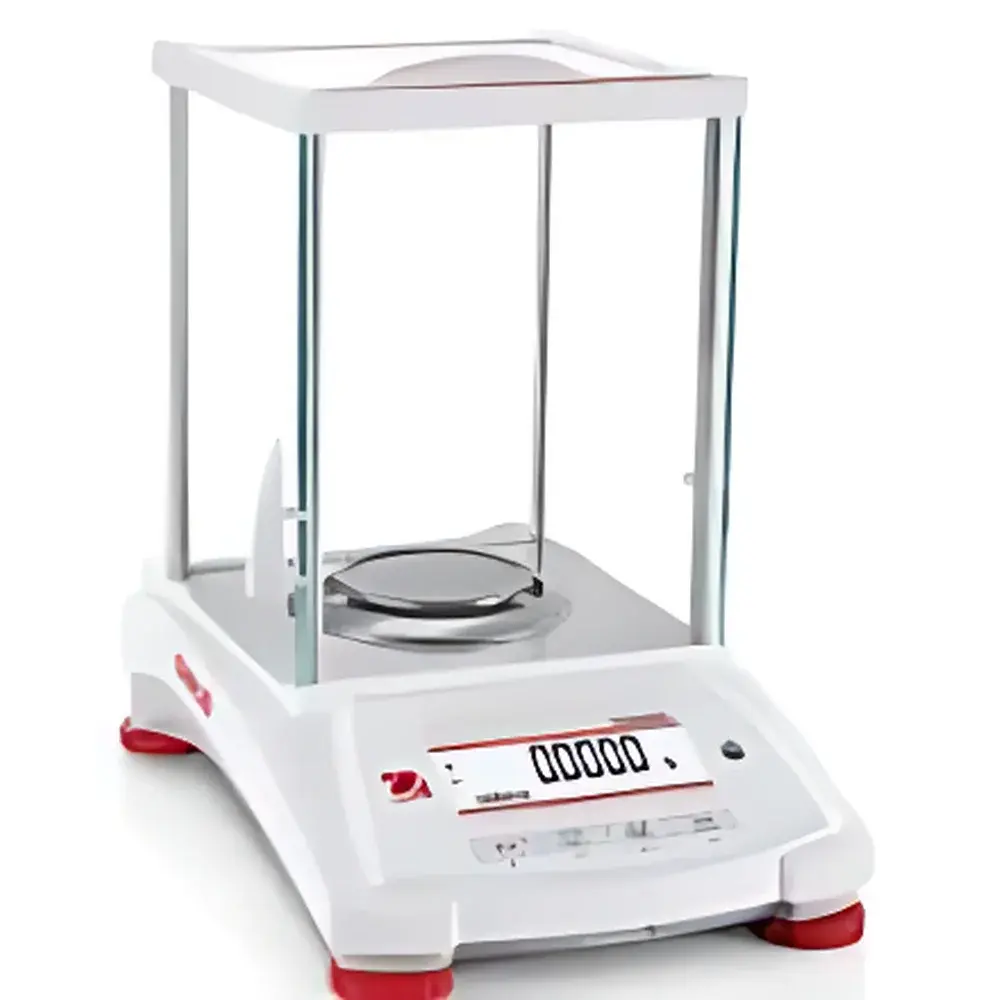
OHAUS PX223ZH and PX223ZH/E Precision Balance (220 g / 0.001 g)
| Brand | OHAUS |
|---|---|
| Origin | USA |
| Model | PX223ZH, PX223ZH/E |
| Maximum Capacity | 220 g |
| Readability | 0.001 g |
| Repeatability | 0.001 g |
| Calibration | External |
| Application Class | Laboratory Precision Balance |
| Operating Temperature | 10–30 °C |
| Operating Humidity | ≤80% RH (at ≤30 °C), linearly decreasing to 50% RH at 40 °C |
| Interface | RS232, USB |
| Display | Backlit LCD with dual-line operation prompts |
| Construction | Die-cast aluminum base, removable stainless-steel pan, glass draft shield, underhook weighing, anti-theft lock |
Overview
The OHAUS PX223ZH and PX223ZH/E are high-reliability precision balances engineered for routine laboratory applications requiring consistent 0.001 g readability and robust environmental adaptability. Designed as a direct successor to the AR series, these models operate on electromagnetic force compensation (EMFC) technology — a proven method delivering stable, drift-resistant measurements under variable ambient conditions. With a maximum capacity of 220 g and a repeatability of ±0.001 g (standard deviation), the PX223ZH/E meets ISO/IEC 17025 metrological requirements for intermediate-precision mass measurement in QC labs, academic teaching environments, and light industrial quality control workflows. The balance’s thermal stability is optimized via low-drift sensor architecture and integrated temperature compensation algorithms, enabling reliable performance across its specified operating range of 10–30 °C and up to 80% relative humidity (at ≤30 °C). Its compact footprint (209 × 321 × 309 mm) and modular mechanical design support integration into fume hoods, glove boxes, and benchtop analytical workstations.
Key Features
- Die-cast aluminum base and reinforced plastic housing ensure long-term mechanical stability and resistance to vibration-induced drift.
- Removable 120 mm stainless-steel weighing pan and full-height glass draft shield provide contamination control and ease of cleaning — compliant with GLP hygiene protocols.
- Underhook weighing capability enables density determination and suspended sample measurement without accessory modification.
- Dual-line backlit LCD displays real-time mass value on the top line and context-sensitive operational prompts (e.g., “CAL”, “TARE”, “UNIT”) on the bottom line — supporting intuitive operation without reference to manuals.
- Integrated ESD mitigation system features a red electrostatic discharge (ESD) removal bar mounted above the weighing chamber, reducing static-induced errors during low-mass or dry-powder handling.
- Four tactile mechanical keys enable rapid access to core functions: Tare, Unit, Menu, and Print — minimizing operator training time and input error risk.
- User-configurable parameters include display brightness, auto-dimming delay, environmental damping settings, overload/underload alerts, and stability indicators — all adjustable without firmware updates.
- Multi-language interface supports English, Spanish, French, and Chinese — facilitating deployment across multinational research and manufacturing sites.
Sample Compatibility & Compliance
The PX223ZH/E accommodates a wide range of sample types, including powders, granules, liquids in tared containers, small components, and biological specimens. Its 120 mm pan diameter and 220 g capacity make it suitable for USP minimum weight testing (with typical minimum weighable quantity of 2.0 g at U = 0.10%, k = 2), ASTM E898-22 gravimetric procedures, and ISO 9001-certified calibration recordkeeping. The balance complies with EN 45501:2015 (accuracy class II), supports GLP/GMP audit trails via timestamped RS232/USB data export, and includes built-in real-time clock functionality for traceable measurement logging. All firmware and calibration routines adhere to OIML R76-1 metrological guidelines for non-automatic weighing instruments.
Software & Data Management
Data output is fully configurable through standard RS232 and USB interfaces — compatible with LabArchives, Empower, and custom LIMS platforms. Each transmitted record includes date/time stamp, net/gross/tare values, unit identifier, user ID, and stability flag. Optional OHAUS Acuity software enables automated calibration scheduling, statistical process control (SPC) charting, and compliance reporting aligned with FDA 21 CFR Part 11 requirements (when used with validated PC configuration). Internal memory stores up to 999 records with timestamps; exported files follow ASCII-delimited format (.txt) for seamless spreadsheet import. Communication protocols support both continuous streaming and triggered event transmission (e.g., upon stabilization or key press).
Applications
- General laboratory weighing: Preparation of standards, reagents, and buffers where ±0.001 g resolution satisfies pharmacopeial and regulatory thresholds.
- Counting mode: Piece-counting of uniform parts (e.g., tablets, screws, microcentrifuge tubes) using stored sample averages — with automatic correction for count drift over time.
- Percentage weighing: Formulation of multi-component mixtures relative to a reference mass, commonly applied in polymer blending and catalyst preparation.
- Checkweighing: In-process verification against upper/lower tolerance limits — visualized via dynamic bar-graph progress indicator on the display.
- Animal weighing: Dynamic stabilization algorithm filters out motion artifacts during live-animal or small-rodent weighing.
- Density determination: Integrated density calculation module uses Archimedes’ principle with optional sinker kit (sold separately), supporting ISO 1183-1 and ASTM D792 procedures.
FAQ
Is internal calibration available on the PX223ZH/E?
No — the PX223ZH/E is externally calibrated only. It requires a certified Class M2 or better weight set (e.g., 100 g or 200 g) for routine verification and adjustment.
What is the recommended minimum sample mass for regulatory compliance?
Per USP , the minimum weighable quantity is 2.0 g at 0.10% uncertainty (k = 2), assuming nominal repeatability of 0.001 g. This value may be reduced under controlled humidity and draft-free conditions.
Can the balance interface with a networked LIMS system?
Yes — via RS232-to-Ethernet or USB-to-serial gateways, provided the host system accepts ASCII-formatted serial input with configurable delimiters and carriage-return termination.
Does the PX223ZH/E support GLP-compliant audit trails?
Yes — when connected to a validated computer running OHAUS Acuity or equivalent software, all calibrations, tare events, and measurement exports are timestamped and user-identified per 21 CFR Part 11 Subpart B requirements.
What environmental conditions affect measurement stability?
Air currents, temperature gradients >0.5 °C/min, and electrostatic charge accumulation are primary contributors. Use of the glass draft shield, ESD bar, and placement on a vibration-isolated surface mitigates these effects.