
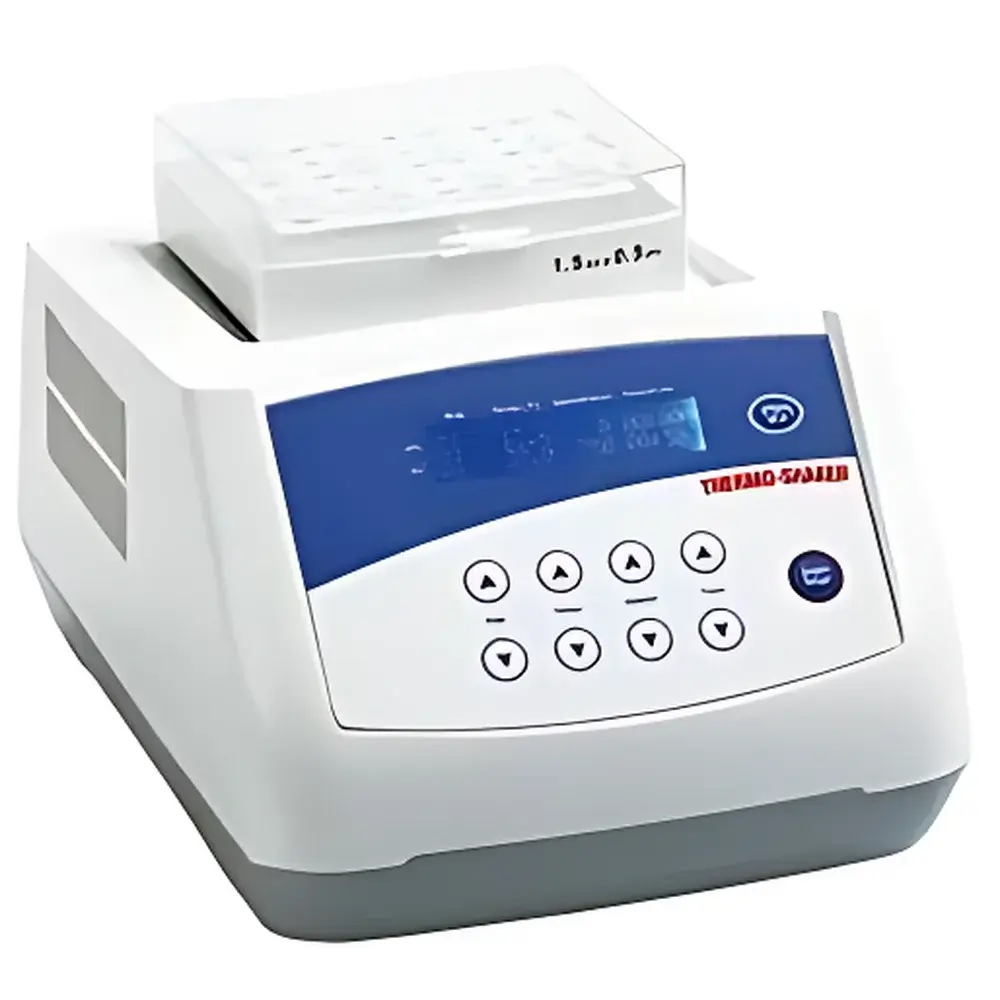
Yiheng TUS-200P Oscillating Dry Bath Incubator
| Brand | Yiheng |
|---|---|
| Model | TUS-200P |
| Temperature Range | RT+5 to 100°C |
| Temperature Accuracy | ±0.1°C |
| Temperature Uniformity | ≤±0.5°C |
| Temperature Stability | ±0.5°C |
| Heating Rate | <12 min (20°C to 100°C) |
| Oscillation Speed | 200–1500 rpm (1 rpm increments) |
| Oscillation Mode | Horizontal circular, 2 mm amplitude |
| Timer Range | 0–99 h 59 min |
| Display | LCD with multi-parameter real-time view |
| Power Supply | AC 220 V, 50/60 Hz, 2.5 A, max. 150 VA |
| Dimensions | 300 × 212 × 180 mm |
| Net Weight | 7 kg |
| Motor Type | Brushless DC motor with soft-start |
| Standard Modules | E-module (15×0.5 mL + 20×1.5 mL) included |
| Module Compatibility | A (96×0.2 mL), B (54×0.5 mL), C (35×1.5 mL), D (35×2.0 mL), E (15×0.5 mL + 20×1.5 mL) |
| Safety Features | Auto-restart after power interruption, audible end-of-timer alarm |
Overview
The Yiheng TUS-200P Oscillating Dry Bath Incubator is a precision-engineered thermal platform designed for simultaneous temperature control and controlled agitation of small-volume samples in microtubes, PCR strips, and vials. Unlike water baths or heating blocks, this dry bath utilizes solid aluminum heating blocks with integrated oscillation mechanics—enabling rapid, uniform heat transfer without evaporation risk or contamination concerns. Its operation is based on Peltier-free resistive heating combined with closed-loop PID temperature regulation and brushless DC motor-driven horizontal orbital shaking (2 mm amplitude). The system is optimized for applications requiring reproducible thermal incubation under mild agitation—including enzyme reactions, cell lysis, DNA hybridization, ligand binding assays, and sample homogenization prior to downstream analysis. With a working temperature range from ambient +5°C to 100°C and sub-degree stability, the TUS-200P meets routine laboratory demands while maintaining compatibility with GLP-aligned workflows through deterministic timing, traceable setpoint retention, and non-volatile parameter storage.
Key Features
- Precision PID-controlled heating system delivering ±0.1°C display resolution and ≤±0.5°C uniformity across the block surface
- Horizontally oscillating platform with continuously adjustable speed from 200 to 1500 rpm in 1-rpm increments, enabling fine-tuned mixing intensity
- Brushless DC motor with soft-start functionality ensures low mechanical noise, extended service life (>20,000 hours), and zero maintenance requirements
- Large backlit LCD interface displaying real-time temperature, setpoint, elapsed/remaining time, and current rpm simultaneously
- Programmable timer (0–99 h 59 min) with audible alarm at completion and auto-shutdown option
- Power-fail recovery mode retains all active settings and resumes operation automatically upon mains restoration
- Modular block architecture supporting rapid interchange of standardized aluminum modules (A–E) for diverse tube formats; custom module design available upon request
- Compact footprint (300 × 212 × 180 mm) and lightweight construction (7 kg) facilitate benchtop deployment in crowded analytical or QC laboratories
Sample Compatibility & Compliance
The TUS-200P accommodates standard microcentrifuge tubes (0.2–2.0 mL), PCR strips, and low-profile vials via five interchangeable aluminum blocks. Its horizontal orbital motion minimizes foaming and shear stress compared to vortexing, making it suitable for sensitive biological samples such as plasmid preps, antibody dilutions, and protein solubilization steps. While not certified to ISO/IEC 17025 or FDA 21 CFR Part 11 out-of-the-box, the instrument supports audit-ready usage when integrated into documented SOPs: all temperature setpoints, timer values, and rpm selections are retained in non-volatile memory, and the absence of network connectivity eliminates data integrity risks associated with remote firmware updates. It complies with IEC 61010-1:2010 for electrical safety in laboratory equipment and operates within Class II pollution degree environments.
Software & Data Management
The TUS-200P operates as a standalone, embedded-control device with no external software dependency. All operational parameters—including temperature setpoint, oscillation speed, and timer duration—are configured directly via the front-panel keypad and validated by visual feedback on the LCD. No drivers, cloud services, or proprietary applications are required. For laboratories implementing electronic lab notebooks (ELNs) or LIMS integration, manual entry of run conditions is supported by the device’s deterministic behavior: identical inputs yield identical thermal and kinetic outputs across units and over time. Optional RS-232 or USB-to-serial adapters (not included) may be used for basic ASCII command logging if connected to third-party data acquisition systems, though the unit does not support bidirectional communication or real-time data streaming.
Applications
- Enzymatic digestions (e.g., restriction enzyme incubations at 37°C with gentle mixing)
- Thermal denaturation and renaturation studies of nucleic acids
- Cell suspension homogenization prior to centrifugation or filtration
- Antibody conjugation and labeling reactions requiring consistent thermal input and mixing
- Pre-analytical sample preparation for HPLC, GC, or mass spectrometry workflows
- Quality control testing of reagent stability under accelerated thermal conditions
- Teaching labs performing kinetics experiments where reproducibility and ease of use are prioritized
FAQ
Does the TUS-200P support external temperature probes for independent verification?
No—the unit relies solely on its internal PT100 sensor embedded in the aluminum block; no probe port or calibration offset function is provided.
Can multiple modules be heated simultaneously?
No—only one module is mounted and heated at a time; swapping modules requires manual intervention and thermal equilibration.
Is the oscillation motion programmable in terms of direction or pattern?
No—it provides fixed horizontal circular motion only; no linear, reciprocating, or variable-angle options are available.
What is the maximum load capacity per module?
Maximum recommended total mass is 500 g, distributed evenly across the module wells to maintain thermal uniformity and mechanical balance.
Does the device meet CE or UL certification requirements?
It carries CE marking per Directive 2014/30/EU (EMC) and 2014/35/EU (LVD); UL listing is not held, but design conforms to UL 61010-1 equivalency for safety.



