
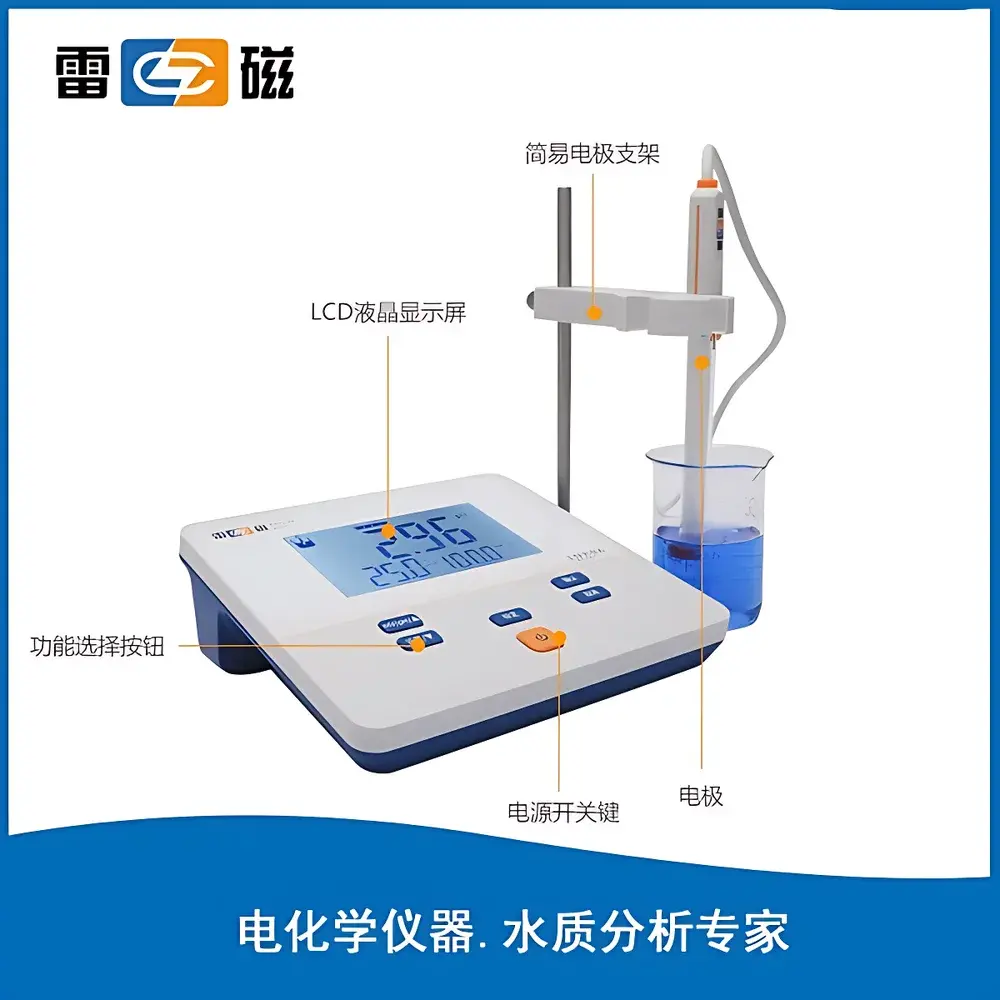
Leici PHS-2F Benchtop pH Meter
| Brand | Leici |
|---|---|
| Origin | Shanghai, China |
| Instrument Type | Benchtop |
| Parameter Type | Single-parameter (pH/mV) |
| Measurement Range | 0.00–14.00 pH |
| Resolution | 0.01 pH |
| Accuracy | ±0.01 pH ±1 digit |
| Basic Error | ±0.01 pH ±1 digit |
| Input Impedance | ≥1×10¹² Ω |
| Stability | (±0.01 pH ±1 digit)/3 h |
| Temperature Compensation | Manual, 0.0–60.0 °C |
| Display | LCD |
| Calibration | Up to 2-point, auto-recognition of 3 standard buffer solutions (Chinese national standard buffers) |
| Power Supply | AC 220 V ±22 V, 50 Hz ±1 Hz |
| Dimensions (W×D×H) | 290 × 210 × 95 mm |
| Weight | 1.5 kg |
Overview
The Leici PHS-2F Benchtop pH Meter is a precision electrochemical instrument engineered for routine pH and millivolt (mV) measurements in academic teaching laboratories, quality control environments, and industrial process support settings. It operates on the fundamental principle of potentiometric measurement: detecting the potential difference between a pH-sensitive glass electrode and a stable reference electrode immersed in an aqueous sample, then converting that voltage into a pH value using the Nernst equation. Designed to meet Chinese national metrological verification regulations (JJG 119–2018), the PHS-2F conforms to Class 0.02 accuracy requirements—making it suitable for applications where trace-level consistency is required but not governed by GLP/GMP or FDA 21 CFR Part 11 regulatory mandates. Its fixed 0.01 pH resolution and ±0.01 pH ±1 digit basic error ensure reproducible results across daily calibration cycles, while its high input impedance (>1×10¹² Ω) minimizes loading effects during measurement of low-conductivity samples.
Key Features
- LCD display with clear segment-based readout for pH and mV values, optimized for ambient lab lighting conditions
- Dual-mode measurement capability: calibrated pH mode and direct mV (redox) mode, supporting both qualitative and quantitative electrochemical analysis
- Two-point calibration protocol with automatic recognition of three nationally standardized pH buffer solutions (pH 4.01, 6.86, and 9.18 at 25 °C per GB/T 27501–2011)
- Manual temperature compensation (MTC) functionality covering 0.0–60.0 °C, enabling correction of electrode response drift without integrated temperature probe hardware
- User-configurable calibration via manual entry of custom buffer values, accommodating non-standard or proprietary reference solutions
- Stable analog front-end architecture with low-drift circuitry, delivering (±0.01 pH ±1 digit)/3 h short-term stability under continuous operation
- Compact benchtop form factor (290 × 210 × 95 mm) and lightweight design (1.5 kg) for space-constrained workstations
Sample Compatibility & Compliance
The PHS-2F is validated for use with standard aqueous electrolyte solutions, buffer standards, environmental water samples, and general-purpose chemical process streams. It supports common pH composite electrodes—including Leici’s E-201-C type—with BNC input connectivity and standard reference junction compatibility. While not equipped with automatic temperature sensing or digital electrode identification, its manual temperature compensation allows adaptation to moderate thermal gradients typical in classroom or workshop environments. The instrument complies with GB/T 27501–2011 (General Specifications for Laboratory pH Meters) and JJG 119–2018 (Verification Regulation for pH Meters), ensuring metrological traceability within China’s national measurement system. It does not incorporate audit trail, electronic signature, or data integrity features required under FDA 21 CFR Part 11 or ISO/IEC 17025; therefore, it is intended for non-regulated, internal-use applications only.
Software & Data Management
The PHS-2F operates as a standalone, embedded-system instrument with no onboard memory or digital interface. All measurements are displayed in real time and must be manually recorded. No firmware updates, remote configuration, or PC connectivity (e.g., RS-232, USB, or Bluetooth) are supported. This design prioritizes operational simplicity, electromagnetic noise immunity, and long-term reliability in environments where networked instrumentation introduces unnecessary complexity or cybersecurity exposure. Users requiring data logging, export, or integration into LIMS should pair the PHS-2F with external recording devices or consider higher-tier models such as the PHSJ-3F or PHSJ-4A, which feature RS-232 output and 200-point internal storage.
Applications
- Undergraduate and graduate chemistry laboratory instruction for acid-base titration endpoint verification and buffer preparation validation
- Routine QC testing of cleaning agents, disinfectants, and rinse waters in pharmaceutical manufacturing support areas
- Environmental monitoring of surface water, wastewater influent, and effluent streams in municipal and industrial treatment facilities
- Food and beverage production line checks for product consistency (e.g., dairy fermentation, soft drink carbonation, sauce formulation)
- Electroplating bath maintenance and corrosion inhibitor evaluation in metal finishing operations
- Calibration verification of field-deployable pH probes and portable meters using traceable reference standards
FAQ
What buffer solutions are recognized by the PHS-2F during auto-calibration?
The instrument automatically identifies the three primary Chinese national standard buffers: pH 4.01 (potassium hydrogen phthalate), pH 6.86 (phosphate), and pH 9.18 (borax) at 25 °C, per GB/T 27501–2011.
Does the PHS-2F support automatic temperature compensation (ATC)?
No. Temperature compensation is manual only; users must enter the measured sample temperature via front-panel keys before reading pH.
Can the PHS-2F measure samples with very low ionic strength, such as deionized water?
It can display a value, but accuracy is not assured below ~50 µS/cm conductivity due to unstable junction potentials and high electrode impedance effects. For ultrapure water, specialized low-conductivity electrodes and instruments with flow cells or cation-exchange membranes are recommended.
Is the PHS-2F compliant with ISO/IEC 17025 or GLP documentation requirements?
No. It lacks timestamped data storage, user access controls, calibration history retention, or electronic audit trails—features essential for accredited testing laboratories.
What is the expected service life of the E-201-C electrode when used with the PHS-2F?
Under normal use (daily calibration, proper storage in 3 M KCl solution, avoidance of protein/fat fouling), the E-201-C typically maintains specification performance for 12–18 months. Electrode slope verification should be performed weekly using two-point calibration diagnostics.





