
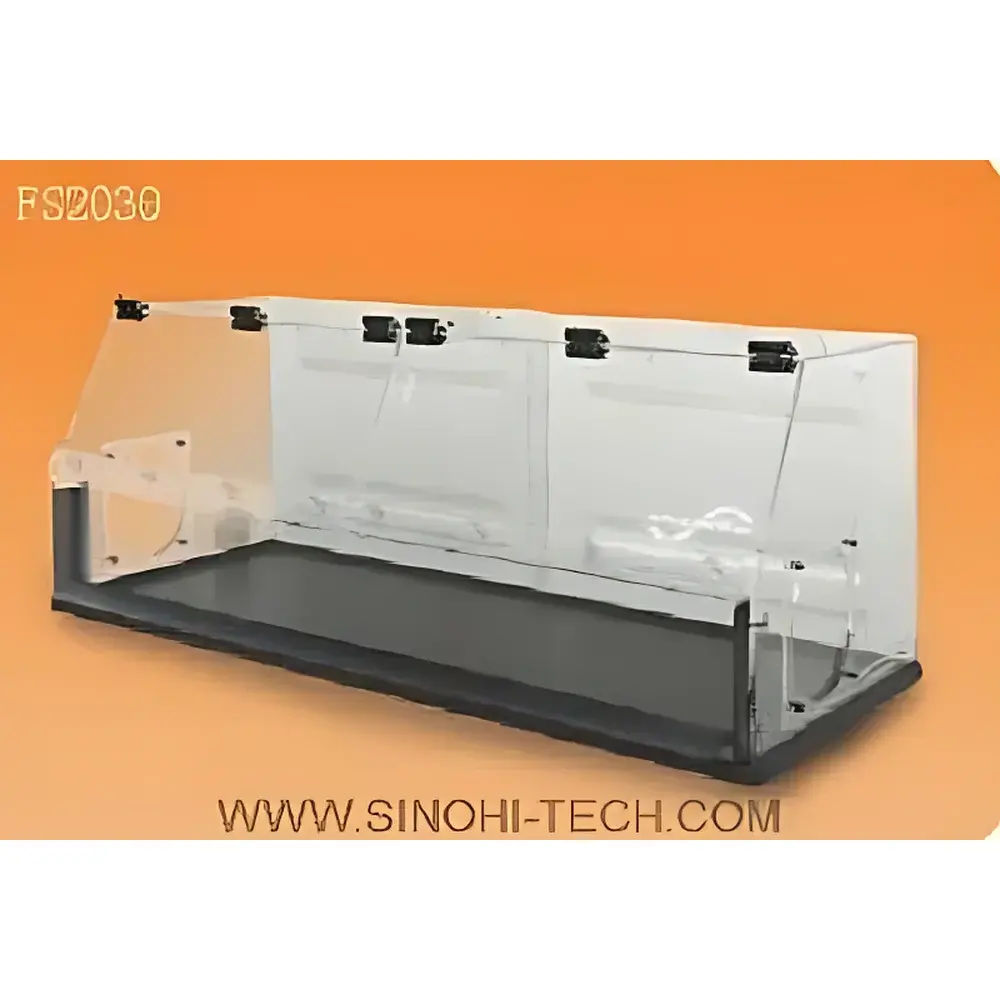
Flow Sciences FS2030 Balance Safety Enclosure
| Origin | USA |
|---|---|
| Manufacturer Type | Authorized Distributor |
| Origin Category | Imported |
| Model | FS2030 |
| Pricing | Available Upon Request |
Overview
The Flow Sciences FS2030 Balance Safety Enclosure is an engineered containment solution specifically designed for high-precision analytical and micro-balances operating in regulated laboratory environments. Unlike conventional fume hoods or general-purpose enclosures, the FS2030 integrates aerodynamic containment with vibration-isolated work surface integration to preserve balance stability—critical when measuring samples at sub-milligram resolution. It operates on a constant-volume, low-turbulence airflow principle: conditioned room air is drawn uniformly across the work surface via optimized front sash and rear plenum geometry, minimizing air velocity fluctuations (<0.02 m/s RMS deviation) that could induce buoyancy effects or mechanical oscillation in sensitive load cells. The enclosure meets ANSI/AIHA Z9.5–2012 performance criteria for balance enclosures and is validated for use with Class I, II, and III analytical balances per USP and ISO 17025 requirements for weighing uncertainty control.
Key Features
- Aerodynamically contoured airflow edge wings—patented design directing laminar flow from sash opening to rear baffle without eddy formation or recirculation zones
- Concave resin composite base with seamless, chemical-resistant surface; rated for full-pressure spray cleaning (up to 60 psi) and compatible with decontamination protocols using 70% ethanol, 10% bleach, or hydrogen peroxide vapor
- Integrated face velocity alarm system with audible/visual alert and real-time digital readout (0.3–0.6 m/s range), compliant with ASHRAE 110 verification methodology
- Dual-side modular access ports: standardized 100 mm diameter openings for optional waste bag adapters, glove port inserts, or inert gas purging manifolds
- Non-perforated, optically flat tempered glass sash (6 mm thickness) with dual-position stop mechanism for reproducible operator positioning during gravimetric procedures
- Structural frame fabricated from powder-coated cold-rolled steel with reinforced corner joints; total mass (84.37 kg) contributes to passive vibration damping under floor-mounted installation
Sample Compatibility & Compliance
The FS2030 accommodates standard benchtop analytical balances up to 400 mm depth and 350 mm width—including models from Mettler Toledo (XSE/XSR series), Sartorius (Entris/Secura), and Ohaus (Adventurer Pro). Its internal dimensions (1518 mm W × 584 mm D × 495 mm H) provide ≥100 mm clearance above balance pan height to prevent airflow disruption during door opening/closing cycles. The enclosure is certified to UL 61010-1 (Safety Requirements for Electrical Equipment for Measurement, Control, and Laboratory Use) and conforms to NFPA 45 (Standard on Fire Protection for Laboratories Using Chemicals) for Class B hazardous material handling. Optional HEPA filtration (EN 1822 H14) or activated carbon scrubber modules enable compliance with OSHA PEL and ACGIH TLV exposure limits for volatile organics and fine particulates (e.g., cytotoxic APIs, nanomaterials, heavy metal salts).
Software & Data Management
While the FS2030 is a standalone mechanical enclosure, its analog face velocity sensor output (4–20 mA) is compatible with third-party building management systems (BMS) and laboratory information management systems (LIMS) via Modbus RTU or BACnet MS/TP gateways. When integrated into GLP/GMP workflows, the alarm event log (timestamped, with velocity deviation delta) supports 21 CFR Part 11-compliant audit trails when paired with validated data acquisition software such as LabArchives ELN or Thermo Fisher SampleManager LIMS. Calibration certificates for initial airflow validation are provided with NIST-traceable anemometer reports (±1.5% accuracy), and annual requalification follows ISO/IEC 17025 clause 6.4.5 for environmental monitoring equipment.
Applications
- High-accuracy gravimetric preparation of reference standards in pharmaceutical QC labs (ICH Q5, Q7)
- Weighing of potent compounds (OEB 3–5) requiring containment integrity verified by tracer gas testing (SF₆, per ISO 10637)
- Microgram-level formulation of catalysts and battery electrode slurries in materials R&D
- USP and compliant compounding of sterile and hazardous drugs
- ISO/IEC 17025 accredited calibration laboratories performing balance verification under controlled thermal and airflow conditions
FAQ
Does the FS2030 require external ducting?
No—it is a recirculating (ductless) enclosure with optional dual-stage filtration; however, hard-ducted configuration is available for applications involving high-boiling-point solvents or non-adsorbed vapors.
Can it be used with automatic balance doors?
Yes—the sash opening profile and internal clearance are engineered to interface with Mettler Toledo AutoDoor™ and Sartorius Cubis® II motorized draft shields without airflow interference.
Is vibration isolation built into the base?
The concave resin base is not actively isolated, but its mass distribution and mounting interface reduce transmission of broadband floor vibrations (10–100 Hz) by ≥12 dB compared to standard laminate benches, per ASTM E1876 modal analysis guidelines.
What maintenance intervals are recommended?
Filter replacement every 6–12 months depending on usage intensity; annual airflow mapping and alarm calibration per ISO 14644-3 Annex B; sash track lubrication every 24 months using food-grade silicone grease.
Is electrical certification available for EU markets?
CE marking is provided under Machinery Directive 2006/42/EC and EMC Directive 2014/30/EU; RoHS 2011/65/EU compliance documentation included with shipment.



