
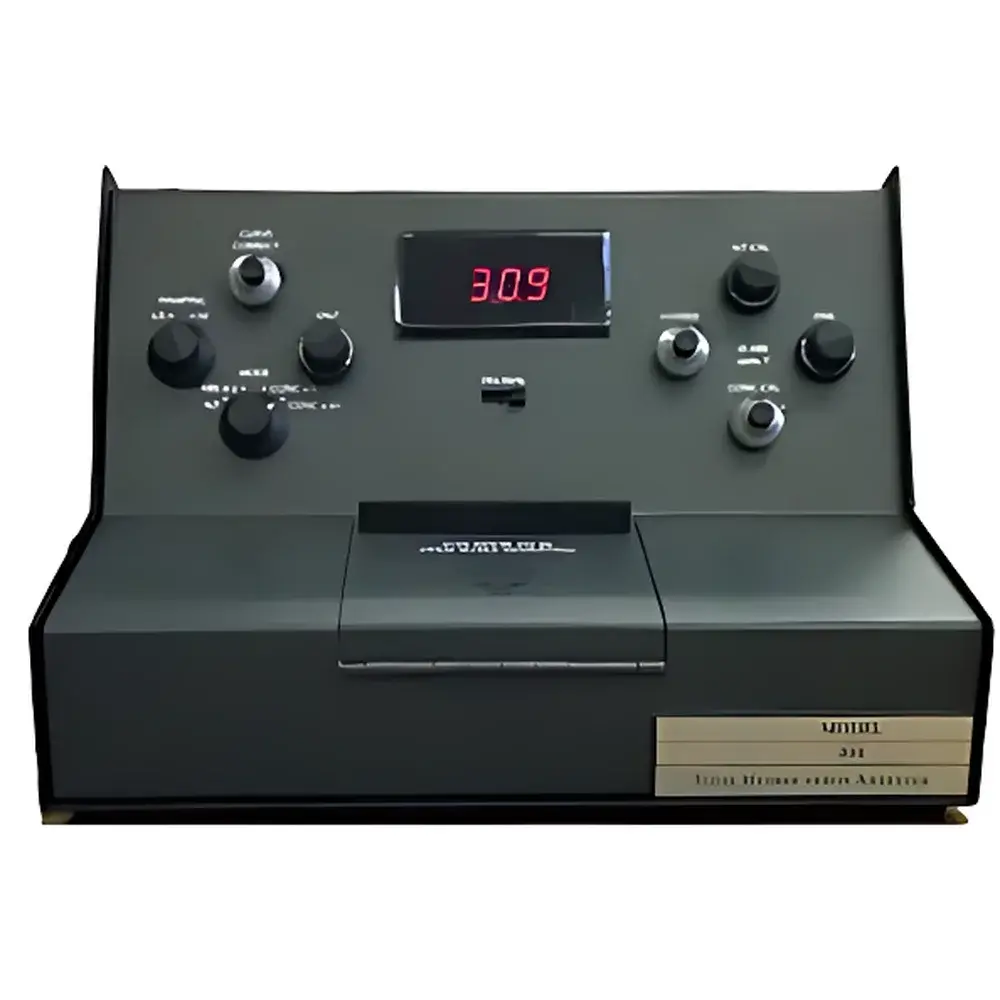
Buck HC-404 Fixed-Wavelength Infrared Oil-in-Water Analyzer
| Origin | USA |
|---|---|
| Manufacturer Type | Authorized Distributor |
| Origin Category | Imported |
| Model | HC-404 |
| Instrument Type | Benchtop Laboratory Analyzer |
| Measurement Principle | Infrared Absorption Spectrophotometry at 2924 cm⁻¹ |
| Transmittance Range | 0–100% T |
| Detection Limit | 0.2 ppm (as TPH in water) |
| Accuracy | ±1% of full scale |
| Resolution | 0.1% T / 0.001 Abs |
| Measurement Cycle Time | 40 s (Damping 2 mode) |
| Detector | Thermoelectrically Cooled PbSe |
| Signal-to-Noise Ratio | >2500:1 |
| Drift | ≤0.01 Abs/h |
| Dimensions (W×D×H) | 36 × 28 × 26 cm |
| Weight | 10 kg |
| Cell Compatibility | 10, 50, and 100 mm quartz cuvettes |
Overview
The Buck HC-404 Fixed-Wavelength Infrared Oil-in-Water Analyzer is a dedicated benchtop spectrophotometer engineered for rapid, quantitative determination of total petroleum hydrocarbons (TPH) in aqueous matrices—including surface water, groundwater, wastewater, soil extracts, and sediment leachates. Unlike scanning IR instruments, the HC-404 operates at a single, optimized mid-infrared absorption band centered at 2924 cm⁻¹ (3.42 µm), corresponding to the asymmetric C–H stretching vibration characteristic of aliphatic hydrocarbons. This fixed-wavelength design eliminates spectral acquisition time and mechanical complexity while delivering high reproducibility and robustness under routine laboratory conditions. The instrument complies with U.S. Environmental Protection Agency (EPA) Method 1664A (for n-hexane extractable material) and aligns with the analytical intent of EPA Methods 418.1 and 1664B—particularly where field-deployable simplicity and regulatory traceability are prioritized over full spectral resolution. Its optical architecture integrates a stabilized infrared source, precision interference filter, thermoelectrically cooled PbSe detector, and temperature-compensated electronics to ensure long-term baseline stability and minimal drift.
Key Features
- Fixed-wavelength detection at 2924 cm⁻¹ (3.42 µm) for selective, interference-resistant quantification of aliphatic hydrocarbon content
- Thermoelectrically cooled PbSe detector with signal-to-noise ratio exceeding 2500:1, enabling reliable detection down to 0.2 ppm TPH in water
- Dual damping modes: 10-second response (Damping 1) for screening; 40-second stabilized measurement (Damping 2) for high-precision quantitation
- Simultaneous digital display of transmittance (%T), absorbance (Abs), and concentration (ppm), calibrated per user-defined standards
- Flexible cuvette compatibility: accommodates 10 mm, 50 mm, and 100 mm pathlength quartz cells to extend dynamic range from sub-ppm to >1000 ppm without dilution
- Linear range extension via three-point calibration—no software interpolation required—supporting both low-level environmental compliance and high-concentration industrial effluent monitoring
- Compact footprint (36 × 28 × 26 cm) and 10 kg mass enable integration into regulated QC labs, mobile environmental testing units, or on-site field laboratories
Sample Compatibility & Compliance
The HC-404 is validated for use with liquid-phase samples prepared according to standard EPA extraction protocols—typically using n-hexane or Freon-113 (where permitted) followed by phase separation and solvent evaporation. It accepts direct analysis of clear, filtered extracts or pre-treated aqueous samples meeting turbidity <1 NTU. For solid matrices (soil, sludge), EPA Method 3550C or SW-846 3550B extraction is recommended prior to measurement. The analyzer supports GLP-compliant operation through manual logbook documentation and meets essential requirements for ISO/IEC 17025-accredited laboratories when used within defined method validation parameters. While not inherently 21 CFR Part 11 compliant (lacking electronic audit trails), its analog output option allows connection to external LIMS systems with full data integrity controls.
Software & Data Management
The HC-404 operates as a stand-alone instrument with embedded firmware—no PC dependency or proprietary software installation required. All calibration coefficients, zero/baseline offsets, and unit conversions are stored in non-volatile memory. Measurement data are displayed in real time and may be recorded manually or exported via optional analog recorder output (0–1 V or 4–20 mA). For laboratories requiring digital traceability, third-party data acquisition systems can interface with the analog output to generate CSV- or PDF-formatted reports compliant with internal QA procedures. Calibration verification follows a three-step process: blank correction, standard reference measurement (e.g., mineral oil in n-hexane), and linearity check—fully documented per ASTM D7066-22 guidelines for hydrocarbon analyzers.
Applications
- Environmental monitoring: Routine TPH screening of drinking water sources, wastewater treatment plant influent/effluent, and groundwater near underground storage tanks (UST)
- Industrial compliance: Verification of oil-water separator performance in petrochemical refineries, metalworking facilities, and food processing plants
- Maritime regulation: Onboard analysis of bilge water and ballast discharge per MARPOL Annex I requirements
- Automotive service: Monitoring washwater runoff quality from vehicle maintenance facilities and highway rest stops
- Soil remediation: Quantitative assessment of hydrocarbon removal efficiency during thermal desorption or bioremediation campaigns
- Regulatory auditing: Supporting state and federal inspections under Clean Water Act (CWA) Section 402 NPDES permit conditions
FAQ
Does the HC-404 require annual factory recalibration?
No—routine user verification using certified reference standards (e.g., NIST-traceable mineral oil solutions) is sufficient. Factory recalibration is recommended only after physical shock, detector replacement, or failure of verification checks.
Can the HC-404 measure aromatic hydrocarbons like benzene or toluene?
Not selectively—the 2924 cm⁻¹ band responds primarily to aliphatic C–H bonds. Aromatic compounds exhibit stronger absorption near 1600 cm⁻¹ and require UV-Vis or GC-based methods for accurate quantification.
Is hexane extraction mandatory before analysis?
Yes, for aqueous samples containing emulsified or dissolved hydrocarbons. Direct aqueous measurement is possible only for free-phase oils above solubility limits and is not EPA-compliant.
What is the maximum allowable turbidity for sample extracts?
Extracts must be optically clear (<1 NTU) and free of suspended particulates; filtration through 0.45 µm PTFE membrane is required prior to cuvette loading.
Does the instrument support multi-point calibration curves?
It supports linear two-point calibration and extended-range three-point verification—but does not perform polynomial curve fitting. Linearity is maintained across 0–100% T via hardware gain adjustment.
Related Products







