
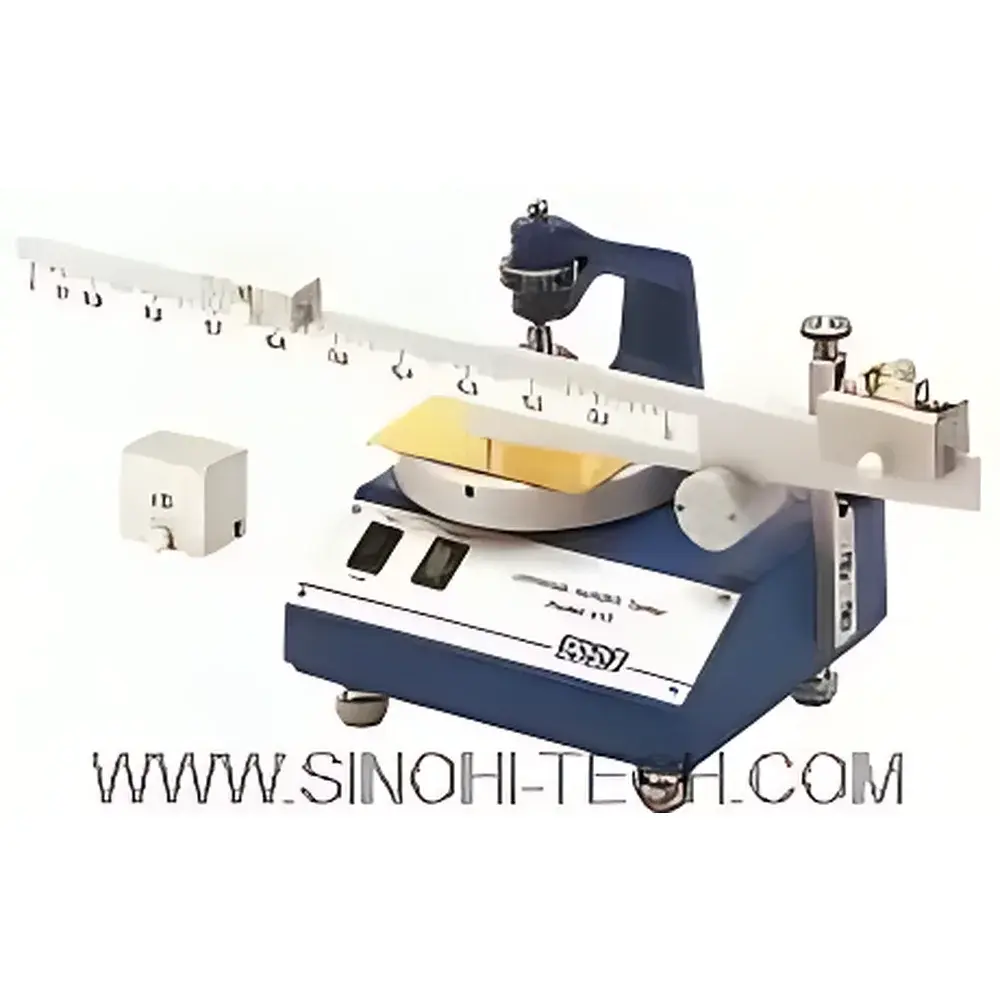
Erichsen #413 Universal Scratch Tester
| Origin | Germany |
|---|---|
| Manufacturer Type | Authorized Distributor |
| Origin Category | Imported |
| Model | #413 Universal |
| Pricing | Upon Request |
Overview
The Erichsen #413 Universal Scratch Tester is a precision-engineered mechanical adhesion and surface resistance evaluation instrument designed for standardized scratch testing of coatings, laminates, and thin-film systems on rigid substrates. It operates on the principle of controlled tangential force application via a fixed-angle stylus traversing a rotating sample platform—a method aligned with established tribological scratch assessment protocols used in quality control laboratories and R&D environments. The device implements a constant-speed rotational test geometry where the specimen rotates beneath a stationary, vertically loaded stylus; this configuration ensures repeatable kinematic boundary conditions essential for comparative evaluation across material batches and coating formulations. Unlike dynamic or high-speed scratch testers, the #413 delivers deterministic, low-velocity mechanical stress profiles ideal for detecting cohesive failure, interfacial delamination, chipping, or plastic deformation thresholds under calibrated normal loads.
Key Features
- Adjustable vertical loading system utilizing calibrated weights (1 N and 10 N standard) to apply precise, traceable normal forces during scratching
- Fixed rotational speed options: 5 rpm (50 Hz supply) or 6 rpm (60 Hz supply), with optional low-speed variants (1 rpm or 1.2 rpm) available upon specification
- Compact benchtop footprint (280 × 500 × 200 mm) and lightweight design (~6.5 kg net weight) enabling flexible integration into QC labs and production-floor testing stations
- Universal sample holder accommodating flat specimens up to 100 × 100 × 22 mm or cylindrical samples Ø40 × 22 mm
- Included calibration-certified reference plates (ISO 4586-2 compliant: PMMA and HPL boards, 5 each) for routine performance verification and inter-laboratory correlation
- Integrated leveling system with bubble level and balancing weight to ensure orthogonal stylus-sample contact alignment
Sample Compatibility & Compliance
The #413 supports a broad range of coated and laminated substrates including metal sheets, plastic panels, painted wood composites, and printed circuit board finishes. Its mechanical architecture conforms to fundamental requirements of ISO 1518 (paint and varnish—scratch resistance), BS 3900-E2 (British Standard for paint testing), DEF STAN 1053 (UK Ministry of Defence coating specifications), and ASTM D7027 (standard test method for scratch resistance of organic coatings using a diamond stylus). While not fully automated, the instrument’s manual operation mode enables full compliance with GLP documentation workflows when paired with standardized SOPs, operator training records, and logbook-based result annotation per USP and FDA 21 CFR Part 11–aligned data handling practices.
Software & Data Management
The Erichsen #413 operates as a standalone mechanical tester without embedded digital control or data acquisition hardware. All test execution, load selection, rotation initiation, and endpoint determination are performed manually per defined procedural steps. However, its modular design allows seamless integration with third-party imaging systems (e.g., stereo microscopes or digital macro cameras) for objective scratch morphology documentation. Users may implement structured digital reporting templates compliant with ISO/IEC 17025 documentation standards, including metadata fields for operator ID, environmental conditions (temperature/humidity), stylus type and wear status, applied load, rotation duration, and pass/fail classification per visual rating scale defined in the included operating manual. Traceability is reinforced through serial-numbered accessories—including stylus holders, calibration plates, and certified weights—each supplied with individual identification tags.
Applications
- Quality assurance of automotive OEM and aftermarket coatings (e.g., clearcoats, primer-surfacer systems)
- Evaluation of decorative laminate scratch resistance in furniture and architectural panel manufacturing
- Comparative screening of ink adhesion on flexible packaging films and rigid label stocks
- Validation of anti-scratch nanocoating performance on consumer electronics housings and optical lenses
- Pre-compliance testing prior to formal submission under ISO 20566 (road vehicle—coating adhesion and scratch resistance)
- Teaching and demonstration applications in polymer science and surface engineering laboratories
FAQ
What stylus types are compatible with the #413 tester?
The instrument accepts interchangeable stylus holders supporting multiple standardized tips: 90° diamond (r = 90 µm), Clemex-type, Bosch-type (Ø0.75 mm), ISO 1518/BS 3900-E2/DEF STAN 1053 compliant (Ø1.0 mm), and van Laar-type (Ø0.5 mm). All stylus part numbers are listed in the accessories catalog.
Is electrical calibration certification provided with the unit?
No electronic calibration is required—the system relies on mechanical mass standards (1 N and 10 N weights) traceable to national metrology institutes. Calibration plates (ISO 4586-2) are supplied for functional verification of scratch visibility and depth consistency.
Can the rotation speed be adjusted continuously?
No. Speed is fixed at either 5 rpm (50 Hz) or 6 rpm (60 Hz) depending on mains frequency. Optional low-speed configurations (1 rpm or 1.2 rpm) must be specified at time of order and require internal gear modification.
Does the tester meet FDA or EU CE requirements?
The #413 is CE-marked per Machinery Directive 2006/42/EC. As a non-electronic, non-medical, non-explosive environment device, it does not fall under FDA regulatory scope; however, its use in pharmaceutical packaging coating validation aligns with ICH Q5E and Annex 15 guidance when embedded in validated laboratory procedures.



