
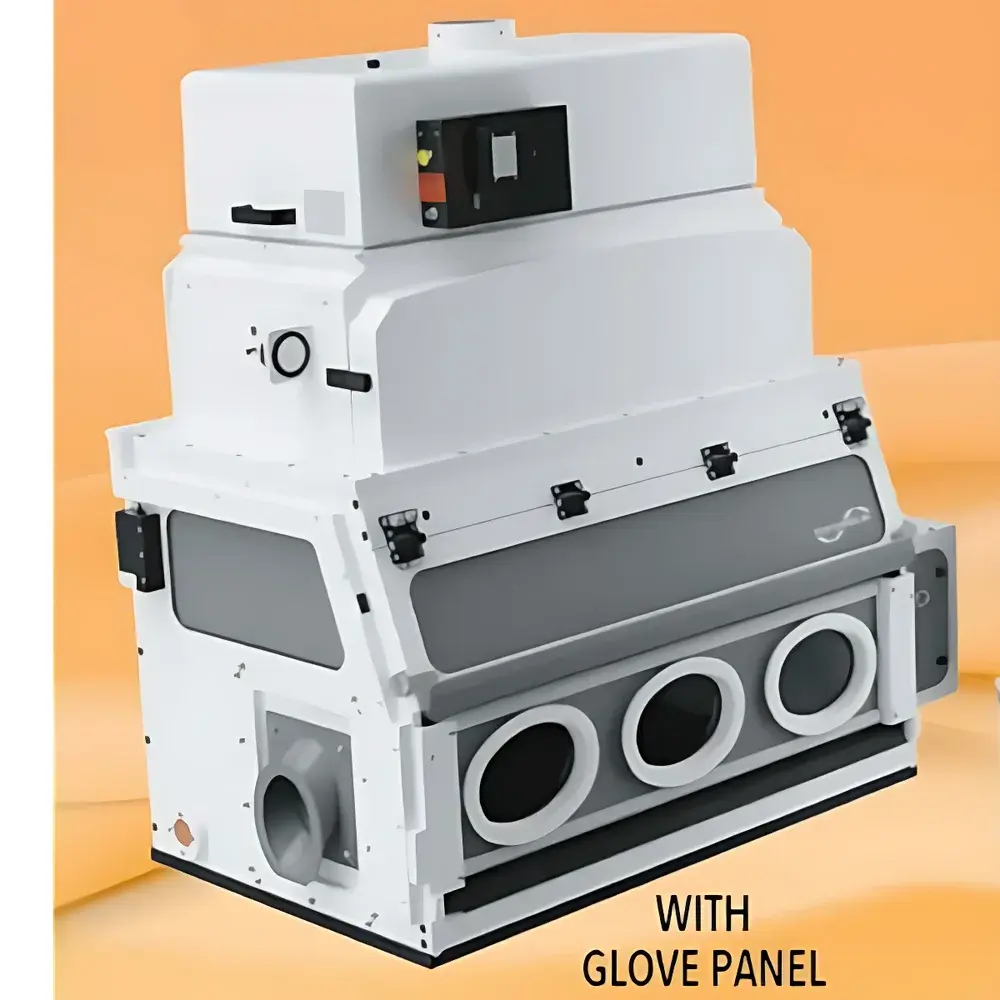
Flow Sciences EH Series Hybrid Isolator
| Brand | Flow Sciences |
|---|---|
| Origin | USA |
| Model | EH Series |
| Construction | White Polypropylene Frame with Tempered Glass Viewing Panels |
| Base Material | Chemical-Resistant Phenolic with Integral Spill Containment Lip |
| Filtration | Dual 10 cm Thick HEPA Filters (Primary + Secondary) |
| Internal Classification | ISO 5 (Class 100) |
| Airflow Mode | Recirculating or Ducted Exhaust |
| Glove Port Configuration | Removable/Modular Glove Panels with Auto-Sensing Dual-Speed Fan Control |
| Side/Transfer Ports | Configurable with Dual-Safe Waste Chute, Continuous Liner Port, RTP Interface (Customizable) |
| Standard Widths | 900 mm, 1200 mm, 1500 mm, 1800 mm |
| Depth | 784 mm |
| Internal Height | 686 mm |
| Occupational Exposure Band (OEB) Support | OEB 3–5 |
| Third-Party Verified Operator Exposure | <50 ng/m³ (application- and quantity-dependent) |
| Compliance | Designed to support GLP/GMP workflows, compatible with USP <800> and ISO 14644-1 requirements |
Overview
The Flow Sciences EH Series Hybrid Isolator is an engineered containment solution for laboratory-scale handling of potent active pharmaceutical ingredients (APIs), cytotoxic compounds, and other high-hazard materials requiring strict occupational exposure control. Operating on the principle of negative-pressure, airflow-controlled isolation, the EH Series employs a dual-HEPA filtration architecture—comprising both primary and secondary 10 cm deep filters—to maintain ISO 5 (Class 100) air quality within the work chamber. Its hybrid design enables seamless transition between glove-based operation and open-front mode, facilitated by an integrated proximity sensor that automatically modulates fan speed to sustain consistent face velocity (typically 0.3–0.5 m/s) regardless of glove panel configuration. This dynamic airflow management ensures reproducible containment performance across variable process conditions—critical for applications such as weighing, dissolution, blending, and analytical sample preparation where operator safety and material integrity must be concurrently preserved.
Key Features
- Modular glove port system: Fully removable, chemically resistant gloves allow operation in either sealed or open-front mode without compromising containment integrity.
- Auto-sensing dual-speed centrifugal blower: Increases RPM when gloves are installed; reduces speed during open-front use—maintaining ISO 5-compliant laminar flow and stable face velocity.
- ISO 5-certified internal environment: Side-mounted HEPA supply units deliver unidirectional, particle-free airflow across the entire work surface, validated per ISO 14644-1 protocols.
- Chemical-resistant phenolic base with integral spill containment lip: Prevents lateral migration of spills into critical sealing zones and simplifies decontamination.
- Configurable side and transfer ports: Options include dual-safe waste chutes, continuous liner interfaces, and rapid transfer port (RTP) connections—enabling safe material ingress/egress without breaching containment.
- Standardized footprint with scalable widths: Available in 900 mm, 1200 mm, 1500 mm, and 1800 mm nominal widths; all units share uniform depth (784 mm) and internal height (686 mm), supporting ergonomic workflow integration.
Sample Compatibility & Compliance
The EH Series accommodates a broad range of laboratory instrumentation—including analytical balances, FTIR spectrometers, ovens, sieving equipment, and powder feeders—within its sealed workspace. Its structural materials (white polypropylene frame, tempered glass viewing panels, and phenolic base) provide proven resistance to common solvents, acids, and bases encountered in API processing. Third-party containment validation confirms operator exposure levels consistently below 50 ng/m³ under representative OEB 4–5 operating conditions—meeting the threshold requirements of USP for hazardous drug handling. The isolator’s design supports audit readiness for GLP and GMP environments, including traceable airflow logs, filter change records, and compatibility with 21 CFR Part 11–compliant data management systems when integrated with optional digital controllers.
Software & Data Management
While the base EH Series operates via analog controls, optional digital interface modules enable real-time monitoring of critical parameters—including differential pressure across HEPA banks, face velocity, filter loading status, and fan RPM. These data points can be logged locally or exported via RS-485/Modbus RTU to centralized LIMS or MES platforms. All firmware complies with IEC 62304 software lifecycle standards, and audit trails meet ALCOA+ principles (Attributable, Legible, Contemporaneous, Original, Accurate, Complete, Consistent, Enduring, Available). Optional validation packages include IQ/OQ documentation aligned with ASTM E2500 and ISO/IEC 17025 guidelines.
Applications
The EH Series serves as a primary engineering control for high-potency compound handling in R&D labs, QC/QA testing suites, and pilot-scale formulation development. Typical use cases include: precision weighing of nanogram-to-milligram quantities of cytostatic agents; solvent-based dissolution and homogenization of low-solubility APIs; inert-atmosphere mixing of oxygen-sensitive intermediates; and FTIR-based identity verification of controlled substances under containment. Its flexibility supports multi-step workflows—e.g., transferring weighed material from balance to dissolution vessel to filtration unit—all within a single, continuously monitored ISO 5 environment.
FAQ
Can the EH Series be integrated with building exhaust systems?
Yes—it supports both recirculating and ducted exhaust configurations. Ducted operation requires static pressure compensation and is validated per ASHRAE 110 tracer gas testing.
What OEB levels does the EH Series support?
It is validated for OEB 3 through OEB 5 applications, with third-party testing confirming sub-50 ng/m³ operator exposure in representative OEB 4–5 scenarios.
Is ISO 5 certification included with purchase?
ISO 5 classification is inherent to the design and verified during factory acceptance testing (FAT); final site-specific certification requires on-site particle count and airflow mapping per ISO 14644-1.
Are custom dimensions available beyond standard widths?
Yes—Flow Sciences offers bespoke configurations, including non-standard depths, heights, and port placements, subject to structural and airflow modeling review.
How often must HEPA filters be replaced?
Filter service intervals depend on usage intensity and challenge agents; typical replacement occurs every 12–24 months, with pressure drop monitoring enabling predictive maintenance scheduling.



