
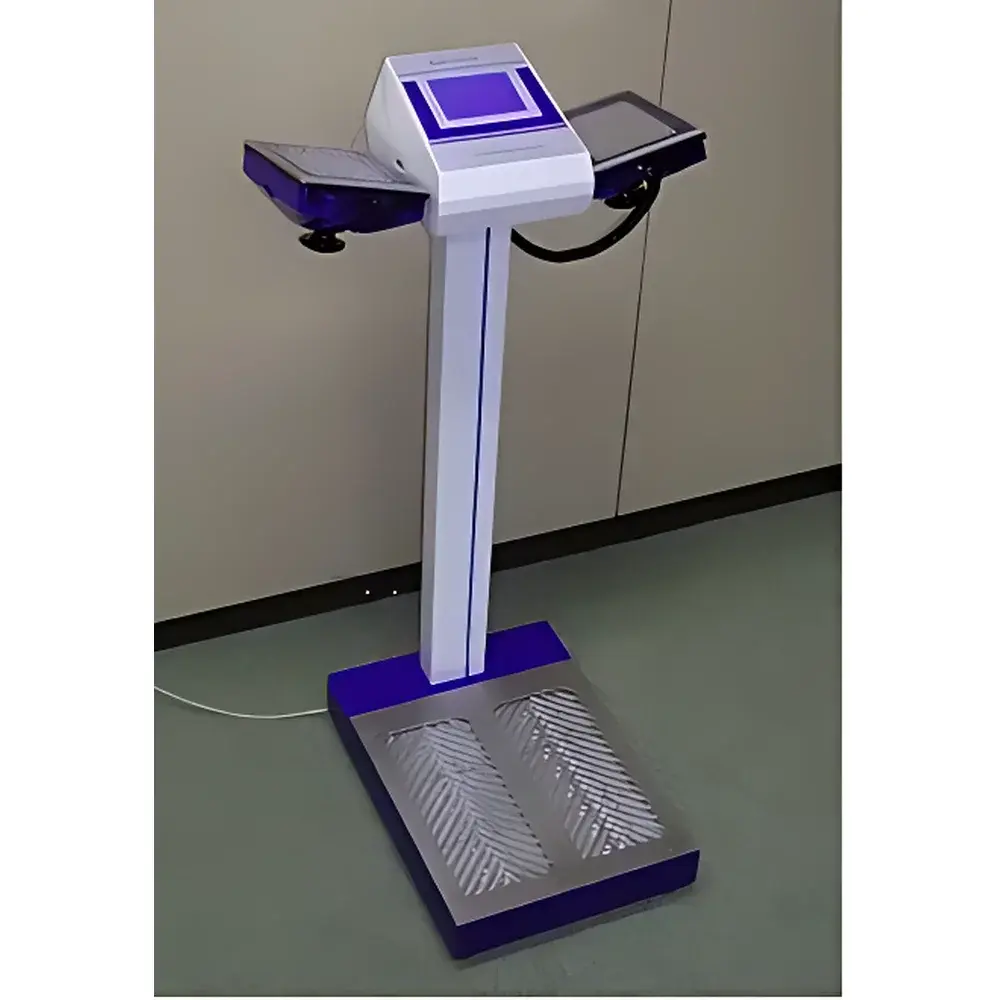
Berthold LB147 Hand-and-Foot Contamination Monitor
| Brand | Berthold |
|---|---|
| Origin | Germany |
| Model | LB147 |
| Instrument Type | Alpha/Beta/Gamma Contamination Monitor |
| Detector Type | ZnS(Ag)-coated plastic scintillator (gas-free) |
| Hand Detector Area | 2 × 8625 mm² |
| Foot Detector Area | 2 × 13875 mm² |
| Window Density | 0.4 mg/cm² |
| Count Rate Range | 0–50,000 cps |
| Background (Hand) | α: 0.1 cps, β: 15 cps |
| Background (Foot) | α: 0.2 cps, β: 40 cps |
| Power Supply | 230 V AC, 50 Hz, 110 W |
| Operating Temperature | −10 °C to +40 °C |
| Dimensions (W×D×H) | 1350 × 650 × 840 mm |
| Weight | 115 kg (with casters) |
| Detection Efficiency (typical) | Sr-90/Y-90 (β): 42% (hand), 37% (foot) |
| Cs-137 (β+γ) | 44% (both) |
| Am-241 (α) | 20% (hand), 10% (foot) |
| Data Storage | 1000 measurements |
| Display | Color LCD touchscreen |
| Measurement Modes | α-only, β/γ-only, or simultaneous α + β/γ |
| Output Units | cps or Bq (with calibration factor) |
Overview
The Berthold LB147 Hand-and-Foot Contamination Monitor is a fixed-position, high-sensitivity radiation contamination screening system engineered for routine exit monitoring in nuclear medicine departments, radiopharmaceutical production facilities, research laboratories, and nuclear power plant controlled areas. It operates on the principle of alpha and beta/gamma detection via large-area plastic scintillators coated with zinc sulfide (ZnS:Ag), eliminating dependence on pressurized counting gas—thereby enhancing operational safety, reducing maintenance overhead, and ensuring long-term stability under continuous use. Unlike gas-proportional or Geiger-Müller-based systems, the LB147’s solid-state detector architecture provides intrinsic immunity to environmental humidity fluctuations and pressure variations, making it especially suitable for high-traffic access control points where reliability and reproducibility are critical. Its dual-hand and dual-foot configuration enables rapid, standardized whole-body extremity screening in accordance with IAEA Safety Standards Series No. RS-G-1.7 and EURATOM Directive 2013/59/Euratom.
Key Features
- Gas-free ZnS(Ag)-coated plastic scintillation detectors—no gas supply, no quenching, no high-voltage drift; ideal for unattended operation in regulated environments.
- Modular, robust steel frame with electrostatic powder-coated surface—designed for frequent decontamination and compliance with ISO 20553 (radiological protection in nuclear facilities).
- Two removable hand detectors (8625 mm² each) that double as portable contamination probes for garments, tools, or small equipment—enabling flexible deployment beyond fixed portal use.
- Integrated self-diagnostic system with four independent counting channels, position sensors, audible feedback, and automatic background subtraction—ensuring measurement integrity before each scan.
- Color LCD touchscreen interface supporting multiple display modes: numeric readout, real-time histogram, or silent operation—configurable per facility SOP requirements.
- Onboard data logging for up to 1000 measurements with timestamp, operator ID (optional RFID integration), and mode-specific calibration metadata—supporting audit-ready record retention.
Sample Compatibility & Compliance
The LB147 is optimized for detecting surface contamination from common radionuclides encountered in operational health physics workflows—including 14C, 36Cl, 99mTc, 131I, 137Cs, 90Sr/90Y, and 241Am. Its low-density entrance window (0.4 mg/cm²) ensures high transmission efficiency for low-energy beta emitters such as 14C and 3H (via bremsstrahlung detection), while maintaining sufficient stopping power for alpha particles. The instrument meets EN 60846-1:2014 (radiation protection instrumentation – ambient and/or directional dose equivalent rate meters) and is designed to support GLP-compliant documentation practices. Optional firmware upgrades enable alignment with FDA 21 CFR Part 11 electronic record/electronic signature requirements when integrated into validated laboratory information management systems (LIMS).
Software & Data Management
Data export is supported via USB 2.0 and optional Ethernet interface, enabling seamless transfer to centralized radiation safety databases. The embedded firmware supports configurable alarm thresholds per nuclide group (e.g., separate α and β/γ limits), with visual indication of contaminated zones directly overlaid on the touchscreen display—facilitating immediate operator response without interpretation delay. All stored records include detector-specific efficiency corrections, background subtraction timestamps, and user-defined measurement tags. Exported CSV files contain raw counts, net counts, uncertainty estimates (Poisson-based), and conversion factors applied—ensuring full traceability for regulatory reporting under national radiation protection ordinances (e.g., UK IRR17, German StrlSchV).
Applications
- Routine exit screening of personnel from controlled radiation areas in hospitals, cyclotron facilities, and radiopharmaceutical manufacturing suites.
- Final release verification of PPE, lab coats, gloves, and footwear prior to laundering or disposal.
- Post-maintenance survey of tools, tongs, and handling fixtures used in hot cells or gloveboxes.
- Training and competency assessment for radiation workers—leveraging built-in pass/fail logic and configurable pass criteria aligned with ALARA principles.
- Supplemental monitoring during decommissioning projects where rapid, repeatable surface assay of structural components is required.
FAQ
Does the LB147 require periodic gas refills or detector replacement?
No—the ZnS(Ag)-plastic scintillator detectors are solid-state and maintenance-free over their service life. No consumables or gas cylinders are required.
Can the LB147 be calibrated for specific radionuclides not listed in the standard efficiency table?
Yes. Using Berthold’s proprietary calibration software (LB-Soft), users may import custom efficiency curves derived from traceable reference sources or Monte Carlo simulations—subject to internal validation protocols.
Is the instrument compatible with networked radiation safety management platforms?
Yes. With optional Ethernet module and LB-Connect middleware, the LB147 integrates with major enterprise radiation safety software (e.g., RadPro, RAMP, or custom LIMS) via TCP/IP or Modbus TCP.
What is the typical minimum detectable activity (MDA) for 241Am on hands using the LB147?
Under standard conditions (10-second count, 0.1 cps background), MDA is approximately 0.37 Bq (10 dpm) per hand—calculated per ANSI N13.30 and ISO 7503-1 methodologies.
How is operator training and procedural compliance assured?
The system includes guided startup diagnostics, context-sensitive help overlays, and configurable lockout timers—ensuring only authorized, trained personnel initiate measurements. Audit logs capture all configuration changes and measurement events.







