
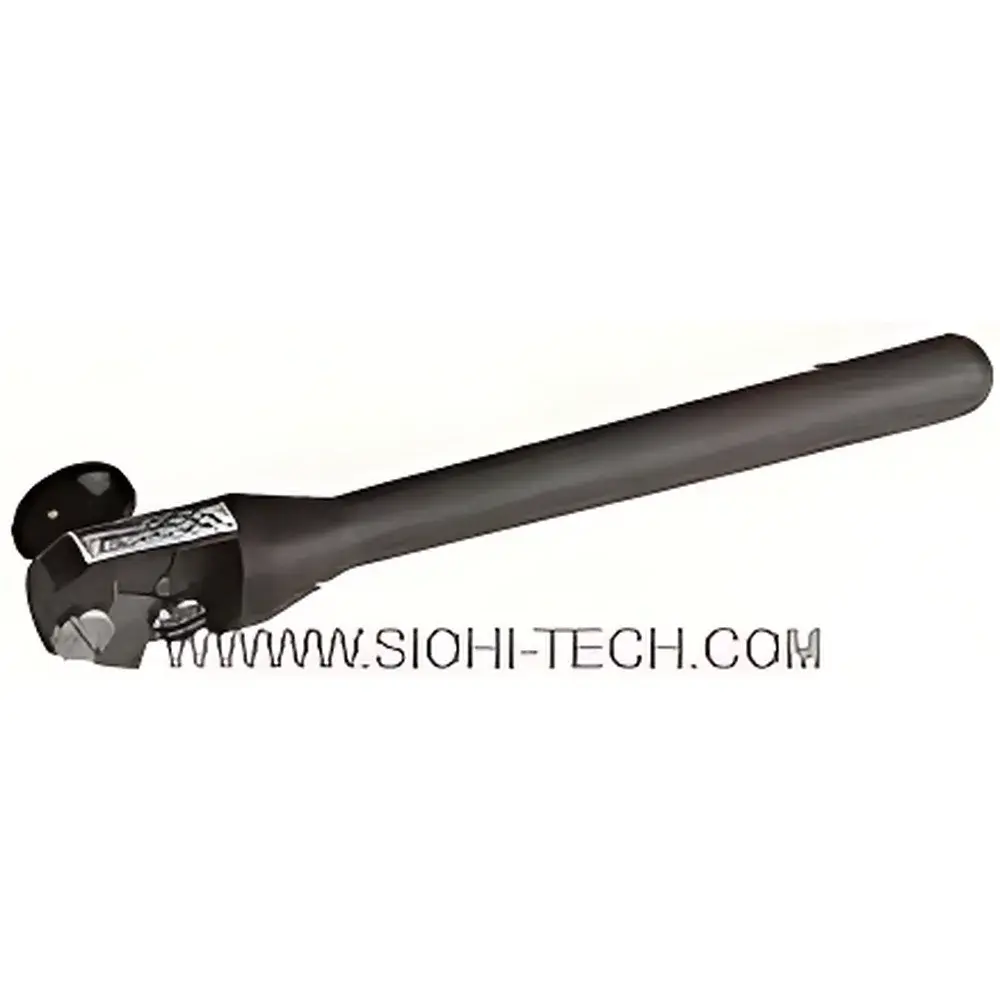
Erichsen #463 Scratch Tester (Compliant with DIN 50021 and New Jian Standards)
| Origin | Germany |
|---|---|
| Manufacturer Type | Authorized Distributor |
| Origin Category | Imported Instrument |
| Model | #463 |
| Pricing | Upon Request |
Overview
The Erichsen #463 Scratch Tester is a precision-engineered mechanical scratch testing instrument designed for controlled, reproducible generation of defined linear damage on coated metal substrates—primarily to support subsequent corrosion resistance evaluation under standardized accelerated aging conditions. Operating on the principle of quasi-static, single-pass mechanical indentation, the device employs a hardened tungsten carbide stylus to produce consistent, through-coating scratches that expose the underlying metallic substrate. This enables quantitative assessment of coating integrity, interfacial adhesion degradation, and underfilm corrosion propagation—key performance indicators in automotive, aerospace, architectural coatings, and industrial protective systems. The tester complies with DIN 50021 (salt spray testing), ISO 15197 (scratch adhesion test for organic coatings), and aligns with the Chinese “New Jian” (Xin Jian) standard framework for coating durability verification in infrastructure and construction applications.
Key Features
- Robust, manually operated mechanical architecture with ergonomic handle and precision-guided carriage system for straight-line scratch execution.
- Interchangeable tungsten carbide stylus: standard 1.0 mm rectangular cross-section; optional 0.5 mm variant available upon request for higher-resolution defect generation.
- Vertical height adjustment via calibrated locking screw mechanism, enabling precise control over stylus protrusion and resulting scratch depth (typically 10–30 µm nominal, dependent on coating hardness and applied load).
- Fixed-angle mounting bracket ensures repeatable stylus orientation (90° perpendicular to sample surface) and eliminates angular deviation during scratching.
- No external power supply required—fully manual operation ensures intrinsic stability, portability, and compatibility with cleanroom or field-deployable environments.
- Designed for integration into standardized test sequences: scratch application precedes salt spray (DIN 50021), humidity cycling (ISO 6270), or electrochemical impedance spectroscopy (EIS) analysis.
Sample Compatibility & Compliance
The #463 Scratch Tester accommodates flat, rigid specimens up to 300 × 200 mm in dimension and ≤25 mm in thickness—including steel, aluminum, galvanized sheet, and pre-treated metal panels. It supports both single-line and St. Andrew’s cross (X-pattern) scratching configurations per ISO 2409 and ASTM D3359 methodologies. All mechanical tolerances and stylus geometry conform to ISO 15197 Annex A specifications for scratch adhesion testers. Test documentation generated using this instrument meets GLP requirements when paired with traceable calibration records and operator log entries. While the instrument itself does not require electronic validation, its use within GMP-regulated coating qualification workflows is fully compatible with FDA 21 CFR Part 11-compliant data management systems when integrated with digital imaging and corrosion rating software.
Software & Data Management
As a purely mechanical instrument, the #463 Scratch Tester does not incorporate embedded firmware or onboard software. However, it is routinely deployed in conjunction with third-party image analysis platforms (e.g., ImageJ with ISO 4628-8 corrosion rating plugins) and LIMS-integrated reporting tools. Scratch location, length, and morphology are documented via calibrated optical microscopy or digital macro photography (≥10× magnification). When used in regulated environments, operators maintain handwritten or electronic test records—including specimen ID, scratch count/spacing, stylus type, and post-scratch conditioning parameters—to satisfy audit trails required under ISO/IEC 17025 and CNAS accreditation standards.
Applications
- Quantitative evaluation of coating adhesion loss following accelerated corrosion exposure (e.g., scribe creep measurement per ISO 4628-8).
- Comparative screening of primer/topcoat systems for automotive OEMs and Tier-1 suppliers.
- Validation of cathodic disbondment resistance in pipeline coatings per ISO 15711.
- Research into interfacial failure mechanisms at the coating–substrate boundary under electrochemical stress.
- Quality assurance in coil coating production lines where rapid, non-destructive adhesion verification is critical.
- Supporting certification testing for building products under China’s GB/T 9286 and “New Jian” technical guidelines for municipal infrastructure projects.
FAQ
Does the #463 Scratch Tester require calibration certification?
Yes—annual mechanical verification of stylus geometry, carriage linearity, and vertical adjustment repeatability is recommended per ISO/IEC 17025 Clause 6.5. Calibration certificates from accredited metrology labs are available through authorized distributors.
Can the #463 be used on non-metallic substrates such as composites or plastics?
It is primarily validated for metallic substrates per DIN 50021 and ISO 15197. Use on softer substrates requires empirical validation of scratch consistency and may necessitate reduced stylus protrusion or alternative tip geometry.
Is the “New Jian” compliance formally certified by a Chinese authority?
The #463 meets the functional and dimensional requirements outlined in the “New Jian” technical guidance documents for coating scribing equipment; formal certification is performed by provincial Construction Quality Supervision Stations during on-site instrument verification.
What maintenance is required for long-term reliability?
Routine cleaning of the stylus and guide rails with isopropyl alcohol; periodic inspection of the locking screw torque (0.8–1.2 N·m); replacement of the tungsten carbide stylus after ~500 scratches or visible wear under 50× magnification.



