
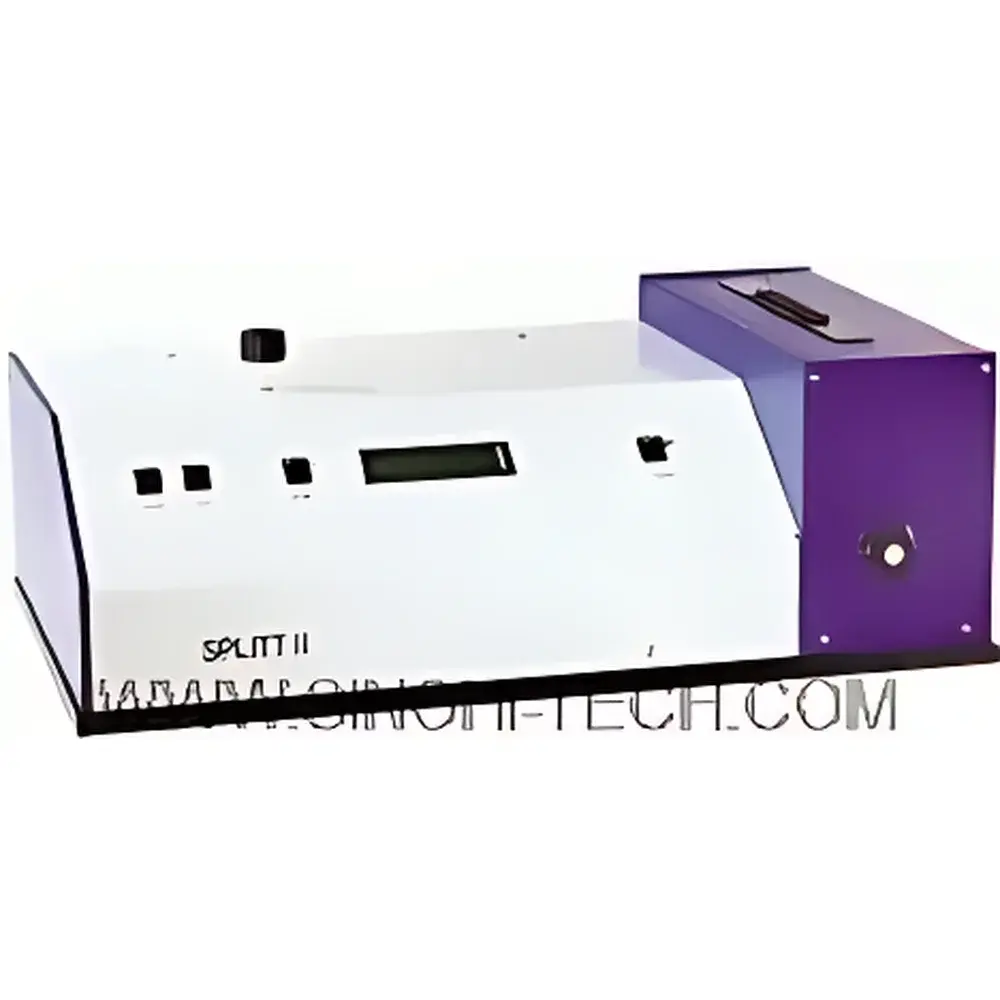
Erichsen #408 Single-Bead Impact Tester
| Origin | Germany |
|---|---|
| Manufacturer Type | Authorized Distributor |
| Origin Category | Imported |
| Model | #408 |
| Pricing | Upon Request |
Overview
The Erichsen #408 Single-Bead Impact Tester is a precision-engineered benchtop instrument designed for standardized evaluation of coating adhesion and resistance to stone-chip damage under controlled impact conditions. It implements the free-flight single-bead impact principle defined in DIN 55996-3 (draft), which forms the technical foundation for upcoming ISO and EN standards governing automotive coating performance. Unlike continuous multi-bead impact systems (e.g., Erichsen #508), the #408 delivers highly reproducible, discrete impacts using a single steel sphere accelerated by regulated compressed air—enabling quantitative assessment of localized coating failure modes such as cracking, delamination, or substrate exposure. The system operates on a validated aerodynamic acceleration path with optical velocity verification, ensuring traceable impact energy delivery per test event. Its compact architecture integrates thermal conditioning via Peltier elements and inert atmosphere control, supporting testing at both ambient (23 °C) and low-temperature (–20 °C) conditions relevant to real-world vehicle service environments.
Key Features
- Benchtop design with integrated compressed-air propulsion system for single-bead acceleration
- Free-flight impact geometry compliant with DIN 55996-3 Chapter 3 (Methods A, B, C, D)
- LCD digital display showing real-time impact velocity (km/h) and sample temperature (°C)
- Precise velocity calibration: ≤3 preliminary shots required to achieve target speed (250 km/h for 2 mm bead; 100 km/h for 5.5 mm cylindrical projectiles)
- Electro-pneumatic sample clamping on thermally regulated aluminum base plate (Peltier-controlled at 23 °C or –20 °C)
- Nitrogen purge capability (0.5 bar overpressure, ~1 L/min) to suppress frost formation during sub-zero testing
- Integrated cooling water circuit (≤15 °C, ~3 L/min) for sustained Peltier efficiency
- Adjustable impact pattern grid: up to 4 rows × 7 impacts per row on samples up to 105 × 210 mm
- Robust construction: 600 × 380 × 220 mm footprint; total mass ≈ 20 kg
Sample Compatibility & Compliance
The #408 accommodates flat metallic substrates (e.g., cold-rolled steel, aluminum alloys) coated with OEM automotive paints, primers, clearcoats, or functional polymer layers. Sample thickness is limited to ≤3 mm to ensure mechanical stability during pneumatic clamping and impact loading. The instrument supports all impact media specified in DIN 55996-3: spherical steel beads (Ø2.0 mm, m = 0.033 g) and cylindrical impactors (Ø5.5 mm, m = 0.5 g) with three distinct tip geometries. Test execution adheres to documented procedures aligned with VDA 6.3 process audits and supports GLP-compliant recordkeeping when paired with external lab documentation systems. While the device itself does not embed electronic audit trails, its operational parameters (velocity, temperature, pressure) are directly observable and manually loggable—facilitating compliance with ISO/IEC 17025 method validation requirements.
Software & Data Management
The Erichsen #408 operates without proprietary software or embedded data logging. All operational parameters—including impact velocity, chamber temperature, and pneumatic supply pressure—are displayed locally on the front-panel LCD. Users are expected to record test configurations and visual evaluation results (e.g., chip density, crack length, substrate exposure area) using standardized laboratory notebooks or LIMS-integrated templates. For laboratories requiring digital traceability, integration with third-party image analysis tools (e.g., ImageJ macros for chip quantification) or ELN platforms is supported via manual export of metadata. No firmware updates or cloud connectivity are provided; hardware calibration intervals follow Erichsen’s recommended biannual verification protocol using certified reference beads and calibrated pressure transducers.
Applications
Primary use cases include R&D and QC validation of automotive exterior coatings across Tier 1 suppliers and OEM paint shops. Specific applications encompass: comparative evaluation of primer-surfacer-clearcoat systems under thermal stress; screening of new resin chemistries (e.g., acrylic-polyurethane hybrids) for improved chip resistance; qualification of electrocoat (e-coat) formulations for underbody protection; and correlation studies between lab-scale impact response and field-reported stone-chip damage on production vehicles. The –20 °C testing mode enables simulation of winter road conditions where brittle fracture dominates failure mechanisms. Secondary applications extend to aerospace sealants, wind turbine blade coatings, and rail transport protective systems where localized mechanical shock resistance is critical.
FAQ
What impact velocities does the #408 support?
The system achieves 250 km/h for Ø2 mm steel beads and 100 km/h for Ø5.5 mm cylindrical impactors, adjustable via precision pressure regulation.
Is the instrument compatible with ISO/EN standardization efforts?
Yes—it implements the free-flight methodology described in DIN 55996-3, which is under formal adoption as ISO 20567-3 and EN ISO 20567-3.
Does the #408 require external chillers or compressed air dryers?
No chiller is needed—the integrated water cooling loop maintains Peltier efficiency. Compressed air must be oil-free and filtered to ISO 8573-1 Class 2:2:2.
Can test data be exported digitally?
No native export function exists; however, all displayed parameters are manually recordable, and visual results may be digitized via external imaging systems.
What maintenance schedule is recommended?
Erichsen recommends pressure sensor verification every 6 months and full pneumatic path inspection annually, per Technical Bulletin ER-408-MNT-2023.



