
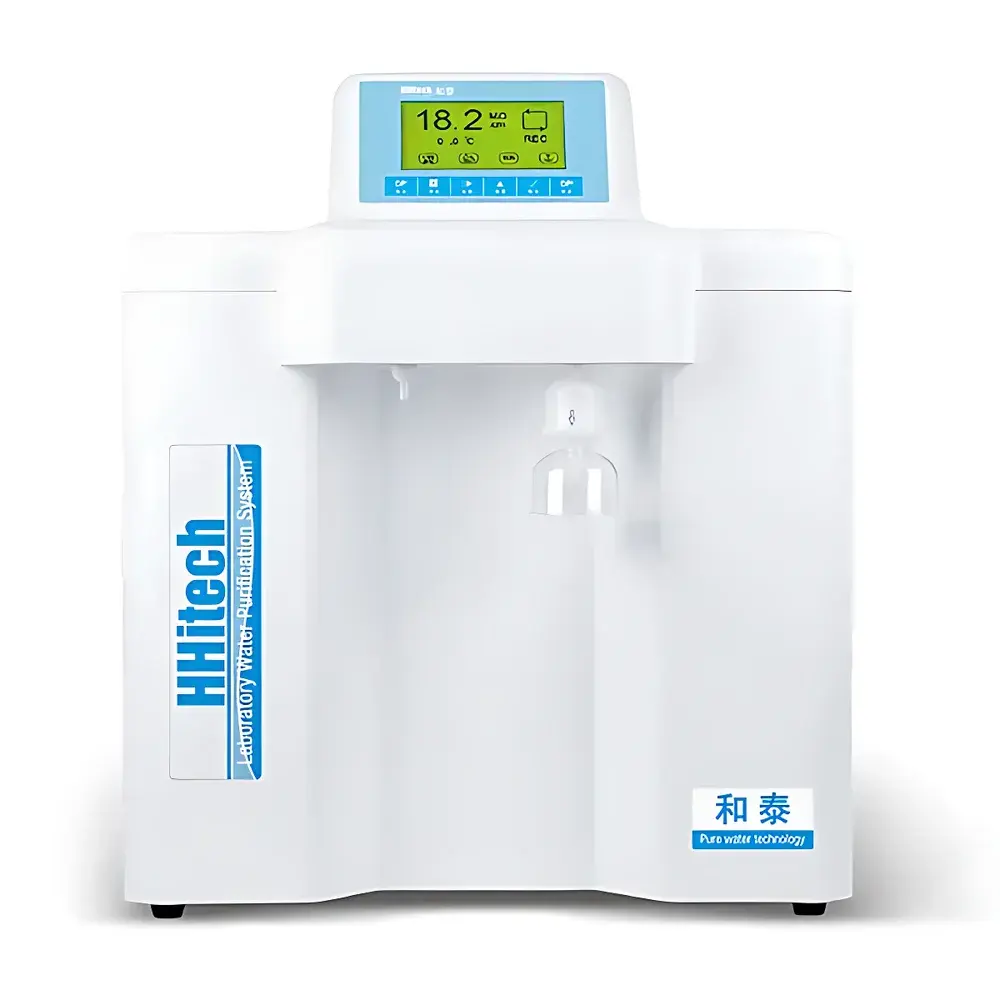
HHitech Master-R Dual-Stage Reverse Osmosis Ultra-Pure Water System
| Brand | HHitech |
|---|---|
| Origin | Shanghai, China |
| Manufacturer Type | Direct Manufacturer |
| Country of Origin | China |
| Model | Master-R |
| Price Range | USD 1,400–4,200 (est.) |
| Pure Water Grade | ASTM Type I |
| Resistivity | 18.2 MΩ·cm @ 25 °C |
| Heavy Metals & Soluble Silica | <0.01 ppb |
| Total Organic Carbon (TOC) | <3 ppb |
| Microbial Count | <0.01 CFU/mL |
| Endotoxin | <0.001 EU/mL |
| Particles (>0.1 µm) | <1 particle/mL |
| RO Output Conductivity | 1–5 µS/cm (stable under challenging feed water conditions) |
| Flow Rate | 24 L/h (at 25 °C, 50 psi, 15% recovery) |
| Dimensions | 50 × 36 × 54 cm |
| Weight | ~30 kg |
| Power | 220 V, 50 Hz, 120 W |
Overview
The HHitech Master-R is a dual-stage reverse osmosis (RO) ultra-pure water system engineered for continuous, reliable production of ASTM Type I ultrapure water in research laboratories, pharmaceutical QC environments, and analytical instrumentation support applications. It employs a validated two-pass RO architecture—comprising dual high-rejection RO membranes, an integrated intermediate storage tank, and post-RO purification modules—to achieve robust rejection of ions, organics, colloids, microorganisms, and endotoxins. Unlike single-stage or simplified dual-stage configurations, the Master-R’s staged design ensures stable feed pressure to the second RO stage, minimizes membrane fouling, and extends consumable service life while maintaining consistent output conductivity ≤5 µS/cm—even when inlet TDS exceeds 200 ppm. The system meets core requirements for GLP-compliant water generation and serves as primary feed for sensitive applications including HPLC mobile phase preparation, cell culture media formulation, molecular biology assays, and trace elemental analysis.
Key Features
- Engineered dual-stage RO with independent booster pump and pressure-regulated intermediate tank—ensuring stable flux and consistent rejection performance across variable feed water quality.
- Microprocessor-based control system with 240 × 128 pixel LCD display (106 × 57 mm), real-time animated status visualization, and multi-level menu navigation.
- Triple-point online water quality monitoring: feed water, first-pass RO permeate, and final ultrapure water—with programmable alarm thresholds for resistivity, TOC, and endotoxin indicators.
- Programmable dispensing modes: time-based (1–99 min) and quality-based (0.1–18.2 MΩ·cm), enabling precise volume delivery per application requirement.
- Comprehensive consumables management: configurable lifespan tracking for pre-filters, RO membranes, UV lamps, and ultra-purification cartridges—including automatic replacement alerts and usage history logging.
- Integrated dual-wavelength UV system (185 nm + 254 nm) using imported low-pressure mercury lamps for simultaneous TOC reduction and microbial inactivation.
- Optional ultrafiltration module (MWCO 5000 Da, imported) certified for endotoxin removal (<0.001 EU/mL), suitable for stem cell culture, IVF, and monoclonal antibody production.
- NSF-certified fluid path components—including PES-based 0.45 + 0.1 µm terminal filters—ensuring sterile, particle-free delivery at point-of-use.
- Full-system sanitization protocol: one-button activation of chemical disinfection cycle using NSF-approved tablets; compatible with routine validation per ISO 14644-1 and EU GMP Annex 1.
- GLP-aligned hardware design: corrosion-resistant engineering-grade polymer chassis, modular cartridge architecture, and audit-trail-capable data logging via RS232/USB interface (optional).
Sample Compatibility & Compliance
The Master-R is validated for use with municipal tap water meeting ASTM D1193 specifications (TDS <200 ppm, temperature 5–45 °C, pressure 1.0–4.0 kgf/cm²). When paired with optional external softening or iron/manganese removal units, it accommodates higher-salinity or hard-water sources without compromising membrane integrity or product water quality. All wetted materials comply with USP Class VI and NSF/ANSI Standard 58 for RO systems. The system supports full regulatory traceability: password-protected configuration (dual-tier access), timestamped event logs, and year-long automated data capture—aligning with FDA 21 CFR Part 11 requirements for electronic records and signatures. Its architecture conforms to ISO 9001 manufacturing controls and is routinely deployed in facilities operating under cGMP, GLP, and ISO/IEC 17025 frameworks.
Software & Data Management
The embedded firmware provides secure, auditable data handling through configurable user permissions (factory and operator levels), encrypted parameter settings, and non-volatile memory retention of operational events—including alarm triggers, consumable depletion warnings, and manual intervention timestamps. Optional RS232 or USB connectivity enables export of daily water quality summaries, system uptime metrics, and calibration verification logs in CSV format. Data files are structured for direct import into LIMS platforms or internal QA databases. Firmware updates are performed via authenticated USB stick, preserving configuration integrity during version upgrades. No cloud dependency or remote telemetry is implemented—ensuring full data sovereignty and compliance with institutional IT security policies.
Applications
The Master-R delivers ultrapure water meeting or exceeding ASTM D1193 Type I, CLSI A2, and ISO 3696 Grade 1 specifications. Primary applications include: preparation of HPLC and UHPLC mobile phases; rinsing and calibration of ICP-MS, AAS, and IC instruments; formulation of electrophysiology buffers and PCR master mixes; feed water for steam autoclaves and glassware washers requiring low conductivity; and long-term storage of sensitive reagents where TOC and endotoxin carryover must be minimized. Its modular design allows seamless integration with pressurized storage tanks (15 L stainless steel or polyethylene) or gravity-fed reservoirs, supporting both centralized distribution and benchtop point-of-use deployment.
FAQ
What feed water quality is required for optimal Master-R performance?
Municipal tap water with TDS ≤200 ppm, free chlorine <1 ppm, and turbidity <1 NTU is recommended. For higher TDS or hardness, external softening or sediment pre-treatment is advised to maximize RO membrane service life.
How often must consumables be replaced under typical lab use?
Pre-filtration (KDF + AC) lasts ~12 months at 20 L/day; dual RO membranes operate 2–3 years depending on feed quality; UV lamps require annual replacement; ultra-purification cartridges last 6–12 months based on resistivity decay rate and TOC load.
Is the system compliant with FDA 21 CFR Part 11?
Yes—the optional data logging module provides electronic record integrity, user authentication, audit trails, and tamper-evident timestamps, satisfying core Part 11 requirements for regulated environments.
Can the Master-R supply water directly to multiple instruments simultaneously?
Yes—via connection to a pressurized storage tank (e.g., 15 L NSF-certified pressure vessel) or gravity-fed reservoir, enabling parallel distribution to HPLC, mass spectrometers, and cell culture incubators without flow interruption.
Does the system support IQ/OQ/PQ documentation packages?
HHitech provides standardized installation qualification (IQ) and operational qualification (OQ) templates, including test protocols for resistivity stability, TOC suppression, and endotoxin removal efficiency—facilitating internal or third-party validation per ISO/IEC 17025.



