
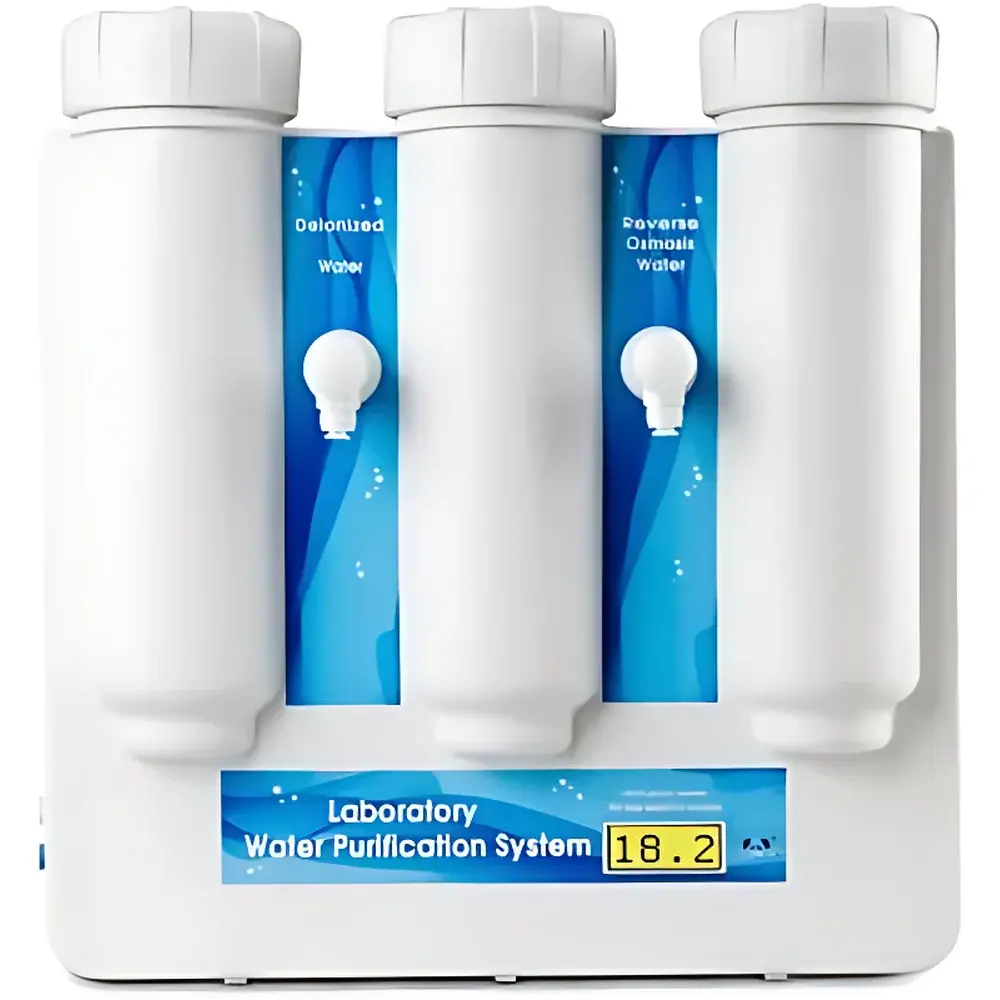
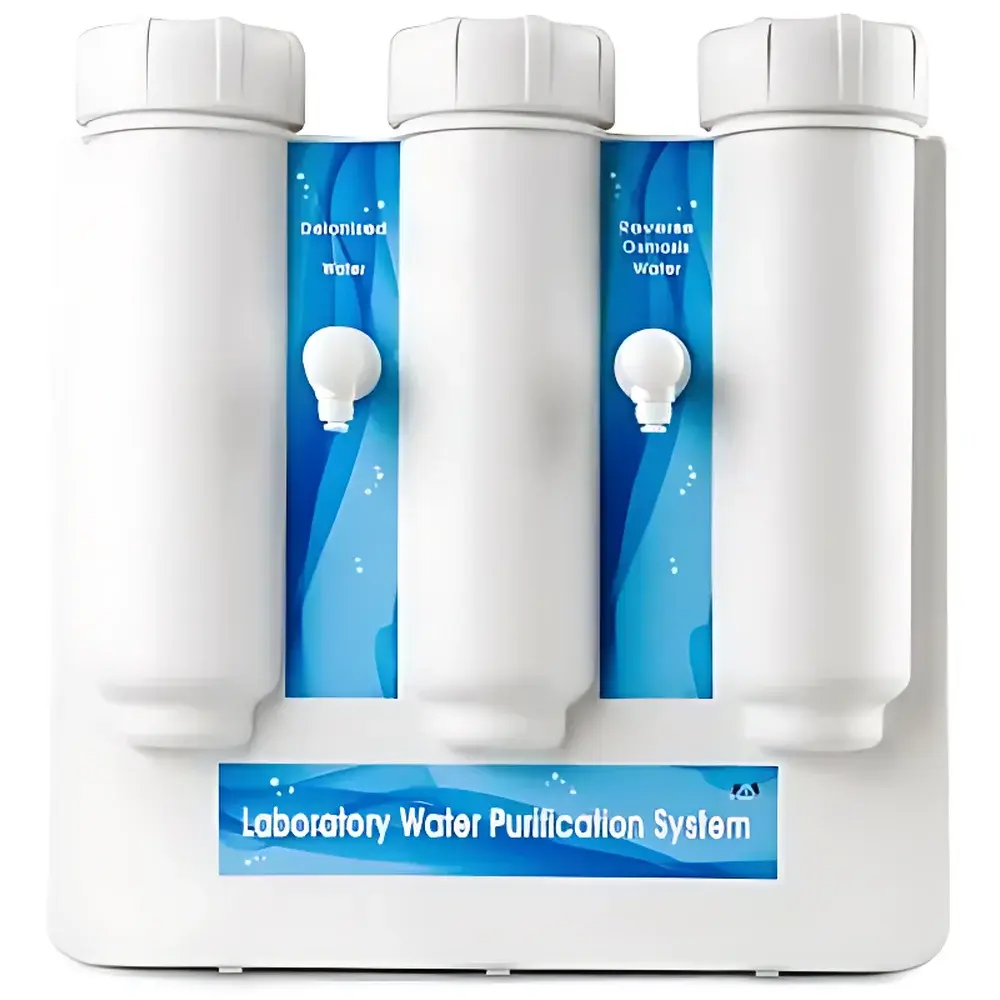
HHitech RO DI Digital Plus Ultra-Pure Water System
| Brand | HHitech |
|---|---|
| Origin | Shanghai, China |
| Manufacturer Type | OEM Manufacturer |
| Product Category | Domestic |
| Model | RO DI |
| Quotation | USD 950 (FOB Shanghai) |
| Feed Water Quality | Municipal tap water (TDS < 200 ppm, 5–45 °C, pressure 1.0–4.0 kgf/cm²) |
| Purification Stages | PF + AC + RO + DI |
| Pre-filter | 1 × PP sediment cartridge |
| Carbon Filters | 2 × activated carbon cartridges |
| RO Membrane | 100 GPD (≈379 L/day), DOW Filmtec™ or CSM brand |
| DI Resin Columns | 2–3 × nuclear-grade ion exchange cartridges (imported) |
| Resistivity (DI water) | 15–18.2 MΩ·cm at 25 °C |
| Conductivity | 0.055–0.067 µS/cm |
| Heavy Metals & Soluble Silica | < 0.1 ppb |
| Total Organic Carbon (TOC) | < 1 ppb (measured as non-detectable in standard operation) |
| Microbial Count | < 1 CFU/mL (with optional 0.2 µm PES final filter) |
| Particulates (>0.22 µm) | < 1 particle/mL (with optional 0.2 µm PES final filter) |
| RO Permeate TDS | ≤ 5% of feed water TDS (salt rejection ≥ 95%) |
| Flow Rate (DI water) | 15–30 L/h at 25 °C |
| Instantaneous Dispense Rate | > 1.8 L/min (with pressurized storage tank) |
| Display | Backlit LCD resistivity monitor + handheld TDS pen (battery-powered) |
| Dimensions (W×D×H) | 41 × 22 × 42 cm |
| Weight | ~20 kg |
| Power Supply | AC 220 V ±10%, 50 Hz, 72 W |
| Certifications | NSF/ANSI Standard 58 (RO components), NSF/ANSI Standard 61 (plumbing materials), CE-marked electrical safety |
Overview
The HHitech RO DI Digital Plus is a compact, fully automated ultra-pure water system engineered for laboratories requiring consistent, high-fidelity Type I water per ISO 3696:1987 and ASTM D1193-2022 Grade I specifications. It employs a four-stage purification architecture—pre-filtration (PP), dual-stage activated carbon adsorption, high-rejection reverse osmosis (RO), and multi-bed deionization (DI)—to remove particulates, chlorine, organic contaminants, dissolved ions, colloids, and microorganisms. The system utilizes industry-standard 100 GPD thin-film composite RO membranes (DOW Filmtec™ or CSM) with ≥95% salt rejection efficiency under nominal conditions (feed TDS = 200 ppm, 25 °C, 50 psi, 15% recovery). Final polishing is achieved via nuclear-grade mixed-bed ion exchange resin, delivering resistivity up to 18.2 MΩ·cm and TOC < 1 ppb. Its modular, integrated design minimizes footprint while maintaining full service accessibility—compliant with GLP operational principles for traceable maintenance and calibration.
Key Features
- One-piece sanitary PP injection-molded chassis—chemical-resistant, non-leaching, and compliant with USP Class VI biocompatibility requirements
- Tool-free top-access cartridge bay enabling rapid pre-filter replacement without cabinet disassembly—supports audit-ready GLP documentation
- Intelligent microprocessor control with real-time pressure sensing: automatic shutdown during feed interruption, tank-level-dependent cycling, and scheduled RO membrane flush cycles to inhibit scaling and biofilm formation
- Integrated backlit LCD resistivity monitor (0.001–18.2 MΩ·cm resolution) with temperature compensation (25 °C), plus portable battery-operated TDS meter for feed/RO water verification
- NSF-certified fluid path: all tubing, quick-connect fittings, and housings meet NSF/ANSI 58 (RO) and 61 (potable water contact) standards
- Expandable architecture: standard quick-fit outlet ports support direct connection to analytical instruments (e.g., HPLC, IC, AAS), humidifiers, stability chambers, or hydrogen generators
- Optional 0.2 µm PES final filter certified for bacterial retention (log reduction value ≥7), enabling sterile-grade dispensing for cell culture media preparation and molecular biology applications
Sample Compatibility & Compliance
The RO DI Digital Plus produces water suitable for critical laboratory workflows where ionic interference, organic leachables, or endotoxin carryover must be eliminated. It meets or exceeds the purity thresholds required for HPLC mobile phase preparation (USP ), ICP-MS sample dilution (ASTM D511), ELISA buffer formulation, and semiconductor wafer rinsing (SEMI F57). All wetted materials—including housing, tubing, and resin columns—are extractables-tested per USP and ISO 10993-5. The system supports FDA 21 CFR Part 11–compliant data logging when paired with optional external USB data loggers (not included). Final water quality conforms to ISO 3696 Class 1, CLSI EP23-A, and EN 14523:2015 for ultrapure water used in life science research.
Software & Data Management
While the base unit operates via embedded firmware without cloud connectivity, its resistivity and TDS readouts are analog-output capable (0–5 V or 4–20 mA) for integration into centralized lab monitoring systems (e.g., LabVantage, STARLIMS). Optional RS232/USB interface modules enable timestamped export of conductivity, temperature, and system status logs (start/stop events, filter life alerts, pressure anomalies) in CSV format. Audit trails include operator ID tagging (via external RFID reader), change history of calibration coefficients, and electronic signature-capable validation reports—fully aligned with GLP/GMP documentation frameworks.
Applications
- HPLC, UHPLC, and LC-MS mobile phase and column equilibration
- Preparation of trace-metal analysis standards (ICP-OES, ICP-MS)
- Cell culture media, transfection reagents, and PCR master mixes
- Cleaning of optical components, quartz cuvettes, and photolithography tools
- Calibration of pH meters, conductivity probes, and TOC analyzers
- Feed water for steam autoclaves, ultrapure steam generators, and cleanroom humidification systems
- Environmental testing chambers requiring low-conductivity humidification
FAQ
What is the expected service life of the RO membrane under typical municipal feed conditions?
With proper pretreatment and daily automatic flushing, DOW/CSM 100 GPD membranes typically deliver 2–3 years of stable performance at ≥93% salt rejection when feed TDS remains below 200 ppm.
Can the system be validated for GMP environments?
Yes—the modular design, NSF-certified components, electronic event logging (with optional interface), and documented IQ/OQ protocols support qualification per ASTM E2500 and EU Annex 15. Third-party PQ services are available upon request.
Is the DI resin replaceable in situ without system depressurization?
Yes—resin cartridges feature sealed quick-coupling interfaces; replacement requires only cartridge ejection and insertion, with no tools or line draining necessary.
Does the system comply with ISO 14644-1 Class 5 cleanroom water requirements?
When equipped with the 0.2 µm PES final filter and operated within validated parameters, it consistently delivers water meeting ISO 14644-1 airborne particle limits for critical point-of-use applications.
How does ambient temperature affect DI water resistivity output?
Resistivity is temperature-dependent; the built-in sensor applies automatic 25 °C compensation per ASTM D1125. Uncompensated readings below 20 °C or above 30 °C may deviate by ±3–5% without correction.



