
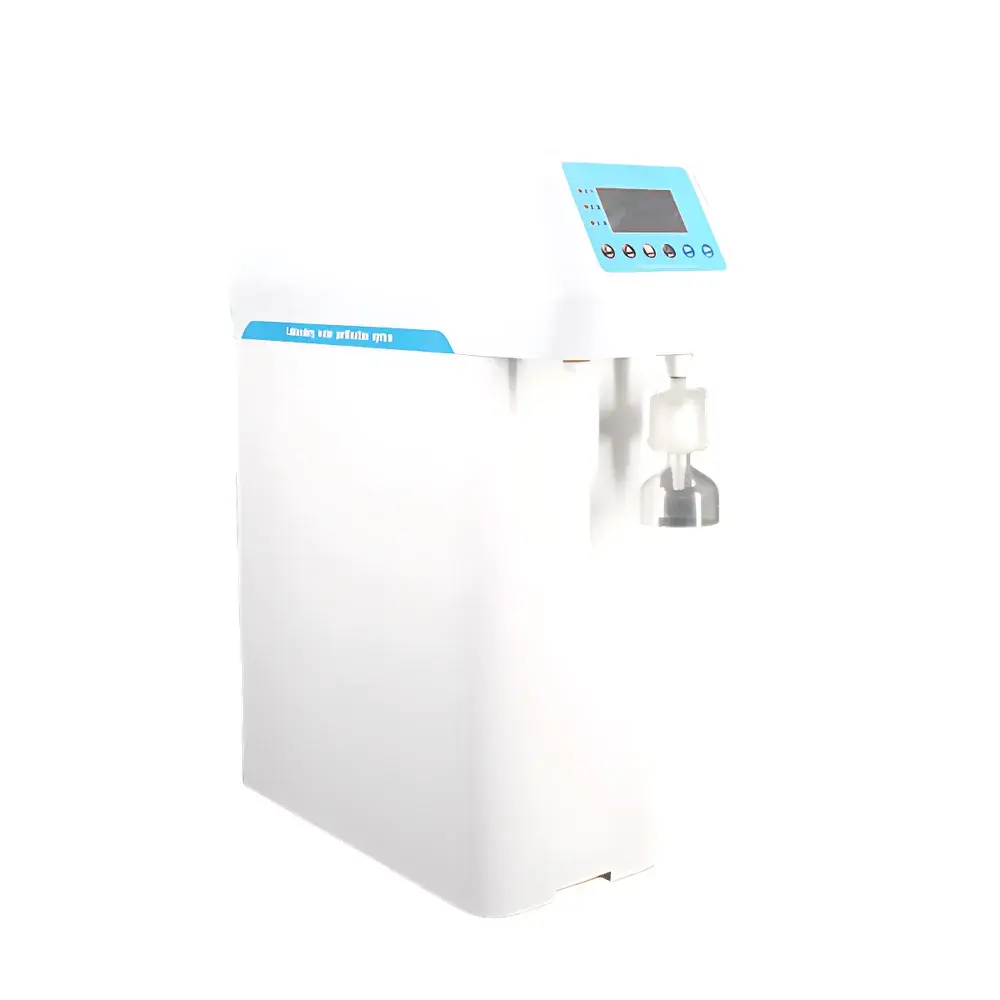
HHitech Mini-S/D Series Ultra-Pure Water System
| Brand | HHitech |
|---|---|
| Origin | Shanghai, China |
| Manufacturer Type | Direct Manufacturer |
| Product Origin | Domestic (China) |
| Model | Mini-S15 / Mini-D |
| Pure Water Grade | ASTM Type I / ISO 3696 Class 1 / GB/T 6682-2008 Grade I |
| Resistivity | 18.2 MΩ·cm @ 25 °C |
| Heavy Metals & Soluble Silica | <0.01 ppb |
| Total Organic Carbon (TOC) | <3 ppb |
| Microbial Count | <0.01 CFU/mL |
| Endotoxin | <0.001 EU/mL |
| Particles (>0.1 µm) | <1 particle/mL |
| UV Wavelengths | 185 nm & 254 nm |
| UF MWCO | 5000 Da |
| RO Rejection Rate | ≥98–99% (ions), >99% (organics >200 Da) |
| Production Rate | 15 L/h (Mini-S15), 1.0 L/min (Mini-D, pressure-dependent) |
| Dimensions (L×W×H) | 34 × 50 × 56 cm |
| Weight | ~25 kg |
| Power Supply | 220 V, 50 Hz, 72 W |
Overview
The HHitech Mini-S/D Series Ultra-Pure Water System is an integrated, compact laboratory water purification platform engineered for analytical instrumentation applications requiring continuous, high-reliability Type I ultrapure water. It employs a multi-stage purification architecture—combining reverse osmosis (RO), dual-wavelength ultraviolet (UV) photooxidation (185 nm + 254 nm), ultrafiltration (UF), and mixed-bed deionization—to convert municipal tap water (Mini-S) or pre-purified feedwater (Mini-D) into ultrapure water compliant with stringent international standards including ASTM D1193-20, ISO 3696:1987, USP , EP 2.2.44, CLSI GP12-A3, and GB/T 6682–2008 Grade I. The system operates under controlled laminar flow conditions and maintains stable resistivity at 18.2 MΩ·cm at 25 °C, with TOC consistently below 3 ppb and endotoxin levels ≤0.001 EU/mL—critical for sensitive techniques such as HPLC, LC-MS, ICP-MS, cell culture, and molecular biology workflows.
Key Features
- Microprocessor-controlled operation with backlit LCD interface supporting multilevel menu navigation and real-time animated process visualization
- Dual-path online monitoring: TDS measurement for RO permeate; resistivity (μS/cm and MΩ·cm) tracking for UP water with temperature compensation
- Automated RO membrane maintenance: scheduled anti-scaling flush every 2 hours plus manual forced flush to extend membrane service life
- Intelligent consumables management: programmable lifetime settings for pre-filters, RO membranes, UV lamps, and UP polishing cartridges; countdown timers with visual/audible alerts upon expiration
- Comprehensive safety interlocks: low-inlet-pressure detection, tank-full shutoff, conductivity/resistivity deviation alarms, and end-of-life consumables lockout
- Ergonomic dual-mode dispensing: manual push-button and programmable auto-dispense (time: 1–99 min; quality threshold: 0.1–18.2 MΩ·cm)
- Integrated 12-L pressurized storage tank with NSF-certified fittings and tubing, minimizing footprint and eliminating need for external reservoirs
- Monolithic engineering-grade plastic chassis with electrical/water separation, corrosion-resistant design, and GLP-compliant construction
- Low-TOC fluid path: all wetted components—including dual-wavelength UV lamp (imported quartz sleeve), 5000 Da UF membrane, and high-capacity UP cartridge—are selected and validated to minimize organic leaching
Sample Compatibility & Compliance
The Mini-S/D series delivers consistent ultrapure water suitable for direct use in high-sensitivity analytical platforms and life science applications. Its output meets the chemical purity requirements for ASTM Type I water across all critical parameters: ionic purity (resistivity ≥18.2 MΩ·cm), organic contamination (TOC <3 ppb), microbial load (<0.01 CFU/mL), endotoxin (<0.001 EU/mL), and submicron particulates (0.1 µm). The system supports regulatory traceability through password-protected dual-access control (factory and user levels), full audit trail logging of operational events and parameter changes, and hardware-level compliance with NSF/ANSI Standard 58 for RO systems and NSF/ANSI Standard 61 for potable water contact materials. All models are designed for alignment with GLP, GMP, and ISO/IEC 17025 laboratory quality frameworks.
Software & Data Management
While the Mini-S/D operates via embedded firmware without external PC dependency, its onboard controller logs timestamped records of system status, alarm events, consumables usage, and calibration history. These logs are accessible via the LCD interface and support manual export via USB (optional module). The system’s architecture incorporates non-volatile memory to retain configuration and event data during power interruption. For laboratories operating under FDA 21 CFR Part 11 requirements, optional Ethernet or RS232 modules enable integration with centralized LIMS or electronic lab notebook (ELN) platforms—supporting secure user authentication, electronic signatures, and immutable audit trails. Firmware updates are performed via authenticated USB drive to ensure integrity and version control.
Applications
This system serves as a primary water source for analytical instrumentation demanding minimal background interference—including high-performance liquid chromatography (HPLC), gas chromatography (GC), inductively coupled plasma mass spectrometry (ICP-MS), atomic absorption spectroscopy (AAS), and total organic carbon (TOC) analyzers. In life sciences, it supplies water for mammalian cell culture, IVF media preparation, electrophysiology, PCR/qPCR reagent formulation, and RNase-/DNase-free applications (validated by <1 pg/mL RNase and <5 pg/mL DNase levels in UF-equipped models). Its compact footprint and quiet operation make it ideal for benchtop deployment in core facilities, QC labs, and academic research environments where space and reliability are constrained.
FAQ
What feedwater sources are compatible with the Mini-S and Mini-D models?
The Mini-S series accepts municipal tap water (5–35 °C, 1.0–4.0 bar inlet pressure); the Mini-D series requires pre-purified feedwater—such as distilled, deionized, or RO water—at near-atmospheric pressure (0–1 bar).
How does the dual-wavelength UV system improve water quality?
The 185 nm wavelength generates hydroxyl radicals that oxidize trace organics to CO₂ and H₂O, while 254 nm provides germicidal irradiation—synergistically reducing TOC and microbial load without chemical addition.
Is the system compliant with FDA 21 CFR Part 11 for electronic records?
Out-of-the-box, the base model supports ALCOA+ principles (Attributable, Legible, Contemporaneous, Original, Accurate); full 21 CFR Part 11 compliance requires optional network connectivity and third-party validation protocols.
Can the Mini-S/D be connected to a central distribution loop?
It is designed as a point-of-use system with integrated storage; for loop integration, a recirculating pump kit and external loop monitor must be added per site-specific validation requirements.
What is the expected service life of the UP polishing cartridge?
Under typical lab usage (10–15 L/day of UP water), the cartridge lasts 6–12 months; lifespan is dynamically adjusted based on real-time ion loading and displayed via the consumables manager.



