
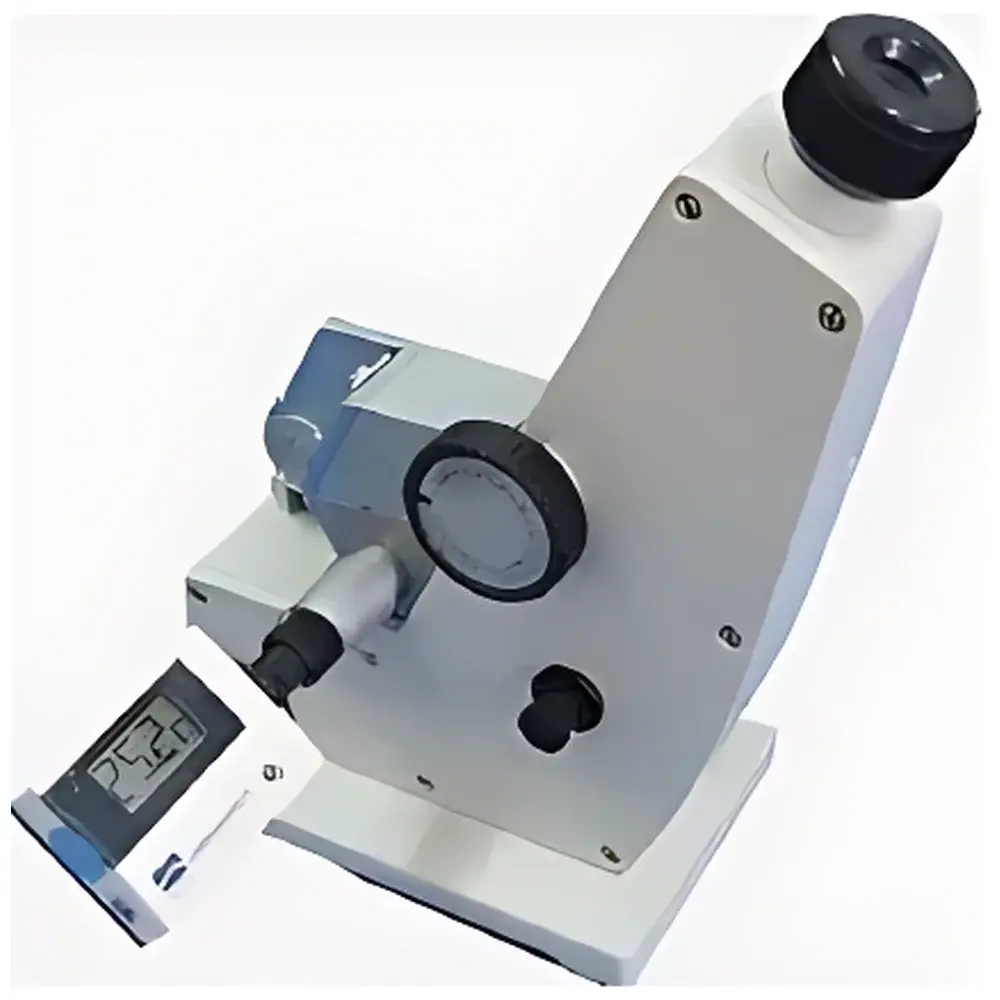
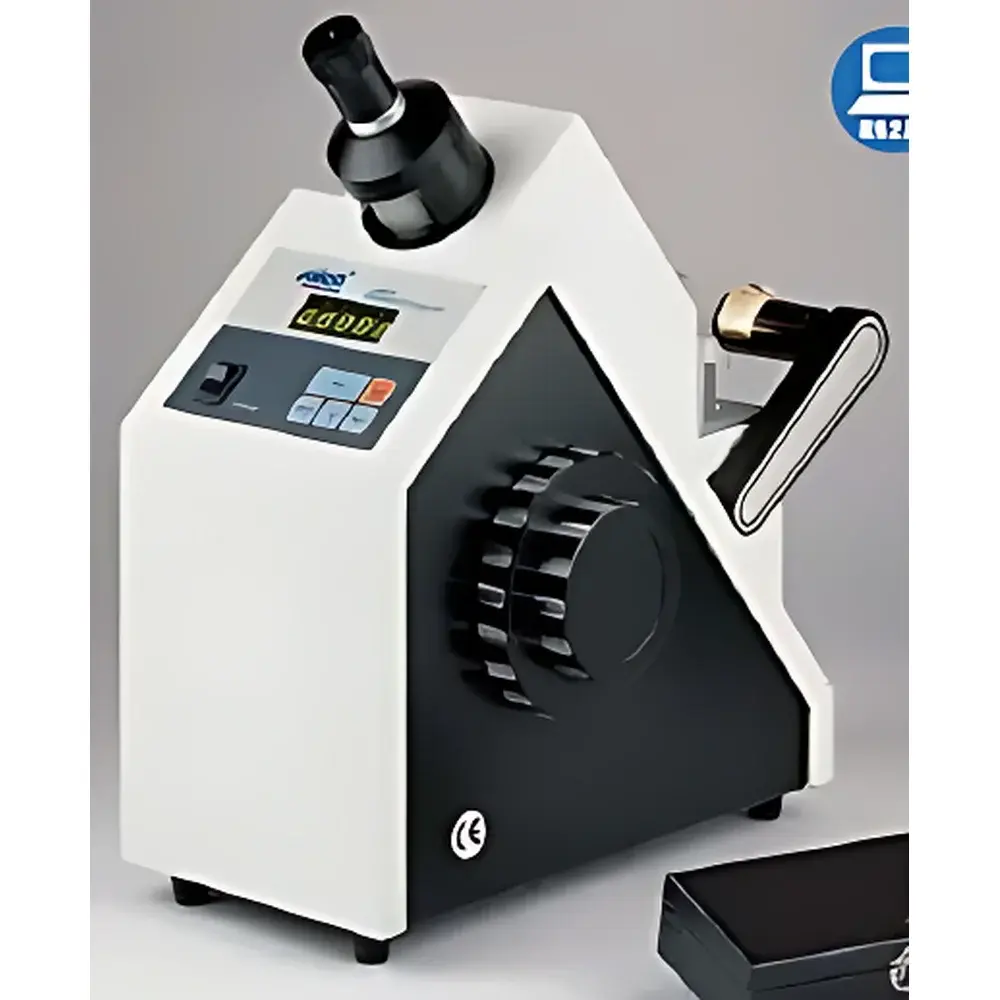
JP 2WAJ Abbe Refractometer
| Brand | JP |
|---|---|
| Origin | Spain |
| Type | Benchtop Abbe Refractometer |
| Temperature Control | Yes (external water bath compatible) |
| Digital Display | Yes |
| Refractive Index Range (nD) | 1.300–1.700 |
| Brix Range | 0–95% |
| Refractive Index Resolution | 0.0005 |
| Refractive Index Accuracy | ±0.0002 |
| Brix Accuracy | ±0.1% |
| Built-in Thermometer Range | 0–70 °C |
| Optical System | ×2 magnification telescope with diopter-adjustable eyepiece |
| Construction | Rigid metal housing |
| Dimensions | 240 H × 100 W × 200 D mm |
| Weight | 2.6 kg |
Overview
The JP 2WAJ Abbe Refractometer is a precision optical instrument engineered for accurate, repeatable measurement of refractive index (nD) and related concentration parameters—primarily Brix (% w/w sucrose)—in liquid and transparent solid samples. Based on the classical Abbe principle, it utilizes total internal reflection at the prism-sample interface to determine nD at the sodium D-line (589.3 nm). Its optical path incorporates a high-stability double-prism assembly (illuminating and measuring prisms), a compensating Amici prism for chromatic correction, and a calibrated ×2 telescope system with diopter-adjustable eyepiece to accommodate operator visual variance. Designed for laboratory environments requiring traceable, manual optical measurement, the 2WAJ delivers metrological performance aligned with ISO 2163, ASTM D1218, and USP refractometry standards.
Key Features
- Rigid all-metal construction ensures mechanical stability and long-term calibration retention under routine bench use.
- Digital display integrated with analog scale reading enables dual-mode verification and minimizes parallax error.
- Integrated thermometer (0–70 °C) mounted directly on the prism block provides real-time sample temperature monitoring—critical for nD correction per ISO 17025 temperature control requirements.
- External water bath compatibility (via standard inlet/outlet ports) supports precise thermostatic control for temperature-sensitive measurements (e.g., pharmaceutical syrups or polymer solutions).
- High-resolution scale (0.0005 nD divisions) and ±0.0002 nD accuracy enable detection of subtle compositional changes in quality control workflows.
- Ergonomic design—including compact footprint (240 × 100 × 200 mm) and 2.6 kg mass—facilitates placement on vibration-isolated benches without compromising portability between QC labs.
Sample Compatibility & Compliance
The 2WAJ accommodates homogeneous, optically transparent liquids (e.g., solvents, essential oils, glycerol solutions) and flat, polished solids (e.g., glass slides, polymer films) with refractive indices from 1.300 to 1.700. It is routinely deployed in regulated environments where documentation integrity is mandatory: its manual operation avoids electronic data integrity concerns, while its mechanical repeatability supports GLP-compliant recordkeeping when paired with standardized SOPs. The instrument meets fundamental requirements for ISO/IEC 17025-accredited testing laboratories—particularly for method validation of refractive index as a surrogate for concentration, purity, or molecular weight in polymers and surfactants. No firmware or software validation is required, simplifying 21 CFR Part 11 compliance for paper-based audit trails.
Software & Data Management
As a manually operated optical instrument, the JP 2WAJ does not incorporate embedded microprocessors or proprietary software. All readings are recorded directly into laboratory notebooks or LIMS-compatible spreadsheets. This architecture eliminates cybersecurity vulnerabilities, firmware update dependencies, and electronic signature validation overhead. Users may apply standard nD-to-Brix conversion tables (e.g., ICUMSA, AOAC) or implement validated Excel-based correction algorithms for temperature compensation (per ASTM D1218 Annex A1). Calibration verification is performed using certified reference standards (e.g., distilled water at 20 °C: nD = 1.3330; benzene: nD = 1.5011), traceable to NIST or PTB.
Applications
- Pharmaceutical QC: Verification of excipient purity (e.g., propylene glycol, glycerin) and syrup concentration consistency across batches.
- Food & Beverage: Rapid Brix assessment in fruit juices, honey, and soft drink concentrates—aligned with Codex Alimentarius and EU Regulation (EC) No 1234/2007.
- Chemical Manufacturing: Monitoring solvent composition in reaction mixtures (e.g., ethanol/water azeotropes) and polymer solution viscosity surrogates.
- Academic Research: Teaching core principles of physical optics, dispersion, and thermooptic coefficients in undergraduate physics and analytical chemistry labs.
- Edible Oil & Fat Analysis: Detection of adulteration (e.g., palm oil in olive oil) via nD deviation from reference values (ISO 6320).
FAQ
What wavelength does the 2WAJ use for refractive index measurement?
It operates at the sodium D-line (589.3 nm), consistent with the international nD convention.
Is temperature compensation automated?
No—the instrument provides manual temperature readout (0–70 °C); users apply standard correction formulas or reference tables based on measured prism temperature.
Can it measure opaque or turbid samples?
No—only optically transparent, non-scattering samples yield valid nD readings due to reliance on sharp critical angle detection.
Does it comply with pharmacopeial methods?
Yes—it fulfills the apparatus requirements of USP , Ph. Eur. 2.2.6, and JP 17 for refractometric assay and identity testing.
What maintenance is required?
Regular cleaning of prism surfaces with lens-grade tissue and reagent-grade ether or acetone; annual verification against certified refractive index standards is recommended for ISO 17025 compliance.





