
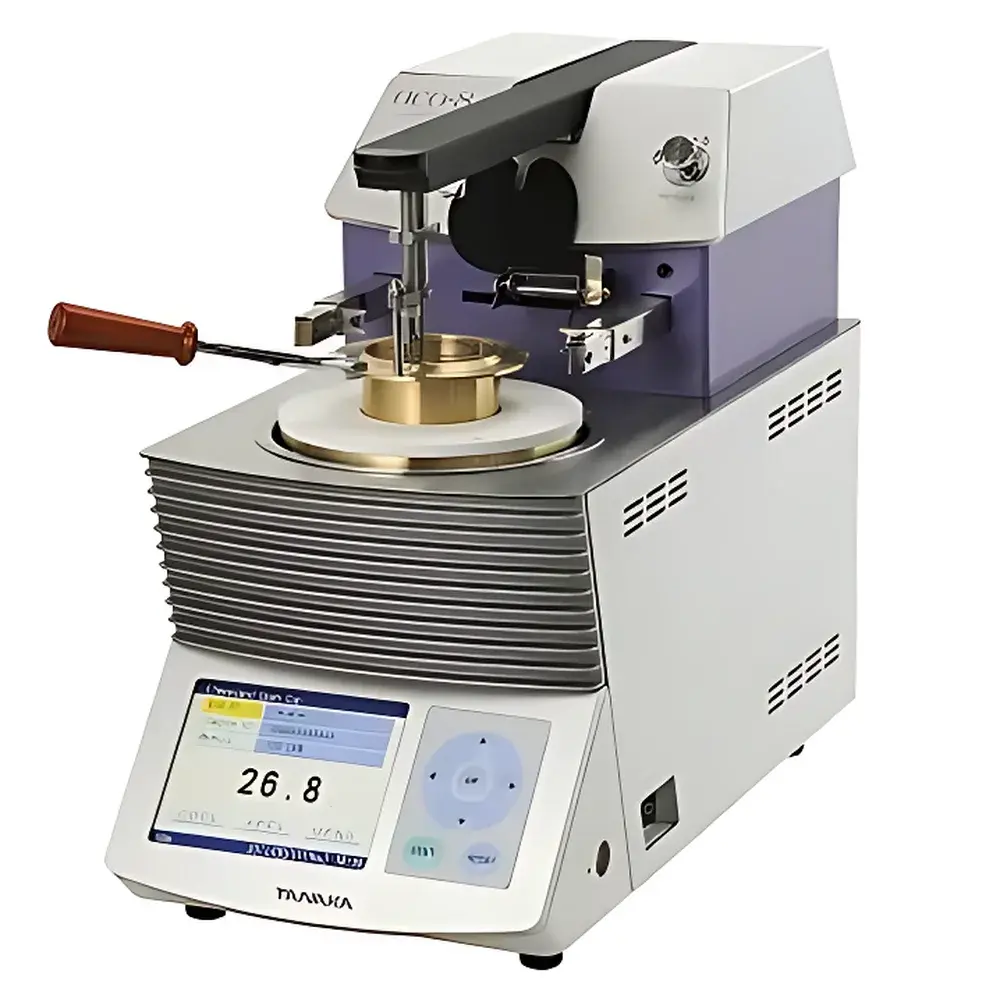
Tanaka ACO-8 Cleveland Open Cup Flash Point Tester
| Brand | Tanaka |
|---|---|
| Origin | Japan |
| Model | ACO-8 |
| Test Standards | ASTM D92, ISO 2592, IP 36 |
| Measuring Range | Ambient to 400 °C |
| Heating Power | 800 W Nichrome coil (220–240 V) |
| Temperature Sensor | PT-100 in stainless steel sheath |
| Flash Detection | Dual ionization rings |
| Ignition Source | Automatic gas ignition (LPG or natural gas, ≤10 kPa) |
| Display | 5.7″ color LCD with LED backlight |
| Data Storage | Up to 200 test records |
| Interface | RS-232C ×1, USB ×1 |
| Cooling | Forced-air via sirocco fan |
| Barometric Correction | Built-in sensor, automatic |
| Safety Shutdown | Multi-condition monitoring (EFP+30 °C, sensor fault, thermofuse blow, arm mispositioning, etc.) |
| Dimensions | 230 × 470 × 390 mm (W×D×H) |
| Weight | 16 kg |
| Compliance | Designed for GLP-aligned laboratory environments |
Overview
The Tanaka ACO-8 Cleveland Open Cup Flash Point Tester is a microprocessor-controlled, all-in-one instrument engineered for precise and repeatable determination of flash point and fire point of petroleum products, bituminous materials, and related viscous or high-boiling liquids according to internationally recognized standard test methods—including ASTM D92, ISO 2592, and IP 36. Operating on the Cleveland open cup principle, the instrument heats a standardized sample in a regulated manner while continuously monitoring vapor concentration above the specimen surface using dual ionization ring electrodes. Upon detection of momentary ignition—defined as a visible flash sustained for at least 0.5 seconds—the system records the corresponding temperature as the flash point. For fire point determination, the instrument continues heating until sustained combustion (≥5 seconds) is confirmed by the same ionization detection mechanism. The ACO-8 integrates real-time barometric pressure compensation, automated safety interlocks, and thermally stable PT-100 temperature sensing within a stainless-steel sheath to ensure traceable accuracy across ambient to 400 °C.
Key Features
- Integrated Swing-Arm Assembly: Flash detector rings and temperature sensor are rigidly mounted on a single pivot arm, enabling rapid, reproducible positioning over the test cup without manual recalibration between samples.
- Automated Fire Point & Containment Logic: Detects fire point per ASTM/ISO definitions and activates a motorized fire containment lid upon confirmation of sustained flame or excessive thermal excursion—minimizing operator exposure and lab hazard risk.
- Dual-Mode Ionization Detection: Patented double-ring electrode configuration provides high signal-to-noise ratio and immunity to false triggering from smoke, steam, or surface turbulence—critical for asphalt and heavy fuel oil testing.
- Intelligent Thermal Management: 800 W Nichrome heating coil coupled with forced-air cooling via sirocco fan enables rapid thermal ramping and controlled cooldown, reducing cycle time to approximately 20 minutes per test (160 Wh energy consumption).
- Comprehensive Safety Architecture: Monitors seven distinct failure modes—including thermofuse integrity, arm position verification, sensor continuity, internal battery voltage, and microcontroller watchdog status—and initiates audible/visual shutdown with diagnostic code display.
- Regulatory-Ready Data Handling: Stores up to 200 test records with timestamp, operator ID (via optional USB keyboard), method selection, atmospheric correction value, and final flash/fire point. Export options include RS-232 (to printer or LIMS), USB flash drive (CSV or XML), and direct parameter transfer to instrument memory.
Sample Compatibility & Compliance
The ACO-8 accommodates standard Cleveland test cups (ACO-02-001) and supports both conventional petroleum distillates and high-viscosity materials such as paving asphalts (via ACO-8AS variant with skimmer paddle assembly). Its design conforms to mechanical and procedural requirements specified in ASTM D92 Annex A1 (asphalt modification), ISO 2592 Clause 6 (apparatus specifications), and IP 36 Section 4 (ignition source geometry). All electronic subsystems comply with IEC 61010-1:2010 for electrical safety in laboratory equipment. When configured with password-protected administrator access (Level 3), audit trails meet minimum expectations for GLP and GMP environments. Optional RS-232 or USB data export may be validated for 21 CFR Part 11 compliance in regulated pharmaceutical or contract testing laboratories.
Software & Data Management
The embedded firmware implements deterministic state-machine control aligned with ASTM D92 procedural sequencing—ensuring consistent ramp rates, dwell times, and ignition timing regardless of operator input. The 5.7″ color LCD provides real-time graphical temperature curve overlay during testing, with configurable alarm thresholds and pass/fail indicators based on method-defined tolerances. Data export protocols support ASCII-delimited formats compatible with LIMS platforms including Thermo Fisher SampleManager, LabVantage, and Waters Empower. USB interface permits not only data retrieval but also secure firmware updates and method template loading—enabling centralized calibration protocol deployment across multi-instrument labs. Built-in clock battery maintains time-stamp integrity during power interruption.
Applications
- Flash and fire point verification of lubricating oils, residual fuels, and diesel blends per refinery QC workflows.
- Asphalt binder qualification in road construction material certification (ASTM D92 Annex A1, AASHTO T 48).
- Batch release testing of industrial solvents and cleaning formulations under OSHA and CLP regulatory frameworks.
- Research-grade thermal stability assessment of biofuels and synthetic hydrocarbons during formulation development.
- Third-party conformity assessment for UN Transport Classification (UN 3082, Class 3 Flammable Liquids) and SDS preparation.
FAQ
What standards does the ACO-8 fully support?
ASTM D92, ISO 2592, and IP 36—including Annex A1 for asphalt testing when equipped with the ACO-8AS configuration.
Is barometric correction applied automatically during testing?
Yes—the integrated absolute pressure sensor continuously measures ambient atmospheric pressure and applies real-time correction to flash point results per ASTM D92 Section 8.2.3.
Can test data be exported directly to a LIMS without intermediate software?
Yes—via RS-232 serial output using standard ASCII framing, or via USB mass storage mode (no driver required) for direct file copy to networked PCs.
What maintenance intervals are recommended for routine operation?
Thermofuse replacement every 2 years (part #320-00-035); annual verification of PT-100 calibration using NIST-traceable reference thermometer (holder part #ACO-05-016 supplied); visual inspection of ionization rings before each use.
Does the ACO-8 require external ventilation or fume hood installation?
While not mandated by ASTM D92, operation within a certified chemical fume hood is strongly advised for flammable vapor containment—particularly during asphalt or high-flash-point material testing where extended heating periods increase cumulative vapor generation.





