
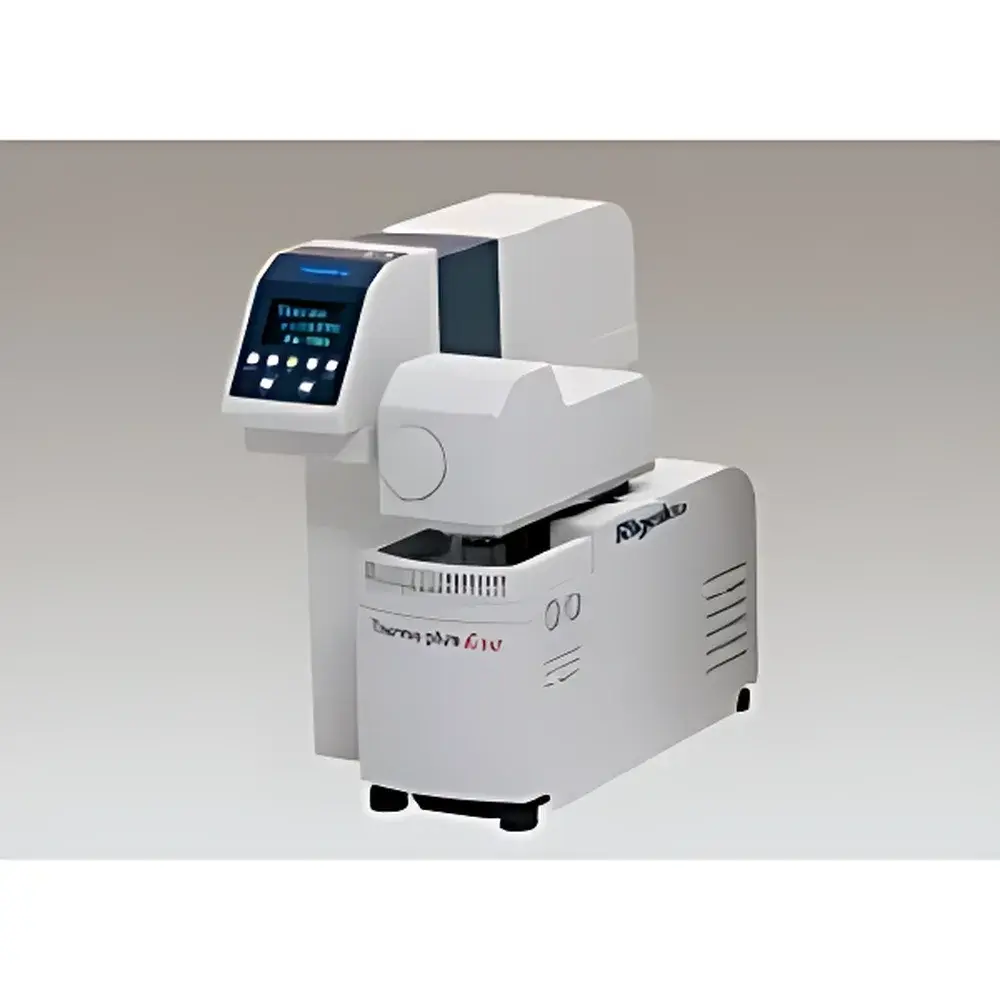
Rigaku Thermo Plus EVO TMA8310 Thermomechanical Analyzer
| Brand | Rigaku |
|---|---|
| Origin | Japan |
| Model | TMA8310 |
| Sample Capacity | Ø9 mm × 20 mm (max) |
| Heating Rate | Up to 100 °C/min |
| Cooling Rate | From 1000 °C to 50 °C in ≤15 min |
| Temperature Control | Pre-compensated PID with hold-mode overshoot correction |
| Compliance | Designed for GLP/GMP environments |
| Software | Multi-station control (up to 8 units per PC) |
| Safety | Integrated furnace safety alarm, emergency stop, ergonomic sample handling fixture |
Overview
The Rigaku Thermo Plus EVO TMA8310 is a high-precision thermomechanical analyzer engineered for quantitative measurement of dimensional changes in solid materials as a function of temperature under controlled mechanical load. Unlike conventional dilatometers or differential thermal expansion systems, the TMA8310 employs Rigaku’s proprietary differential thermal expansion compensation method—where the sensor’s own thermal drift is actively subtracted in real time using a matched reference arm architecture. This eliminates instrumental artifact contributions, enabling sub-micrometer resolution (<0.1 µm) and exceptional reproducibility (RSD < 0.8% across repeated measurements) even for low-expansion ceramics, thin polymer films (<25 µm), and brittle inorganic glasses. The system operates across a wide thermal range (–150 °C to 1000 °C), supported by a compact, fast-response resistive furnace capable of linear heating up to 100 °C/min and rapid forced-air cooling—achieving full thermal recovery from 1000 °C to 50 °C in under 15 minutes. Its modular probe design accommodates multiple mechanical modes without hardware recalibration.
Key Features
- Differential thermal expansion compensation architecture ensures baseline stability and eliminates spurious drift from sensor housing expansion.
- Multi-mode mechanical configuration: interchangeable probes support expansion, compression, tension, and penetration measurements—requiring only accessory exchange, no software reconfiguration.
- High-throughput thermal control: programmable heating/cooling profiles with pre-compensated PID temperature regulation; eliminates overshoot during isothermal holds via predictive thermal lag modeling.
- Ergonomic sample loading: wide-grip tweezer fixture ensures consistent contact force and positional repeatability—critical for accurate ΔL/L₀ calculation in coefficient of linear expansion (CTE) determination.
- Networked operation: single Windows-based workstation controls up to eight TMA8310 units simultaneously, with synchronized data timestamping and centralized audit trail management.
- ECO power management: hardware-level standby optimization reduces idle power consumption by 30%; selectable via front-panel toggle or software interface.
- Real-time status dashboard: integrated LCD panel displays furnace temperature, probe load, cooling status, safety interlock state, and active measurement phase.
Sample Compatibility & Compliance
The TMA8310 accepts cylindrical specimens up to Ø9 mm × 20 mm in length—optimized for bulk polymers, sintered ceramics, metal alloys, and composite laminates. Flat-sheet samples (up to 1 mm thickness) are compatible with the optional flat-sample holder. All measurement protocols adhere to internationally recognized standards: ASTM E831 (linear thermal expansion of plastics), ISO 11359-2 (thermomechanical analysis of polymers), and USP (thermal characterization for pharmaceutical excipients). Data integrity complies with FDA 21 CFR Part 11 requirements through encrypted audit trails, electronic signatures, and immutable dual-backup storage (local SSD + network NAS). System validation documentation—including IQ/OQ/PQ templates—is provided for GxP-regulated laboratories.
Software & Data Management
Thermo Plus EVO Control Software (v4.2+) delivers full instrument orchestration: automated method setup (ramp rate, dwell time, load profile), conditional termination (e.g., power-off after completion, ECO activation, or forced cooldown initiation), and real-time deviation alerts. Calibration routines include automatic probe zeroing, temperature sensor verification (via NIST-traceable Pt100 reference), and mechanical compliance correction. Diagnostics run at startup and during idle periods—flagging anomalies such as thermocouple degradation, load cell hysteresis, or airflow obstruction. Firmware updates deploy silently over LAN; all raw data files (.tdf) are structured in HDF5 format for interoperability with MATLAB, Python (h5py), and third-party LIMS platforms.
Applications
- Quantification of glass transition temperature (Tg) and coefficient of thermal expansion (CTE) in epoxy molding compounds used in semiconductor packaging.
- Creep and stress-relaxation behavior assessment of biomedical polymeric implants under simulated physiological loads.
- Thermal shrinkage profiling of lithium-ion battery electrode coatings during drying and calendering processes.
- Decomposition onset detection in flame-retardant additives via dynamic mechanical displacement under inert atmosphere.
- Interfacial delamination kinetics in multilayer optical films subjected to thermal cycling between –40 °C and 85 °C.
FAQ
What standards does the TMA8310 support for regulatory submissions?
ASTM E831, ISO 11359-2, and USP are natively supported; full 21 CFR Part 11 compliance is enabled via optional software license with electronic signature modules.
Can the system operate unattended overnight?
Yes—scheduled start times, auto-shutdown on completion, ECO mode activation, and email/SNMP alerting ensure robust unattended operation.
Is nitrogen purge integration available?
Standard configuration includes a dedicated gas inlet port compatible with mass flow controllers; optional purge kits support inert (N₂, Ar) or oxidative (air, O₂) atmospheres.
How is mechanical load calibrated?
Load calibration uses traceable dead-weight standards; software performs multi-point verification across the full 0.01–5 N range with hysteresis correction.
What is the minimum detectable dimensional change?
Resolution is 0.01 µm under optimal conditions (stable ambient, low-noise mounting, rigid sample geometry); typical CTE uncertainty is ±0.2 × 10⁻⁶ /°C for certified reference materials.





