
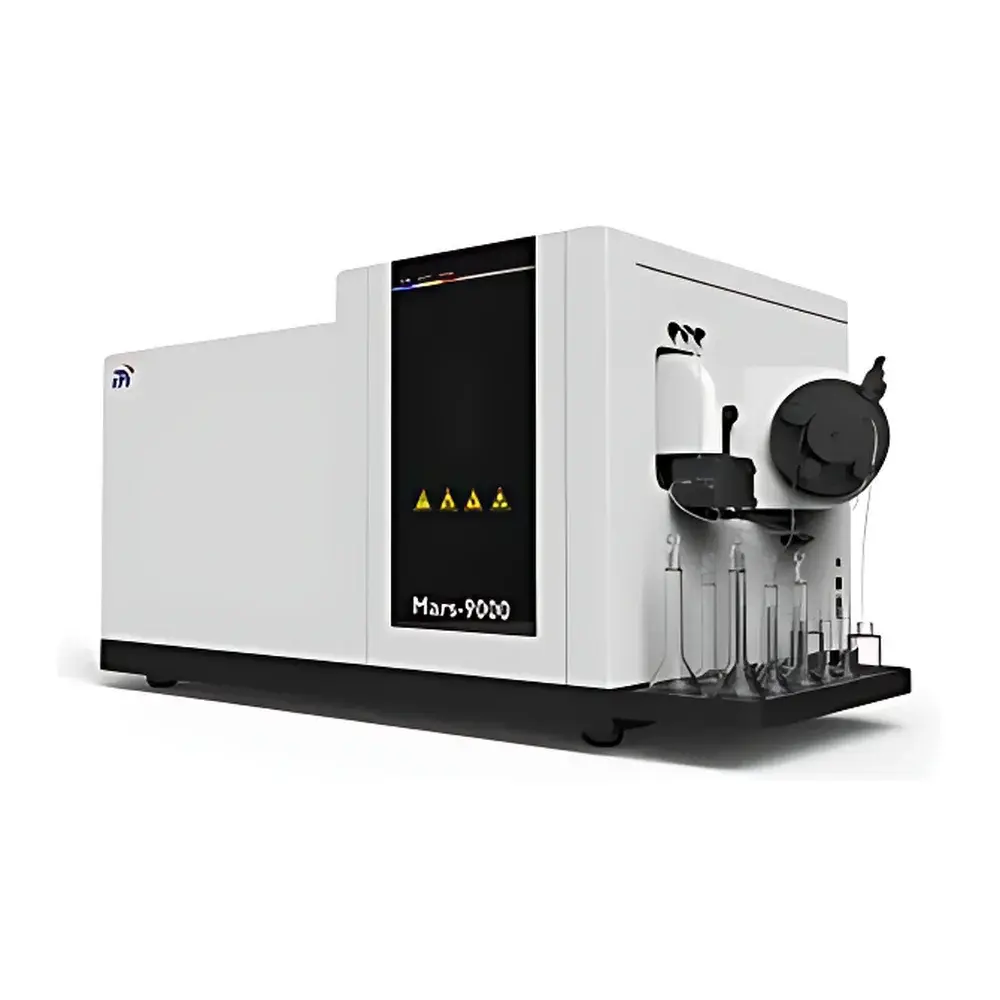
FPI EXPEC 7000 Inductively Coupled Plasma Mass Spectrometer
| Brand | FPI |
|---|---|
| Origin | Zhejiang, China |
| Manufacturer Type | Authorized Distributor |
| Model | EXPEC 7000 |
| Quotation | Upon Request |
| Deployment Mode | Mobile (Vehicle-Mounted) |
| Mass Range | 2–260 amu |
Overview
The FPI EXPEC 7000 is a high-performance, vehicle-deployable inductively coupled plasma mass spectrometer (ICP-MS) engineered for field-based ultra-trace elemental analysis. It operates on the fundamental principle of ionizing sample aerosols in a high-temperature argon plasma (~7,000–10,000 K), followed by mass separation and detection of element-specific ions using a quadrupole mass analyzer. Unlike conventional laboratory-bound ICP-MS systems, the EXPEC 7000 integrates core analytical performance with ruggedized mechanical architecture—enabling quantitative multi-element analysis at sub-femtogram-per-gram (fg/g) detection levels directly in mobile laboratories, environmental monitoring vehicles, or emergency response units. Its self-excited all-solid-state RF generator ensures stable plasma ignition and power delivery under variable electrical supply conditions, while the dual off-axis ion optics minimize neutral noise and polyatomic interferences—critical for accurate isotopic ratio measurement and low-background trace metal quantification.
Key Features
- Mobile-Optimized Platform: Fully integrated into a shock-dampened, climate-controlled vehicle chassis; features a compact 3D motorized stage eliminating manual repositioning of the ICP torch and interface region—reducing thermal drift and positional instability during transit or operation on uneven terrain.
- Robust Gas Handling Architecture: Monolithic gas valve block replaces discrete pneumatic components, minimizing leak paths and failure points; flexible, vibration-resistant tubing connections maintain consistent nebulizer gas flow, auxiliary gas pressure, and collision cell gas delivery across dynamic operating conditions.
- Advanced Ion Optics & Collision Cell: Dual off-axis ion transmission path reduces background signal from photons and neutral species; high-speed dynamic collision/reaction cell (DCRC) enables real-time switching between He, H2, and NH3 gases to suppress oxide and argide interferences (e.g., 40Ar16O+ on 56Fe+) without sacrificing sensitivity.
- Quadrupole Drive Precision: Digitally stabilized RF/DC voltage generation ensures mass calibration stability within ±0.05 amu over 8-hour continuous operation—essential for long-duration field campaigns requiring minimal recalibration.
Sample Compatibility & Compliance
The EXPEC 7000 supports aqueous solutions (0.1–5% HNO3 matrix), digested environmental solids (EPA Method 6020B), biological fluids (diluted serum, urine), and organic matrices when paired with optional organic introduction systems (e.g., microflow nebulizers, oxygen-aided combustion). It complies with ISO/IEC 17025 requirements for testing laboratories and supports audit-ready data handling aligned with GLP principles. When configured with optional HPLC coupling, it enables speciation analysis per EPA Method 1638 (e.g., As(III)/As(V), Cr(III)/Cr(VI)), with retention time alignment and peak integration traceable to NIST SRM standards.
Software & Data Management
- Graphical user interface modeled after Windows Explorer for intuitive method navigation, sequence building, and instrument status visualization.
- Real-time dashboard displays plasma impedance, ion lens voltages, detector pulse/analog mode thresholds, and collision gas flow rates—enabling immediate diagnostic assessment.
- Method library supports version-controlled storage, user-defined QC checklists (e.g., tuning report pass/fail criteria), and automated bracketing calibration with internal standard correction (e.g., 115In, 209Bi).
- Data export conforms to ASTM E1947-compliant CSV and .raw formats; optional 21 CFR Part 11-compliant software module provides electronic signatures, audit trails, and role-based access control for regulated environments.
Applications
The EXPEC 7000 delivers validated performance in regulatory and research contexts requiring mobility without analytical compromise: real-time monitoring of heavy metals (Pb, Cd, Hg, As) in surface water during flood response; rapid screening of soil leachates at brownfield sites; on-site verification of pharmaceutical catalyst residues (Pd, Pt, Rh) per ICH Q2(R2); and speciation analysis of Se and I in fortified food products. Its 2–260 amu mass range covers all stable isotopes of biologically and environmentally relevant elements—including 7Li, 23Na, 27Al, 52Cr, 56Fe, 65Cu, 66Zn, 111Cd, 208Pb—and extends to key actinides (238U, 232Th) for nuclear forensics applications.
FAQ
Can the EXPEC 7000 be operated outside a vehicle-mounted configuration?
Yes—the instrument retains full functionality in fixed-lab mode using its integrated leveling feet and external utility connections (argon, cooling water, power). All calibration and performance verification protocols remain identical across deployment modes.
What level of operator training is required for field deployment?
A certified ICP-MS operator with foundational knowledge of plasma physics and mass spectrometry principles can achieve proficiency within two days of hands-on training, supported by embedded contextual help and guided troubleshooting workflows.
Does the system support isotope dilution mass spectrometry (IDMS)?
Yes—software includes dedicated IDMS calculation modules supporting single- and multi-isotope spike strategies, with uncertainty propagation per GUM (Guide to the Expression of Uncertainty in Measurement) guidelines.




