
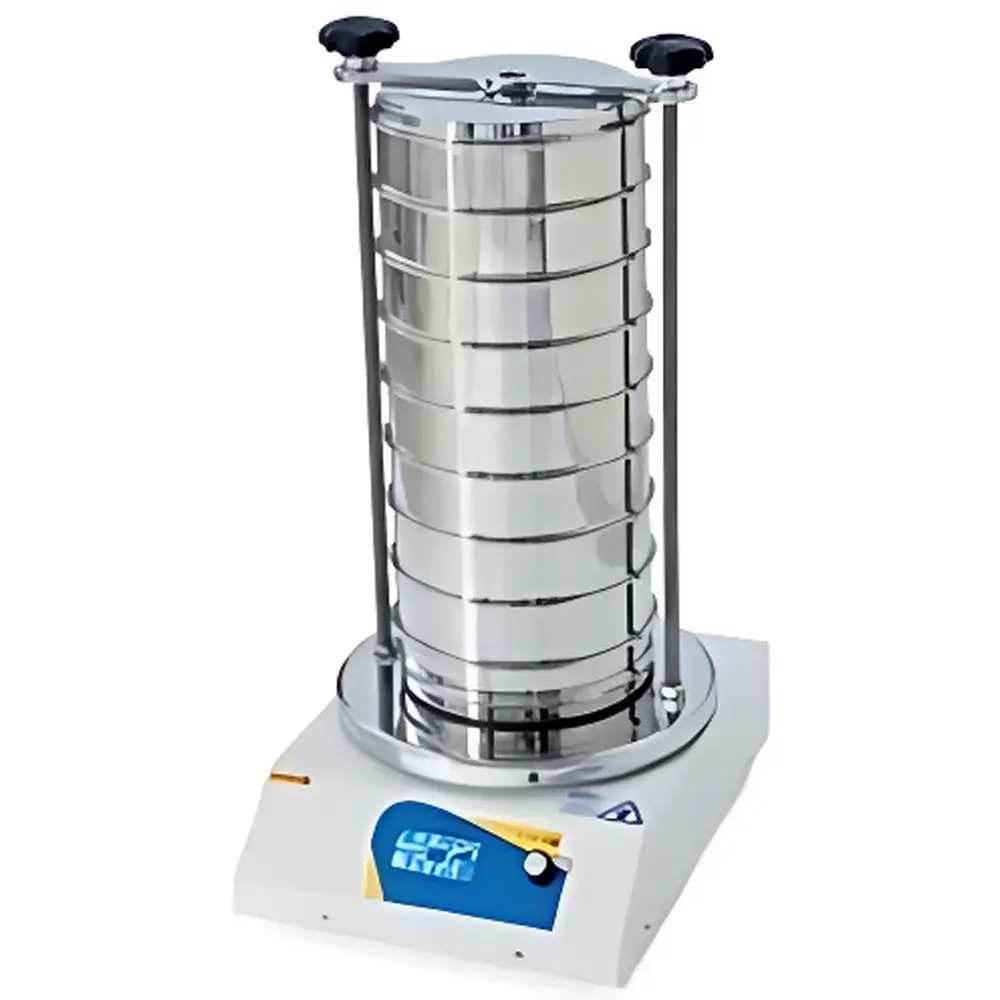
CISA BA200N Electromagnetic Digital Sieve Shaker
| Brand | CISA |
|---|---|
| Origin | Spain |
| Model | BA200N |
| Principle | Electromagnetic Vibration Sieving |
| Sieve Diameter | 200 mm (standard), 203 mm (optional) |
| Max Amplitude | 2 mm |
| Sample Density Range | >0.8 g/cm³ |
| Dimensions (L×W×H, without sieves) | 400 × 310 × 95 mm |
| Net Weight | 27 kg |
| Compliance | ISO 3310-1:2000, ISO 3310-2:1999, ISO 3310-3:2000, BS 410:2001, ASTM E161–2000, AFNOR NF X 11-504 |
Overview
The CISA BA200N Electromagnetic Digital Sieve Shaker is a precision-engineered particle size distribution analyzer designed for reproducible, standardized dry and wet sieve analysis in industrial quality control and R&D laboratories. Operating on the principle of controlled electromagnetic vibration combined with rotational displacement, the BA200N generates a consistent, bidirectional motion—vertical oscillation plus horizontal rotation—that ensures uniform sample dispersion across the sieve surface. This dual-motion profile minimizes particle stratification and agglomeration effects, significantly improving sieving efficiency and statistical reliability compared to purely vertical or horizontal shakers. Developed by CISA—a Spanish manufacturer with over a century of heritage in mechanical sieving instrumentation—the BA200N reflects decades of empirical refinement in sieve dynamics, material fatigue resistance, and metrological traceability. Its design adheres strictly to internationally recognized sieving standards, making it suitable for method validation under GLP, GMP, and ISO/IEC 17025-accredited environments.
Key Features
- Electromagnetic digital drive system delivering precise, programmable vibration frequency and amplitude (max 2 mm)—eliminating mechanical wear associated with cam-driven or eccentric motor mechanisms.
- Rotational displacement integrated with vertical oscillation to enhance particle mobility and prevent blinding of fine-mesh sieves.
- Stainless steel frame and sieve support assembly fabricated from high-alloy corrosion-resistant steel—ensuring long-term dimensional stability, ease of cleaning, and resistance to chemical exposure during wet sieving.
- Dedicated safety interlock system: automatic shutdown upon lid opening, emergency stop button, and overload protection circuitry compliant with IEC 61000-6-2 EMC requirements.
- Intermittent sieving mode enables stepwise analysis for time-sensitive materials (e.g., fragile granules, heat-sensitive APIs), allowing controlled exposure intervals followed by manual or automated fraction collection.
- Modular compatibility with standard ISO 3310-1 and ASTM E11 sieve frames (200 mm and 203 mm diameters); supports stacked multi-deck configurations up to 7 layers.
Sample Compatibility & Compliance
The BA200N accommodates a broad range of particulate materials—including free-flowing powders, granular aggregates, friable solids, and suspended slurries (when used with the optional wet sieving kit). It is validated for samples with bulk densities exceeding 0.8 g/cm³; low-density materials (e.g., aerated polymers or lightweight ceramics) may require optimization of amplitude or duration. All mechanical and operational specifications conform to ISO 3310-1:2000 (test sieves—metal wire cloth), ISO 3310-2:1999 (perforated plate sieves), ISO 3310-3:2000 (electroformed sieves), BS 410:2001, ASTM E161–2000 (standard specification for metal-wire cloth test sieves), and AFNOR NF X 11-504. These alignments ensure data comparability across global laboratories and regulatory submissions involving particle size reporting per USP , EP 2.9.31, or ICH Q5A.
Software & Data Management
While the BA200N operates as a stand-alone electromechanical instrument, its timing and motion parameters are fully configurable via front-panel digital interface with real-time display of elapsed time, cycle count, and status indicators. For integration into digital lab infrastructures, optional RS-232 or USB-to-serial adapters enable connection to LIMS or ELN platforms. When paired with certified balance systems and documented SOPs, the BA200N supports audit-ready workflows compliant with FDA 21 CFR Part 11 (electronic records/signatures) and EU Annex 11 (computerized systems), provided user-defined access controls, change logs, and electronic signature protocols are implemented at the host software level.
Applications
The BA200N serves critical particle sizing functions across regulated and non-regulated sectors: cement and mineral aggregate grading in construction QA; API and excipient particle distribution verification in pharmaceutical manufacturing; grain size analysis of catalyst supports and battery electrode powders in advanced materials R&D; classification of recycled glass cullet and metallurgical slag in circular economy operations; and sediment particle profiling in environmental monitoring programs. Its wet-sieving capability further extends utility to ceramic slip characterization, food starch fractionation, and wastewater solids analysis—where hydration state must be preserved during size separation.
FAQ
Is the BA200N compatible with both ISO and ASTM sieve standards?
Yes—it accepts all standard 200 mm and 203 mm diameter test sieves conforming to ISO 3310-1, ISO 3310-2, ASTM E11, and BS 410.
Can it perform wet sieving without modification?
Wet sieving requires the optional wet kit (including splash guard, drainage tray, and sealed motor housing)—not included by default but available as a factory-configured accessory.
What maintenance is required for long-term accuracy?
Annual verification of amplitude output using calibrated dial indicator and periodic inspection of electromagnetic coil integrity and sieve clamping torque per CISA Technical Bulletin TB-BA200N-Rev.4.
Does it support GLP-compliant documentation?
Yes—when operated within a validated procedural framework that includes equipment logbooks, calibration certificates, and analyst training records, the BA200N meets core GLP requirements for physical testing instrumentation.
Is the 2 mm maximum amplitude adjustable?
Amplitude is digitally selectable in discrete steps (0.5 mm, 1.0 mm, 1.5 mm, 2.0 mm) via the front panel interface; continuous analog adjustment is not supported.



